IoT Connectivity
What Is NB-IoT? A Practical Guide for IoT and Smart Metering Deployments
How NB-IoT works, where it fits in smart metering, its advantages and limitations, and what real-world deployments reveal beyond the specifications.
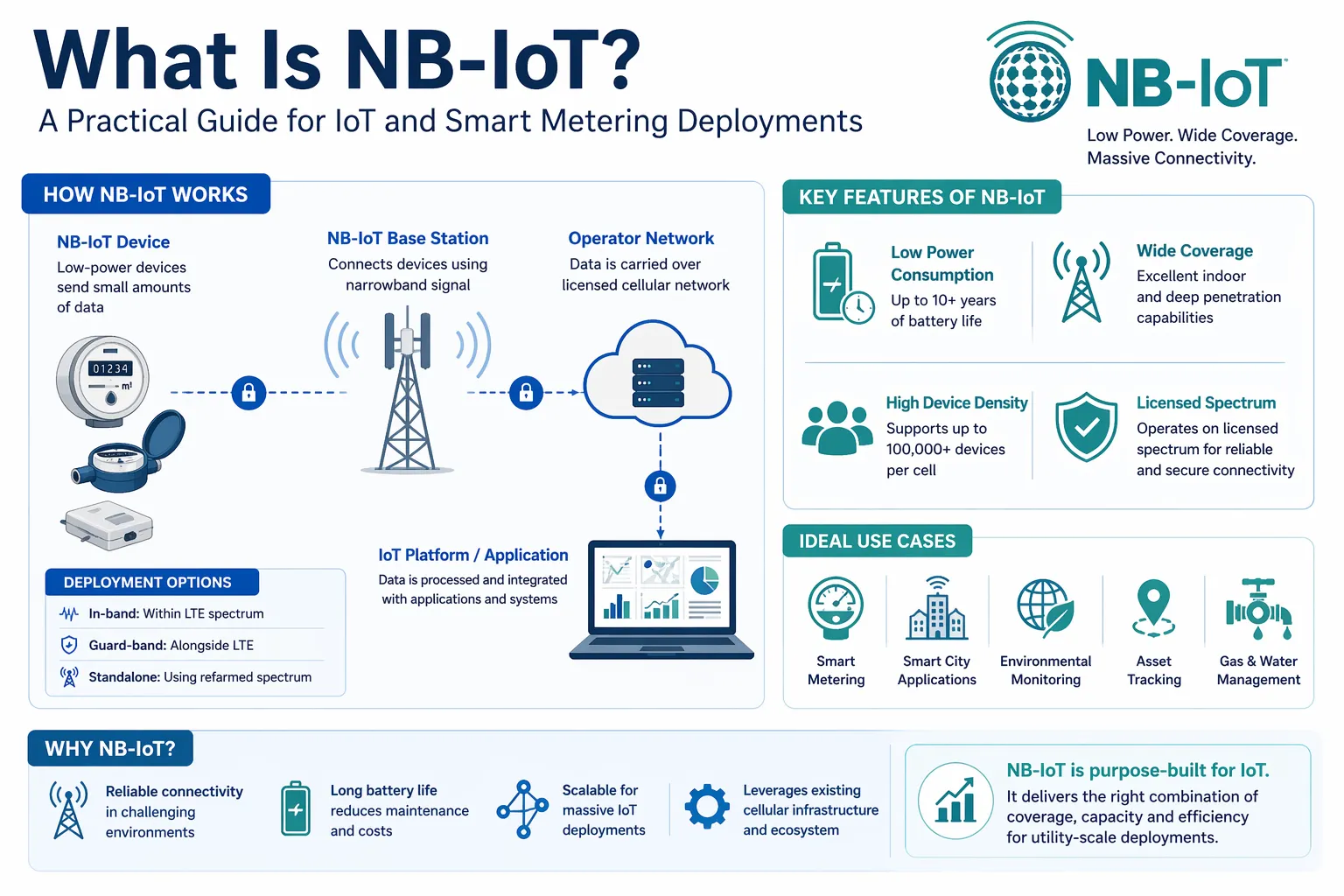
Narrowband IoT (NB-IoT) is a cellular connectivity technology designed for large-scale, low-power IoT deployments.
It is particularly relevant to applications such as smart metering, smart cities and infrastructure monitoring, where devices may need to operate for many years while transmitting relatively small amounts of data.
For utilities, NB-IoT provides an alternative to traditional RF-based communication and other LPWAN technologies by using licensed cellular infrastructure operated by telecommunications providers.
However, choosing NB-IoT should not be based on coverage or power consumption alone. Real-world performance depends on network conditions, device design, installation environment, transmission behaviour and integration with the utility's backend systems.
Key Takeaways
- NB-IoT is a 3GPP-standardized LPWAN technology operating on licensed cellular spectrum.
- It is designed for low-power devices transmitting relatively small amounts of data over wide areas.
- NB-IoT can provide strong coverage and penetration in challenging environments such as basements and meter chambers.
- It is particularly relevant to large-scale smart metering deployments.
- NB-IoT is not designed for high-bandwidth or low-latency applications.
- Battery performance depends on factors including signal quality, transmission behaviour and network conditions.
- Successful deployment requires alignment between the device, cellular network and utility backend systems.
What Is NB-IoT?
NB-IoT stands for Narrowband Internet of Things. It is a Low-Power Wide-Area Network (LPWAN) technology standardized by the 3rd Generation Partnership Project (3GPP).
Unlike unlicensed LPWAN technologies, NB-IoT operates using licensed cellular spectrum and is integrated with cellular network infrastructure.
The technology is optimized for devices that transmit relatively small amounts of data while requiring long battery life, wide-area coverage and support for large numbers of connected devices.
These characteristics make NB-IoT particularly relevant to utility applications where meters may need to communicate periodically over many years without frequent battery replacement.
How NB-IoT Works
NB-IoT operates within cellular network infrastructure and can be deployed using several spectrum configurations.
- In-band: deployed within an existing LTE carrier.
- Guard-band: deployed in the guard-band of an LTE carrier.
- Standalone: deployed using refarmed spectrum.
NB-IoT uses narrowband channels for device communication. This helps reduce power consumption and improve signal penetration, making the technology suitable for locations where conventional wireless communication may be difficult.
This can be particularly useful for smart meters installed indoors, underground, inside meter chambers or within dense urban environments.
Key Features of NB-IoT
Low Power Consumption
NB-IoT is designed for battery-powered devices that may need to operate for years. Actual battery life depends on application behaviour, network conditions and device design.
Wide Coverage
NB-IoT provides extended coverage and is particularly useful where devices are installed in difficult-to-reach locations.
High Device Density
The technology is designed to support large numbers of connected devices, making it suitable for utility-scale deployments involving thousands or potentially millions of meters.
Licensed Spectrum
NB-IoT operates on licensed cellular spectrum, providing a managed communications environment with lower exposure to interference than many unlicensed alternatives.
NB-IoT in Smart Metering
NB-IoT is particularly well suited to smart metering because utility meters typically transmit relatively small amounts of data at relatively low frequency while requiring long operational lifetimes.
Applications can include:
- Smart water meters
- Electricity meters
- Gas meters
The technology can be especially useful where meters are installed in challenging environments such as basements, underground meter chambers and high-rise buildings.
For utility deployments, however, connectivity is only one part of the overall system. The meter, modem, firmware, battery system, cellular network, HES and backend platforms must all work together reliably.
Advantages of NB-IoT
- Wide-area cellular coverage without requiring utilities to build their own communications network.
- Strong penetration for difficult indoor and underground installations.
- Low-power operation suitable for battery-powered devices.
- Large-scale connectivity suitable for utility deployments.
- Reduced network infrastructure complexity compared with building and maintaining a private communications network.
These characteristics make NB-IoT an attractive option when utilities require broad geographic coverage without deploying and operating their own access network.
Limitations of NB-IoT
Latency
NB-IoT is not designed for applications requiring consistently low latency or real-time control.
Data Throughput
The technology is optimized for small data payloads rather than applications requiring high bandwidth.
Network Dependency
NB-IoT depends on cellular network availability and continued operator support. This makes network coverage, commercial availability and long-term operator strategy important considerations during deployment planning.
For utilities, the key question is therefore not simply whether NB-IoT coverage exists, but whether the network can reliably support the required application over the intended asset lifetime.
When to Use NB-IoT
NB-IoT is well suited to applications where devices transmit relatively small amounts of data, require long battery life and need wide-area coverage.
- Smart metering
- Environmental monitoring
- Low-data-rate asset tracking
- Infrastructure sensing
It becomes particularly attractive when data transmission is infrequent and reliable coverage in challenging environments is more important than low latency or high throughput.
When NB-IoT May Not Be Suitable
NB-IoT may not be the best choice for applications requiring:
- Real-time control
- Very low latency
- High-frequency data transmission
- High data throughput
In these situations, alternatives such as LTE-M, LoRaWAN or other communication technologies may provide a better fit depending on the application requirements.
NB-IoT vs Other LPWAN Technologies
NB-IoT is only one option within the broader LPWAN and IoT connectivity landscape.
The most relevant alternatives for utility deployments include:
- LoRaWAN — an unlicensed LPWAN technology that can provide greater flexibility in network deployment.
- LTE-M — a cellular IoT technology offering different performance characteristics and application capabilities.
The choice between these technologies depends on factors such as coverage, network ownership, battery requirements, data volume, latency, device mobility, infrastructure availability and long-term operating model.
For a direct comparison, see: NB-IoT vs LoRaWAN vs LTE-M: Choosing the Right IoT Connectivity for Smart Utilities .
Practical Considerations for NB-IoT Deployment
Coverage Assessment
Coverage should be validated through field testing rather than relying solely on theoretical network maps. Installation location, building construction, meter chambers and surrounding infrastructure can significantly affect actual performance.
Power Management
Battery life depends on more than the nominal power consumption of the modem. Signal conditions, retransmissions, communication frequency and device behaviour all influence the overall energy budget.
System Integration
NB-IoT devices must integrate with the Head-End System, data platforms and existing utility workflows. Connectivity alone does not create a complete AMI solution.
Network Availability
Utilities should assess operator coverage, service availability and long-term network support before committing to a large deployment.
Field Notes from Early NB-IoT Deployment in Malaysia
During the early stages of NB-IoT adoption in Malaysia, I was involved in pilot deployments in Semenyih, working alongside telecommunications, utility and technology partners while the local ecosystem was still developing.
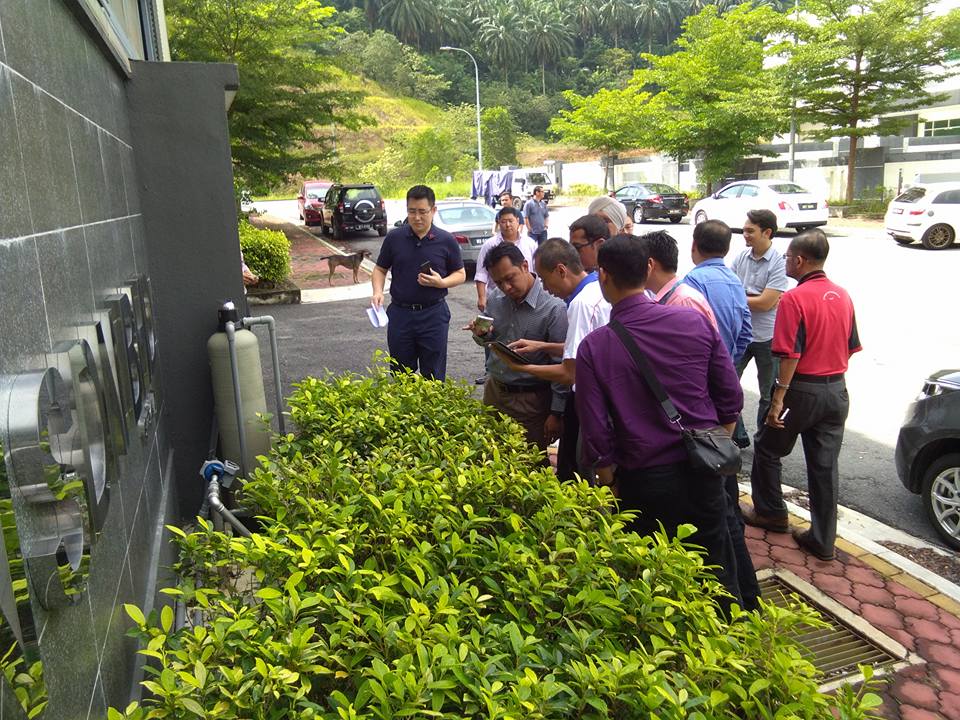
NB-IoT smart metering pilot in Semenyih during Malaysia’s IR4.0 initiatives — working across telco, utility, and technology partners to validate deployment readiness beyond controlled lab conditions.
At the time, much of the industry focus was on validating network coverage and connectivity performance as NB-IoT base stations were being activated.
However, field deployment quickly demonstrated that connectivity was only one part of the challenge.
Device Readiness
The device itself must remain stable and predictable under real network conditions. Firmware behaviour, power consumption and communication performance all become important when a device is expected to operate unattended for many years.
Deployment Scalability
A successful laboratory or pilot demonstration does not automatically translate into a repeatable large-scale deployment. Installation processes, device configuration, commissioning and field support all need to become scalable.
System Integration
Meter data must ultimately flow into the HES, data platforms and existing utility workflows. A technically successful communication link is therefore only one component of a successful AMI deployment.
One of the most important lessons from these early pilots was that NB-IoT should not be viewed simply as a connectivity solution. It is part of a larger ecosystem in which devices, networks and utility systems must work together reliably to deliver value at scale.
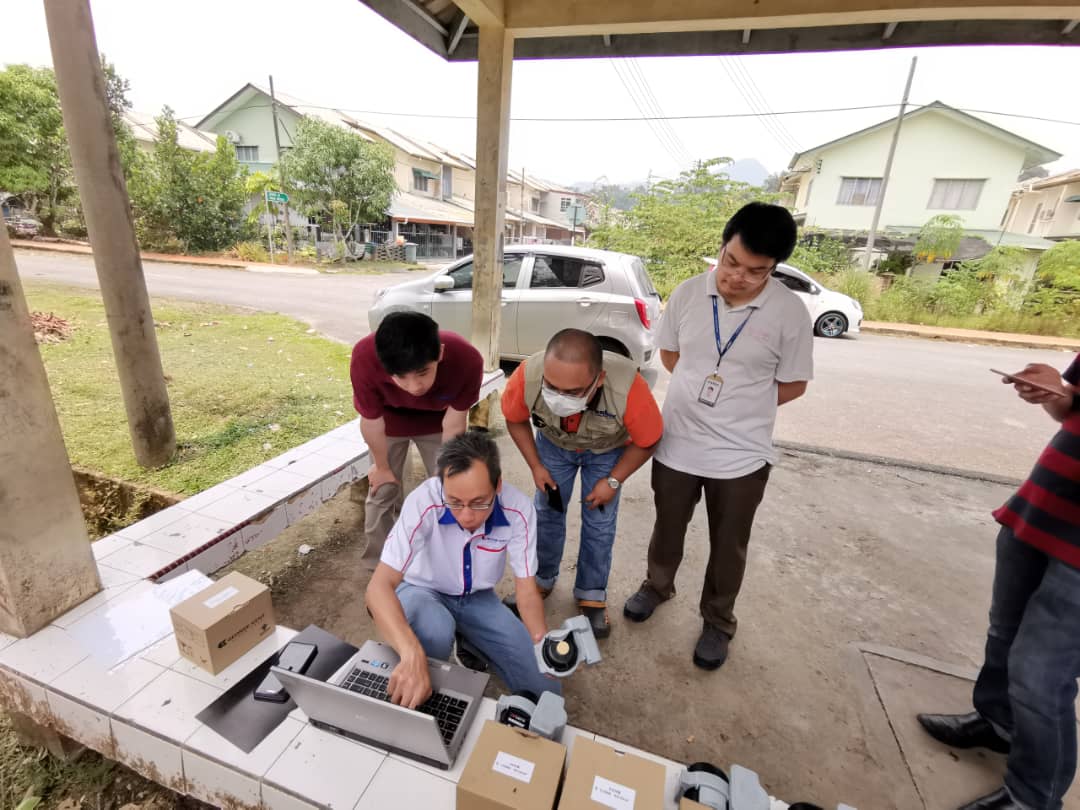
Configuring NB-IoT smart meter devices during pilot setup — aligning device behaviour, network performance, and integration requirements ahead of scaled deployment.
Is NB-IoT Right for Smart Metering?
NB-IoT is a strong connectivity option for large-scale IoT and smart metering deployments where low power consumption, wide coverage and relatively infrequent data transmission are important.
However, technology selection should not be based solely on published specifications. Utilities need to consider real field coverage, battery performance, network conditions, device behaviour, backend integration and long-term operator support.
The experience from early deployments also demonstrates an important principle: reliable connectivity is necessary, but it is not sufficient. The device, communication network and utility systems must operate as an integrated ecosystem.
For smart metering projects, the best connectivity technology is therefore the one that can deliver the required performance reliably throughout the intended operational life of the system.
Read the Full Article on Medium
This page provides a practical introduction to NB-IoT and its application in IoT and smart metering.
The complete article also includes field notes from early NB-IoT smart metering deployments in Malaysia and the lessons learned when moving beyond controlled pilots into real deployment conditions.
Continue reading the full article on Medium for the complete discussion.
Related Smart Metering Topics
- What Is Smart Metering? A Practical Guide for Utilities and Smart Cities
- What Is AMI (Advanced Metering Infrastructure)? Architecture, Components, and How It Works
- AMR vs AMI: Key Differences, Benefits, and When to Use Each
- NB-IoT vs LoRaWAN vs LTE-M: Choosing the Right IoT Connectivity for Smart Utilities
- Smart Metering in Asia: Challenges, Deployment Lessons, and Real-World Constraints
- From Smart Meters to Smart Decisions: How AMI Data Becomes Intelligence for Utilities and Smart Cities
- Why Smart Metering Pilots Fail at Scale — And How Utilities Can Avoid It
- Smart Metering System Architecture: End-to-End Design for Utilities
- What Is LoRaWAN? Architecture, Use Cases, and Limitations in Real Deployments
- Head-End Systems (HES) Explained: The Communication Hub of AMI
- Meter Data Management Systems (MDMS) Explained: Turning Data into Information