Smart Metering Fundamentals
Smart Metering in Asia: Challenges, Deployment Lessons, and Real-World Constraints
What makes smart metering deployment different across Asian markets—and what utilities need to consider beyond the technology.
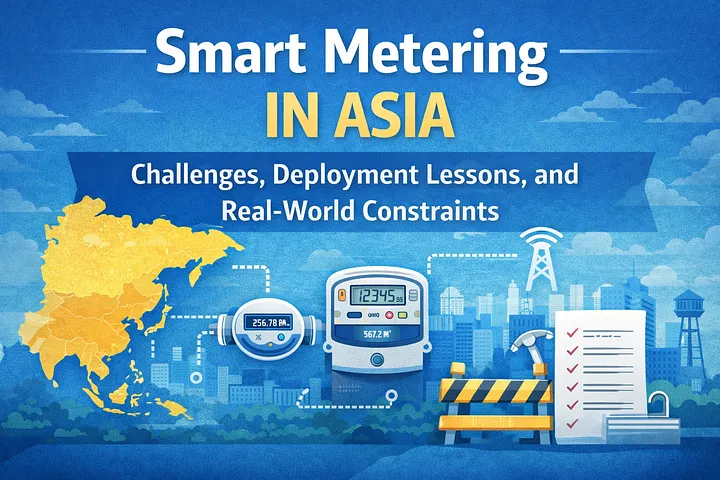
Smart metering adoption across Asia is accelerating. However, large-scale deployments remain complex because utilities operate across widely different infrastructure, environmental and operational conditions.
Asia is not a single deployment environment. Dense urban high-rise developments, suburban housing areas, rural communities and remote locations can create very different requirements for meter installation, communications, maintenance and field operations.
While the underlying technologies are well understood, the practical challenges of implementing them at scale are often underestimated. Connectivity performance, battery life, legacy systems, deployment execution and cost pressures can all influence the long-term outcome of an AMI programme.
This article examines these real-world constraints and highlights practical deployment lessons that utilities should consider when planning and scaling smart metering programmes across Asian markets.
Key Takeaways
- Asia is not a homogeneous smart metering deployment environment; infrastructure and operating conditions vary significantly between markets and locations.
- High-rise buildings, landed housing, rural areas, underground installations and legacy infrastructure can create very different technical and operational requirements.
- Connectivity performance should be validated in the field rather than relying solely on theoretical coverage, network maps or laboratory assumptions.
- Battery life is a system-level outcome influenced by signal strength, transmission frequency, communication retries and overall device design.
- Successful smart metering programmes require attention to backend integration, deployment execution, long-term maintenance and data utilization—not just meter installation.
What This Article Covers
This article examines the practical challenges of deploying smart metering infrastructure across Asia, where utilities must operate across diverse physical environments, infrastructure conditions and organizational capabilities.
The discussion covers infrastructure diversity, connectivity performance, battery life, legacy system integration, cost pressures, deployment execution and the utilization of smart meter data.
Rather than treating smart metering as a technology deployment alone, the article considers it as a long-term utility infrastructure programme in which engineering decisions, field conditions, operational processes and organizational readiness all influence the final outcome.
Practical Insights for Utilities
One of the biggest challenges in Asian smart metering programmes is the assumption that a solution proven in one environment can simply be replicated across another. In practice, infrastructure conditions can vary considerably even within the same utility service area.
High-rise buildings, underground meter chambers, dense urban environments and rural installations can produce very different communication and maintenance conditions. Device placement, antenna performance, accessibility and installation practices therefore need to be considered as part of the system design.
Connectivity is another area where field validation is essential. Theoretical coverage does not always translate into reliable meter communication. Signal attenuation in underground or enclosed locations, building materials, interference and network conditions can all affect communication performance.
Battery life should also be evaluated as a system-level outcome. For battery-powered water meters expected to operate for many years, network signal strength, reporting frequency and communication retry behaviour can materially affect energy consumption and operational life.
Backend integration can become another major constraint. Many utilities continue to operate legacy systems that were not designed for high-frequency meter data, large numbers of connected devices or real-time processing. Integration architecture therefore needs to be considered early rather than treated as a downstream software exercise.
Finally, large-scale deployment is an operational challenge as much as a technical one. Installation coordination, site access, customer engagement, device provisioning and activation can determine whether a technically sound solution can actually be deployed efficiently at scale.
The broader lesson is that successful smart metering programmes are designed around real operating conditions. Reliability, maintainability and scalability should be evaluated alongside technology capability and initial cost.
Read the Full Article on Medium
This page provides a concise practical overview of the challenges involved in smart metering deployment across Asia. The complete article examines infrastructure diversity, connectivity, battery life, legacy systems, deployment execution and the lessons learned from real-world implementations.
Continue reading the full article on Medium for the complete discussion.
Related Smart Metering Topics
- What Is Smart Metering? A Practical Guide for Utilities and Smart Cities
- NB-IoT vs LoRaWAN vs LTE-M: Choosing the Right IoT Connectivity for Smart Utilities
- From Smart Meters to Smart Decisions: How AMI Data Becomes Intelligence for Utilities and Smart Cities
- Why Smart Metering Pilots Fail at Scale — And How Utilities Can Avoid It