Smart Metering Architecture
Smart Metering System Architecture: End-to-End Design for Utilities
How meters, connectivity, HES, MDMS and applications work together to create a scalable smart metering system.
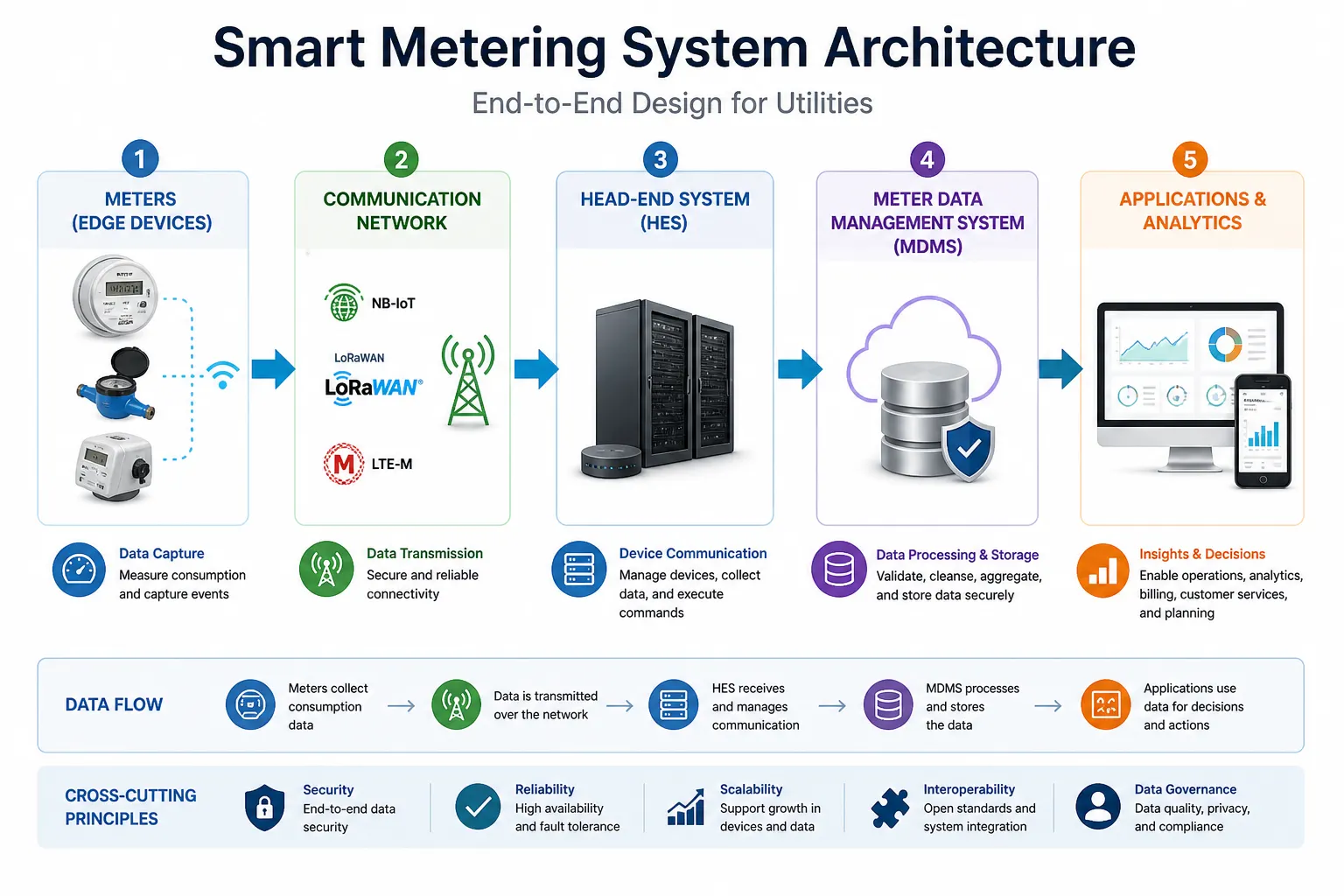
Smart metering is often discussed in terms of devices or connectivity.
In practice, it is a system architecture problem.
A successful smart metering deployment requires meters, communication networks, backend systems, data platforms and operational processes to work together as an integrated system.
This page provides a practical view of smart metering system architecture, from the field meter through connectivity, the Head-End System (HES), Meter Data Management System (MDMS) and utility applications.
Key Takeaways
- Smart metering should be designed as an end-to-end system rather than as a collection of independent components.
- A typical architecture consists of the meter, communication network, HES, MDMS and application layers.
- Connectivity selection affects coverage, reliability, latency, power consumption and deployment complexity.
- The HES manages communication between field devices and backend systems.
- The MDMS validates, processes, stores and prepares meter data for downstream applications.
- Data has limited value unless it is integrated into operational and business processes.
- Scalability and reliability must be considered from the beginning rather than added after deployment.
- The most important architectural principle is end-to-end thinking.
Why Smart Metering Architecture Matters
Many smart metering projects focus heavily on selecting the meter and communication technology.
However, problems often emerge further downstream when the different components are not designed as part of one system.
Typical consequences include:
- Data silos
- Limited operational visibility
- Integration difficulties
- Underutilized meter data
- Difficulty scaling the system
Smart metering delivers value only when the complete architecture is designed coherently.
End-to-End Smart Metering System Architecture
A typical smart metering system can be viewed as five interconnected layers:
Meter → Communication Network → HES → MDMS → Applications
Each layer has a distinct role, but the overall value of the system depends on how effectively the layers work together.
1. Meter Layer — Edge Devices
The meter is the field-level device responsible for measuring consumption and generating the data used by the smart metering system.
Typical Functions
- Consumption measurement
- Event detection
- Data recording
- Communication with the network
Key Design Considerations
- Measurement accuracy
- Long-term reliability
- Battery life for battery-powered meters
- Environmental resilience
- Firmware stability
- Communication performance
2. Communication Network Layer
The communication layer connects field meters to the backend systems that manage and process their data.
Common technologies used in smart metering include:
- NB-IoT
- LoRaWAN
- LTE-M
- RF mesh and other RF technologies
Key Considerations
- Coverage
- Reliability
- Latency
- Scalability
- Power consumption
- Deployment complexity
Communication technology should therefore be selected based on system requirements rather than treated as an isolated technology decision.
For a detailed comparison of the main cellular and LPWAN options, see: NB-IoT vs LoRaWAN vs LTE-M: Choosing the Right IoT Connectivity for Smart Utilities .
3. Head-End System (HES)
The Head-End System (HES) manages communication between the utility backend and field meters.
Typical HES Functions
- Device communication
- Data collection
- Command execution
- Device management
- Communication monitoring
The HES acts as the operational interface between field devices and the utility's downstream data systems.
A well-designed HES is therefore important for reliable and scalable AMI operations.
4. Meter Data Management System (MDMS)
The Meter Data Management System (MDMS) processes and manages meter data after it has been collected through the HES.
Typical MDMS Functions
- Data validation
- Data cleansing
- Data aggregation
- Data storage
- Data preparation for downstream applications
The MDMS transforms raw meter readings into structured information that can be used by utility systems and business processes.
5. Application and Analytics Layer
The application layer is where smart metering data becomes operational and business value.
Applications can include:
- Billing
- Leakage detection
- Demand analysis
- Operational dashboards
- Customer information systems
- Asset and maintenance management
The objective is not simply to collect more meter data, but to turn reliable data into better operational and business decisions.
Data Flow Across the Smart Metering System
In a well-designed architecture, meter data moves through the system in a defined sequence:
- Meters collect data from consumption and events.
- The communication network transmits the data from the field.
- The HES receives and manages communication with the meters.
- The MDMS processes and stores the data.
- Applications use the processed data for operational and business decisions.
The critical point is that the value of the system depends not on any individual component, but on how seamlessly these components integrate.
Common Smart Metering Architecture Pitfalls
1. Treating Components in Isolation
Meters, networks and backend systems may perform well individually but still create integration problems when they are designed independently.
2. Underestimating Data Management
Collecting large quantities of meter data does not automatically create value. Without appropriate validation, processing and management, data can remain difficult to use.
3. Overlooking Operational Integration
Smart metering systems need to integrate with existing utility processes such as billing, maintenance and customer platforms.
4. Choosing Connectivity in Isolation
A communication technology that looks attractive technically may not be suitable for the overall system once coverage, power consumption, reliability and backend requirements are considered.
Design Principles for Effective Smart Metering Architecture
End-to-End Thinking
Design the architecture as one integrated system rather than as independent components.
Scalability
The architecture should support future expansion in meter numbers, geographic coverage, data volume and applications.
Reliability
Systems should be designed for actual field conditions rather than ideal laboratory conditions.
Data-Centric Design
The architecture should begin with how data will ultimately be used, rather than focusing only on how data will be collected.
Field Notes from Real Smart Metering Deployments
In real deployments, architecture challenges often emerge from misalignment between otherwise capable components.
Strong Devices, Weak Integration
Meters and communication networks may perform well, while backend systems are unable to fully utilize the information being generated.
Data Collected but Not Used
Large volumes of meter data can be collected without necessarily producing better operational decisions if analytics and process integration are limited.
Connectivity Chosen in Isolation
Selecting a communication technology without considering the complete system can create performance or integration problems later.
System Complexity Underestimated
End-to-end smart metering requires coordination across metering, communications, software, data management and utility operations.
What Should Utilities Specify in a Smart Metering Architecture?
A good architecture specification should define more than the meter and communication technology.
- Meter performance: accuracy, reliability, environmental requirements and battery life.
- Communication performance: coverage, availability, latency, reporting frequency and retry behaviour.
- HES requirements: device management, communication handling, commands and scalability.
- MDMS requirements: validation, data quality, storage, processing and integration.
- Application requirements: billing, analytics, leakage detection, operations and customer services.
- System KPIs: measurable end-to-end availability, data completeness and operational performance.
- Lifecycle requirements: firmware management, cybersecurity, maintenance and long-term scalability.
This prevents the architecture from becoming a collection of component specifications without clear end-to-end performance objectives.
Smart Metering Is an End-to-End Architecture
Smart metering is not simply a meter deployment or a connectivity project. It is an end-to-end system architecture initiative.
Meters, communication networks, HES, MDMS and applications must work together reliably if utilities are to achieve operational visibility and extract value from their data.
The strongest architectures are therefore designed around scalability, reliability, integration and the intended use of data rather than around individual technologies alone.
For utilities planning a smart metering programme, the key question is not simply: "Which meter or communication technology should we use?"
The more important question is: "How should the complete system work together to deliver reliable operational value at scale?"
Read the Full Article on Medium
This page provides a structured overview of end-to-end smart metering system architecture.
The complete Medium article discusses the architecture layers, data flow, common pitfalls, design principles and practical deployment observations in more detail.
Related Smart Metering Topics
- What Is Smart Metering? A Practical Guide for Utilities and Smart Cities
- What Is AMI (Advanced Metering Infrastructure)? Architecture, Components, and How It Works
- AMR vs AMI: Key Differences, Benefits, and When to Use Each
- NB-IoT vs LoRaWAN vs LTE-M: Choosing the Right IoT Connectivity for Smart Utilities
- What Is NB-IoT? A Practical Guide for IoT and Smart Metering Deployments
- LoRaWAN Explained: Architecture, Use Cases, and Limitations in Real Deployments
- Smart Metering in Asia: Challenges, Deployment Lessons, and Real-World Constraints
- Why Smart Metering Pilots Fail at Scale — And How Utilities Can Avoid It
- From Smart Meters to Smart Decisions: How AMI Data Becomes Intelligence for Utilities and Smart Cities
- Head-End Systems (HES) Explained: The Communication Hub of AMI
- Meter Data Management Systems (MDMS) Explained: Turning Data into Information