AMI Operations
Head-End Systems (HES) Explained: The Communication Hub of AMI
How the Head-End System connects field meters with the wider AMI ecosystem, managing communication, devices, commands, integration and operational visibility.
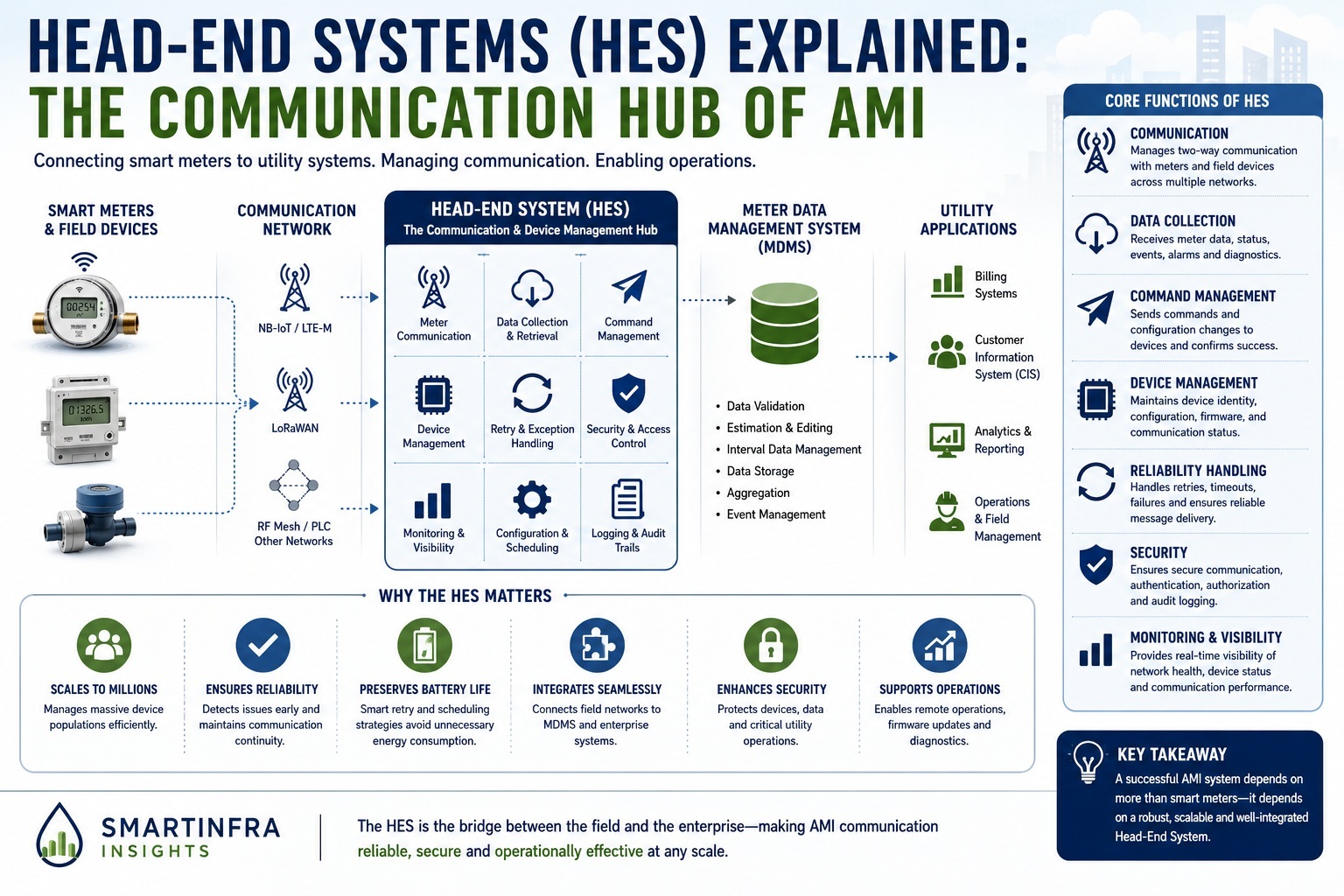
Introduction
A smart meter can measure consumption accurately, and a communication network can transport data. But neither component alone creates a functioning Advanced Metering Infrastructure (AMI) system.
Between the field devices and the utility's higher-level systems sits an important operational layer: the Head-End System (HES).
The HES manages communication with smart meters and other field devices, receives data, sends commands, handles communication failures and provides visibility into device connectivity.
Its importance becomes increasingly apparent as an AMI deployment grows from a small pilot into a large operational network.
Key Takeaways
- The HES is the communication and device-management layer of AMI.
- It sits between field devices and systems such as the MDMS and utility applications.
- HES functions extend beyond collecting meter readings to include commands, device management, retries and communication handling.
- HES behavior can indirectly affect battery-powered water meters.
- Integration, interoperability and scalability become increasingly important as deployments grow.
- Operational visibility helps utilities distinguish device problems from communication or network problems.
- Cybersecurity is critical because the HES connects field devices with higher-level utility systems.
- An HES should be evaluated as a long-term operational platform rather than simply a list of software features.
What Is a Head-End System?
A Head-End System is the software platform responsible for communicating with smart meters and other field devices through the AMI communication network.
A simplified AMI architecture is:
Smart Meter → Communication Network → HES → MDMS → Utility Applications
The HES sits at the boundary between the field network and the utility's IT systems.
Its primary responsibility is interaction with devices and the communication network. The MDMS, by comparison, focuses more on processing, validating, storing and managing meter data.
This distinction is important: the HES is not simply a database of meter readings. It is the system that interacts with the devices producing those readings.
Why the HES Matters
A large AMI deployment may involve tens of thousands or even millions of devices. Utilities need operational visibility into questions such as:
- Which devices are communicating?
- When was data last received?
- Which meters are offline?
- Were commands successfully delivered?
- Are communication retries occurring?
- Which firmware versions are deployed?
- Are devices responding correctly?
A meter that stops communicating is not necessarily a failed meter. The underlying problem could involve the device, network coverage, SIM or subscription, gateway, protocol, configuration or communication server.
The HES provides the operational layer needed to investigate and manage these conditions.
What Does an HES Actually Do?
1. Meter Communication
The primary responsibility of the HES is communication with field devices.
Depending on the AMI architecture, this can involve technologies such as:
- NB-IoT
- LTE-M
- LTE or Cat 1
- LoRaWAN
- RF mesh
- Wireless M-Bus
- PLC
The HES needs to understand the communication method and applicable device protocols, receive information from meters and send commands back to them.
2. Data Collection
The HES receives information generated by field devices.
Depending on the meter and application, this may include:
- Meter readings
- Consumption data
- Battery status
- Communication status
- Tamper events
- Leak or abnormal-flow events
- Device alarms
- Diagnostic information
The HES may also manage scheduled collection processes, such as daily reporting from water meters.
3. Command Management
AMI communication is not necessarily one-way.
Utilities may need to send commands to field devices for functions such as:
- Requesting an immediate reading
- Changing configuration parameters
- Synchronizing time
- Enabling or disabling functions
- Requesting diagnostic information
- Triggering device operations
Where remote valve control or similar functions are supported, the HES may provide the communication path for those commands.
The system therefore needs to know whether a command was successfully delivered and whether the device acknowledged it.
4. Device Management
Large AMI networks require continuous device management.
The HES may maintain information including:
- Device identity
- Communication status
- Network credentials
- Configuration
- Firmware version
- Last successful communication
- Error conditions
This becomes particularly important when utilities operate multiple meter models or communication technologies.
5. Retry and Communication Handling
Communication networks are not perfect. Devices can temporarily lose connectivity, underground meters can experience poor signal conditions, cellular networks can become congested and gateways can become unavailable.
An HES therefore needs appropriate mechanisms for:
- Retry management
- Timeout handling
- Queue management
- Scheduling
- Failure detection
- Reconnection handling
However, more retries do not automatically mean better reliability.
For battery-powered water meters, excessive retries can increase energy consumption and reduce battery life. HES behavior can therefore indirectly affect field-device performance.
HES and Battery Life
The HES is often viewed as a back-office software component, but its operational behavior can have consequences at the meter.
Consider a water meter designed around a long battery-life target. If the HES repeatedly requests data because of an aggressive retry strategy, the meter may wake up and transmit more frequently.
The additional energy consumption occurs at the device, while the consequence may only become visible much later as reduced battery life.
This illustrates an important AMI principle:
Meter + Communication Network + HES + MDMS + Applications
The system needs to be considered as a whole because a change in one layer can affect another.
HES and Communication Technology
HES architecture depends heavily on the communication technology used in the field.
A cellular AMI deployment may require interaction with cellular networks and device connectivity services. A LoRaWAN deployment may involve network servers and gateways, while an RF mesh deployment may involve collectors or concentrators.
The HES therefore needs to integrate with the communication infrastructure beneath it.
This is why utilities should avoid evaluating an HES purely through a feature checklist. The more important question is whether the HES works effectively with the actual communication architecture used in the field.
HES and MDMS: What Is the Difference?
One of the most common areas of confusion in AMI is the boundary between HES and MDMS.
The simplest distinction is:
HES manages communication.
MDMS manages meter data.
The HES receives raw or near-raw information from field devices. The MDMS can then perform functions such as:
- Data validation
- Estimation
- Editing
- Data storage
- Aggregation
- Interval data management
- Data preparation for billing and analytics
A simplified flow is:
Meter → Network → HES → MDMS → Billing / Analytics / Customer Systems
The exact boundary varies between vendors. Some platforms combine capabilities, while others separate them clearly.
Utilities should therefore evaluate the actual architecture rather than relying only on product terminology.
HES Integration Is Critical
An HES rarely operates in isolation.
It may need to communicate with:
- MDMS
- Billing systems
- Customer information systems
- Asset management platforms
- Outage management systems
- Network management systems
- Analytics platforms
- Device management platforms
A technically capable HES can still become an operational problem if it is difficult to integrate with the utility's existing systems.
APIs and Interoperability
Modern AMI environments increasingly depend on well-defined interfaces.
An HES may exchange information through:
- APIs
- Web services
- Message queues
- Database interfaces
- Utility communication protocols
The objective is not simply to support the largest possible number of interfaces.
Interfaces should also be:
- Well documented
- Stable
- Secure
- Scalable
- Easy to monitor
- Suitable for long-term operation
These characteristics become particularly important in multi-vendor environments.
Multi-Vendor AMI and HES
Utilities may eventually operate different generations of meters, vendors, communication technologies and firmware generations.
The HES can become an important integration point for managing this complexity.
A mature architecture should allow utilities to manage different device populations without creating separate operational silos for every device family.
This does not necessarily mean that one HES must support every technology. Rather, utilities should understand how the HES fits into the long-term interoperability strategy.
Scalability: From Pilot to Large-Scale Deployment
An HES that works well with 1,000 meters can behave very differently when the deployment reaches hundreds of thousands or millions of devices.
Scaling introduces challenges such as:
- Large numbers of simultaneous connections
- High volumes of incoming messages
- Command queues
- Database transactions
- Alarm processing
- Device management
- Network failures
- Peak communication periods
A pilot may demonstrate that communication is technically possible. It does not necessarily demonstrate that the HES architecture can support the operational workload of a large deployment.
Monitoring and Operational Visibility
An HES should provide meaningful operational visibility rather than simply creating more dashboards.
Useful information can include:
- Communication success rate
- Device availability
- Last communication time
- Failed commands
- Retry counts
- Network errors
- Firmware distribution
- Device health
The objective is to help operations teams answer practical questions quickly.
For example: is a meter offline because the device has failed, or because the communication network is unavailable?
That distinction can determine whether a field visit is actually necessary.
Cybersecurity
Because the HES sits between field devices and enterprise systems, cybersecurity is a critical consideration.
Relevant areas include:
- Authentication
- Authorization
- Encryption
- Secure device communication
- Credential management
- Access control
- Audit logging
- Network segmentation
- Secure APIs
- Firmware security
Remote commands require particular attention. A system capable of remotely configuring or controlling large numbers of devices needs appropriate controls to ensure commands originate from authorized users or systems.
Security should therefore be part of the HES architecture rather than an afterthought.
What Utilities Should Evaluate When Selecting an HES
Rather than asking only what features an HES provides, utilities should evaluate the platform across several dimensions.
Communication Capability
Can it support the actual field technologies and protocols required?
Scalability
Can it handle the expected number of devices and message volumes?
Interoperability
Can it integrate with different meter vendors and utility systems?
Device Management
Can operations teams efficiently monitor and manage large device populations?
Security
Are authentication, authorization, encryption and audit capabilities appropriate?
Integration
Can it connect cleanly with the MDMS and other enterprise platforms?
Operational Visibility
Can the utility quickly identify communication and device problems?
Lifecycle Support
Can the HES accommodate future meter models, firmware versions, communication technologies and changing operational requirements?
The HES Is More Than a Communication Server
A Head-End System may appear to be another software component in an AMI architecture. In reality, it is one of the key operational layers connecting the physical world of meters and communication networks with the digital world of utility data and applications.
A well-designed HES can help utilities:
- Maintain reliable communication
- Manage large device populations
- Execute remote operations
- Monitor network performance
- Support multiple device types
- Integrate with enterprise systems
- Operate AMI throughout its lifecycle
However, an HES cannot compensate for poor field design, inadequate communication coverage, inefficient firmware or unclear operational requirements.
The strongest results come from treating the HES as part of the complete AMI ecosystem.
Conclusion
The Head-End System is the communication and device-management layer of AMI.
It sits between field networks and higher-level utility systems, managing the complex interaction between meters, communication infrastructure and enterprise applications.
Its importance becomes increasingly visible as deployments grow. At pilot scale, communication may appear relatively simple. At large scale, device management, integration, scalability, cybersecurity, monitoring and operational reliability become critical.
For utilities planning an AMI deployment, the HES should therefore be evaluated not simply as a software product, but as a long-term operational platform.
A successful AMI system is not just about installing smart meters. It is about building an architecture in which the meter, communication network, HES, MDMS and utility applications work together reliably.
Read the Full Article on Medium
This article was originally published on Medium, where the full discussion explores the role of HES in AMI communication, device management, integration, scalability, cybersecurity and long-term utility operations.
Related Smart Metering Topics
- What Is AMI (Advanced Metering Infrastructure)? Architecture, Components, and How It Works
- Smart Metering System Architecture: End-to-End Design for Utilities
- NB-IoT vs LoRaWAN in Real Deployments: What Actually Happens in the Field
- Firmware Management in AMI: The Hidden Operational Challenge
- Cybersecurity in Smart Metering: Real Risks, System Weaknesses, and Practical Defenses
- Why AMI Systems Fail: A System-Level Breakdown (Technology, Data, Organization)
- From Smart Meters to Smart Decisions: How AMI Data Becomes Intelligence for Utilities and Smart Cities
- How Utilities Actually Use Smart Meter Data (Beyond Billing)