Smart Metering Fundamentals
AMR vs AMI: Key Differences, Benefits, and When to Use Each
A practical comparison of Automated Meter Reading and Advanced Metering Infrastructure, and how utilities can choose the right approach.
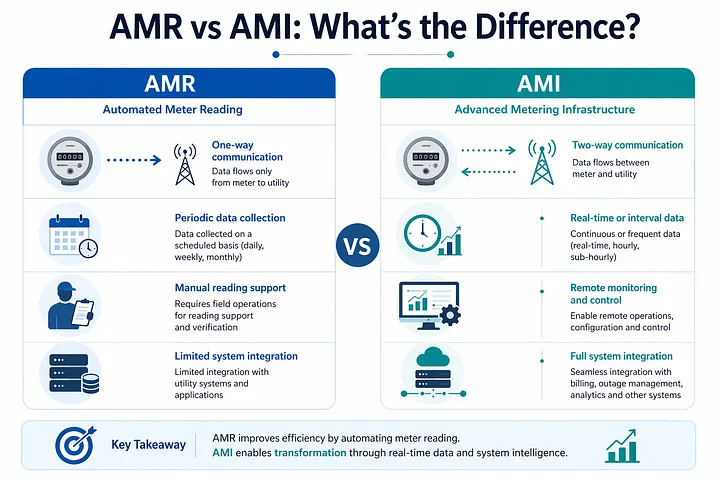
Automated Meter Reading (AMR) and Advanced Metering Infrastructure (AMI) are often used interchangeably when discussing smart metering. However, they represent different levels of capability, connectivity and system maturity.
AMR primarily automates the collection of meter readings, reducing the need for manual meter reading. AMI goes further by creating an integrated infrastructure capable of two-way communication, more frequent data collection and integration with utility backend systems.
Understanding the difference matters when utilities are planning a new metering deployment, upgrading an existing system or deciding whether a lower-cost AMR approach is sufficient for their operational objectives.
The right choice is therefore not simply about selecting the more advanced technology. It depends on cost, infrastructure readiness, operational requirements and the level of long-term capability the utility needs.
Key Takeaways
- AMR automates meter reading, while AMI provides a broader integrated metering infrastructure.
- AMR typically uses one-way communication, while AMI supports two-way communication between meters and utility systems.
- AMR is generally suited to periodic meter reading, while AMI can provide interval or near-real-time data visibility.
- AMI provides deeper integration with billing, analytics and operational systems.
- AMR can be a practical choice where the primary objective is reducing manual meter reading costs.
- AMI is better suited to utilities pursuing operational intelligence and long-term digital transformation.
- Moving from AMR to AMI later can introduce additional complexity, so the long-term roadmap should be considered before deployment.
What Is AMR (Automated Meter Reading)?
Automated Meter Reading (AMR) refers to systems that automatically collect meter readings without requiring manual meter reading at every meter.
AMR data is typically collected periodically and transmitted primarily from the meter to the utility. Common approaches include drive-by or walk-by meter reading and scheduled remote data collection.
The main objective of AMR is operational efficiency. By automating meter reading, utilities can reduce manual collection effort, improve billing accuracy and obtain readings faster than traditional manual processes.
However, AMR generally provides more limited system capability than a full AMI deployment, particularly in terms of two-way communication, data frequency and backend integration.
What Is AMI (Advanced Metering Infrastructure)?
Advanced Metering Infrastructure (AMI) is a fully integrated system that enables communication between smart meters and utility systems.
An AMI deployment typically combines smart meters, communication networks and data management systems to provide more frequent data collection and broader operational capabilities.
Unlike basic AMR systems, AMI can support two-way communication, remote configuration and control, integration with operational systems and real-time or near-real-time data visibility.
AMI therefore represents a significant step beyond automated meter reading, particularly for utilities seeking to use meter data for monitoring, analytics and wider digital transformation.
AMR vs AMI: Key Differences
The difference between AMR and AMI can be understood across five important dimensions.
1. Communication
AMR: Typically uses one-way communication from the meter to the utility.
AMI: Supports two-way communication between the meter and utility systems.
2. Data Frequency
AMR: Meter readings are generally collected periodically, such as daily or monthly.
AMI: Can provide interval data, including hourly, sub-hourly or near-real-time information depending on the system design.
3. System Integration
AMR: Typically has more limited integration with backend systems.
AMI: Is designed to integrate with billing, analytics and operational platforms.
4. Operational Capability
AMR: Primarily focuses on automating meter reading and supporting billing.
AMI: Enables monitoring, remote management, control and analytics.
5. Scalability and Future Readiness
AMR: Can provide a practical improvement where basic meter-reading automation is the main objective.
AMI: Provides a broader foundation for long-term digital transformation and data-driven utility operations.
Benefits of AMR
AMR can provide significant benefits for utilities moving away from manual meter reading.
- Reduced manual meter-reading costs through automated data collection.
- Improved billing accuracy by reducing dependence on manual readings.
- Faster data collection compared with traditional manual processes.
For utilities with limited infrastructure or budgets, AMR can provide a relatively simple and cost-effective step toward automated metering.
Benefits of AMI
AMI provides a broader set of operational and strategic capabilities than basic automated meter reading.
- Continuous data visibility for improved understanding of consumption patterns.
- Early detection of anomalies, including potential leaks and outages.
- Remote device management and configuration.
- Data-driven decision-making through integration with analytics and operational systems.
These capabilities allow AMI to support both immediate operational efficiency and longer-term digital transformation.
When to Use AMR
AMR may be appropriate when the primary objective is to automate meter reading without requiring the full capabilities of an AMI environment.
- Budget constraints limit the ability to make a larger infrastructure investment.
- Existing infrastructure is not yet ready for a fully integrated AMI deployment.
- The primary objective is reducing manual meter-reading effort.
AMR can also serve as a transitional step for utilities that expect to evolve toward more advanced metering capabilities in the future.
When to Use AMI
AMI is more appropriate when a utility requires broader operational visibility and intends to use meter data beyond basic billing.
- Real-time or near-real-time visibility is required.
- Operational efficiency and analytics are strategic priorities.
- Long-term digital transformation is part of the utility's infrastructure strategy.
- The deployment is large enough that integrated data and device management provide significant operational value.
For new large-scale deployments, AMI may provide a stronger long-term foundation than deploying a basic AMR system and upgrading later.
Key Considerations When Choosing Between AMR and AMI
Cost vs Value
AMR generally requires a lower initial investment, while AMI can provide greater long-term value through additional operational capabilities and system integration.
Infrastructure Readiness
AMI requires reliable communications and appropriate backend system integration. Utilities should assess whether the existing infrastructure can support these requirements.
Operational Objectives
The desired outcome should drive the technology choice. If the primary goal is efficiency in meter reading, AMR may be sufficient. If the objective is broader operational transformation, AMI is the stronger fit.
From AMR to AMI: A Common Evolution Path
Some utilities adopt AMR as an initial step before transitioning to AMI.
This approach can make sense when budgets, infrastructure or organizational readiness limit the ability to deploy a complete AMI system immediately.
However, the long-term migration path should be considered before making the initial investment.
Upgrading an AMR environment to AMI later can introduce additional complexity and cost. In some situations, deploying AMI directly may provide a more efficient long-term approach.
The decision should therefore consider not only today's requirements, but also the utility's expected operational and digital capabilities several years into the future.
AMR vs AMI: Which Is Right for Your Utility?
AMR and AMI serve different purposes in the evolution of smart metering.
AMR provides an effective way to automate meter reading and improve operational efficiency. AMI goes further by connecting meters, communications and utility systems into an integrated digital infrastructure.
The decision should therefore not be based solely on the lowest initial cost. Utilities should consider the level of operational capability required, infrastructure readiness, expected data needs and long-term digital transformation objectives.
For some utilities, AMR may be the appropriate solution. For others, particularly new large-scale deployments with broader digital objectives, AMI may provide the stronger long-term foundation.
Read the Full Article on Medium
This page provides a practical comparison of Automated Meter Reading and Advanced Metering Infrastructure.
The complete article examines the differences between AMR and AMI, their benefits, appropriate use cases, decision factors and the potential path from AMR toward AMI.
Continue reading the full article on Medium for the complete discussion.
Related Smart Metering Topics
- What Is Smart Metering? A Practical Guide for Utilities and Smart Cities
- What Is AMI (Advanced Metering Infrastructure)? Architecture, Components, and How It Works
- NB-IoT vs LoRaWAN vs LTE-M: Choosing the Right IoT Connectivity for Smart Utilities
- Smart Metering in Asia: Challenges, Deployment Lessons, and Real-World Constraints
- From Smart Meters to Smart Decisions: How AMI Data Becomes Intelligence for Utilities and Smart Cities
- Why Smart Metering Pilots Fail at Scale — And How Utilities Can Avoid It
- Smart Metering System Architecture: End-to-End Design for Utilities
- What Is NB-IoT? A Practical Guide for IoT and Smart Metering Deployments
- LoRaWAN Explained: Architecture, Use Cases, and Limitations in Real Deployments
- Head-End Systems (HES) Explained: The Communication Hub of AMI
- Meter Data Management Systems (MDMS) Explained: Turning Data into Information