IoT Connectivity
LoRaWAN Explained: Architecture, Use Cases, and Limitations in Real Deployments
How LoRaWAN works, where it fits in smart metering, and what utilities should consider before deploying it at scale.
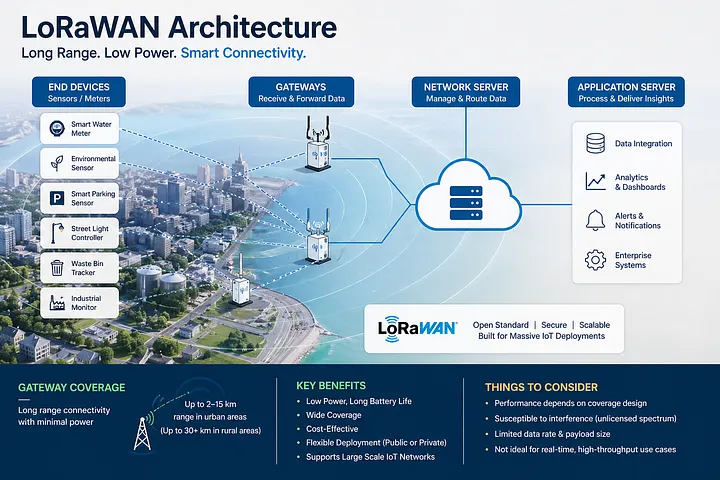
LoRaWAN is a Low-Power Wide-Area Network (LPWAN) technology designed for IoT applications that require long-range communication, low power consumption and relatively small amounts of data.
It is particularly relevant to smart cities, utilities and industrial IoT, where large numbers of battery-powered devices may need to communicate over wide geographic areas.
Unlike cellular IoT technologies such as NB-IoT, LoRaWAN operates primarily on unlicensed spectrum and can support both public and privately operated networks.
This flexibility is one of LoRaWAN's major strengths. However, it also means that network planning, gateway placement, interference management and ongoing optimization become important responsibilities for the deployment owner.
Key Takeaways
- LoRaWAN is an LPWAN technology designed for low-power, long-range IoT communication.
- It uses a star-of-stars architecture built around end devices, gateways, network servers and application servers.
- LoRaWAN operates on unlicensed spectrum, allowing flexible public or private network deployment.
- Smart water metering is one of the important utility applications for LoRaWAN.
- Gateway placement and network planning have a major influence on real-world performance.
- Unlicensed spectrum introduces potential interference and variability in dense environments.
- LoRaWAN is well suited to low-frequency, small-data applications but is not intended for high-bandwidth or real-time control.
- The decision to use LoRaWAN should consider not only device cost and radio range, but also long-term network ownership and operational responsibility.
What Is LoRaWAN?
LoRaWAN stands for Long Range Wide Area Network. It is a communication protocol designed for low-power, long-range IoT networks.
LoRaWAN operates primarily on unlicensed spectrum and uses LoRa radio modulation for communication between end devices and gateways.
The protocol is maintained by the LoRa Alliance and is designed for applications requiring low data rates, long battery life and large numbers of connected devices.
This makes LoRaWAN particularly relevant to utility applications such as smart water metering, environmental monitoring and infrastructure sensing.
LoRaWAN Architecture
LoRaWAN uses a star-of-stars architecture consisting of end devices, gateways, a network server and an application server.
1. End Devices
End devices are typically battery-powered sensors or meters that collect and transmit data.
They are designed for low power consumption and generally communicate at relatively low frequency.
2. Gateways
Gateways receive LoRa radio transmissions from multiple end devices and forward the data to backend systems through IP-based networks.
Unlike cellular base stations, LoRaWAN gateways primarily act as communication bridges. Device and network management functions are handled by the network server.
3. Network Server
The network server manages network-level communication functions, including device communication, duplicate packet handling and routing.
4. Application Server
The application server processes application data and integrates it with dashboards, analytics platforms and utility systems.
How LoRaWAN Works
- The end device collects measurement or sensor data.
- The device transmits the data using LoRa radio.
- One or more gateways receive the transmission.
- The gateway forwards the data to the LoRaWAN network server.
- The network server performs network-level processing and routing.
- The application server processes the data for dashboards, analytics or utility applications.
Multiple gateways may receive the same transmission, providing signal redundancy and supporting scalable network deployments.
Key Features of LoRaWAN
Long-Range Communication
LoRaWAN can support communication over several kilometres depending on the environment, radio configuration and network design.
Low Power Consumption
LoRaWAN devices can operate for years on battery when communication frequency and other power-consuming activities are carefully optimized.
Unlicensed Spectrum
LoRaWAN operates on ISM bands, allowing organizations to deploy networks without relying exclusively on cellular operators.
Flexible Deployment Models
LoRaWAN can support both public operator-managed networks and private networks owned or operated by enterprises or utilities.
LoRaWAN for Smart Metering
LoRaWAN can be a practical connectivity option for smart metering applications, particularly where meters transmit relatively small amounts of data and communication frequency is low.
Smart water metering is a particularly relevant application because consumption readings typically consist of small data payloads that can be transmitted periodically.
LoRaWAN can also be attractive where the utility wants greater control over its communications infrastructure rather than depending entirely on a telecommunications operator.
However, the communication network becomes part of the utility's operational responsibility when a private LoRaWAN deployment is used. Gateway availability, backhaul connectivity, coverage and ongoing network optimization must therefore be managed throughout the system lifecycle.
LoRaWAN Use Cases
LoRaWAN is commonly used for applications where data volumes are relatively small and devices need to operate for long periods.
- Smart water metering
- Environmental monitoring
- Smart city sensors
- Smart parking
- Street lighting monitoring
- Industrial IoT monitoring
It is particularly attractive where wide coverage, low-frequency data transmission and flexible network deployment are important.
Advantages of LoRaWAN
- Flexible network ownership through private or public deployments.
- Lower infrastructure cost in some private-network scenarios.
- Reduced dependence on telecommunications operators.
- Good range in suitable open environments.
- Scalability for large numbers of low-power devices.
For utilities, the ability to control the communications network can be a significant advantage where geographic coverage can be engineered effectively.
LoRaWAN Limitations in Real Deployments
Network Planning Complexity
LoRaWAN performance depends significantly on gateway placement, coverage planning and the physical deployment environment.
Interference and Reliability
Because LoRaWAN commonly operates in unlicensed spectrum, other devices and networks can potentially introduce interference. Performance can therefore become less predictable in dense environments.
Limited Throughput
LoRaWAN is optimized for small data payloads rather than high-bandwidth applications.
Latency and Downlink Constraints
LoRaWAN downlink communication is constrained by the protocol's design and is not intended for applications requiring continuous real-time control.
LoRaWAN vs NB-IoT
LoRaWAN and NB-IoT can both serve low-power IoT applications, but their network models are fundamentally different.
| Factor | LoRaWAN | NB-IoT |
|---|---|---|
| Network model | Private or public | Cellular operator network |
| Spectrum | Unlicensed | Licensed |
| Infrastructure responsibility | Can be utility-owned | Primarily operator-managed |
| Coverage | Depends heavily on gateway design | Depends on cellular network coverage |
| Interference exposure | Higher potential exposure in unlicensed spectrum | Managed licensed spectrum |
| Best suited for | Flexible low-data IoT networks | Large-scale cellular IoT deployments |
Neither technology is universally better. The appropriate choice depends on the utility's coverage requirements, infrastructure strategy, operating model and long-term connectivity objectives.
For a broader comparison of NB-IoT, LoRaWAN and LTE-M, see: NB-IoT vs LoRaWAN vs LTE-M: Choosing the Right IoT Connectivity for Smart Utilities .
When to Use LoRaWAN
LoRaWAN can be a strong choice when the application has relatively low communication frequency and the organization wants flexibility over its network infrastructure.
- Private network control is important.
- Coverage can be engineered effectively.
- Data transmission is relatively infrequent.
- Device data volumes are small.
- The organization is willing to manage the network infrastructure.
When LoRaWAN May Not Be Suitable
LoRaWAN may be less suitable when:
- Very high communication reliability is required in dense environments.
- Real-time communication or control is required.
- The organization does not have the resources to design and operate the network.
- The deployment environment makes gateway coverage difficult to engineer.
- The application requires high data throughput.
Practical LoRaWAN Deployment Considerations
Coverage Design
Coverage should be validated through field measurements rather than relying solely on theoretical range calculations.
Gateway Density
Gateway placement directly influences network availability, redundancy and performance. The required gateway density depends on geography, building structures and the radio environment.
Interference Environment
The deployment area should be evaluated for other devices operating within the same or nearby unlicensed spectrum.
Long-Term Operations
A private LoRaWAN network requires ongoing maintenance, monitoring and optimization. These operational responsibilities should be included in the total cost of ownership.
LoRaWAN for Smart Water Metering: What Utilities Should Evaluate
For smart water metering, the question is not simply whether LoRaWAN can transmit a meter reading. Technically, that is usually straightforward.
The more important questions are whether the communication architecture can provide the required coverage, reliability, battery life and operational scalability over the entire deployment area and asset lifetime.
Utilities should therefore evaluate:
- Daily and monthly communication availability
- Gateway coverage and redundancy
- Battery impact of communication retries
- Meter chamber and indoor penetration
- Network ownership and operating responsibility
- Backhaul availability
- HES and backend integration
- Long-term maintenance requirements
A successful pilot should therefore demonstrate not only that a meter can communicate, but that the complete communication architecture can operate reliably and economically at scale.
Is LoRaWAN Right for Your IoT or Smart Metering Deployment?
LoRaWAN is a flexible and powerful connectivity technology for low-power IoT deployments, particularly where long range, small data payloads and network flexibility are important.
For smart metering, it can be particularly attractive when utilities want control over their communications infrastructure and can effectively engineer gateway coverage.
However, the technology's real-world performance depends heavily on network planning, gateway placement, interference conditions and ongoing operational management.
The key lesson is that LoRaWAN should not be evaluated purely on radio range or device cost. The complete network architecture and its long-term operating requirements need to be considered before committing to large-scale deployment.
For utilities, the right connectivity technology is ultimately the one that can deliver the required reliability, economics and operational capability throughout the intended life of the metering system.
Read the Full Article on Medium
This page provides a practical guide to LoRaWAN architecture, operation, use cases and deployment considerations.
The complete article examines where LoRaWAN fits in IoT and smart metering, its advantages, limitations and the practical challenges that can emerge during real-world deployment.
Continue reading the full article on Medium for the complete discussion.
Related Smart Metering Topics
- What Is Smart Metering? A Practical Guide for Utilities and Smart Cities
- What Is AMI (Advanced Metering Infrastructure)? Architecture, Components, and How It Works
- AMR vs AMI: Key Differences, Benefits, and When to Use Each
- What Is NB-IoT? A Practical Guide for IoT and Smart Metering Deployments
- NB-IoT vs LoRaWAN vs LTE-M: Choosing the Right IoT Connectivity for Smart Utilities
- Smart Metering in Asia: Challenges, Deployment Lessons, and Real-World Constraints
- From Smart Meters to Smart Decisions: How AMI Data Becomes Intelligence for Utilities and Smart Cities
- Why Smart Metering Pilots Fail at Scale — And How Utilities Can Avoid It
- Smart Metering System Architecture: End-to-End Design for Utilities
- Head-End Systems (HES) Explained: The Communication Hub of AMI
- Meter Data Management Systems (MDMS) Explained: Turning Data into Information