Smart Metering Fundamentals
From Smart Meters to Smart Decisions: How AMI Data Becomes Intelligence for Utilities and Smart Cities
Understanding how raw AMI data is transformed into operational intelligence, actionable insights, and better utility decision-making.
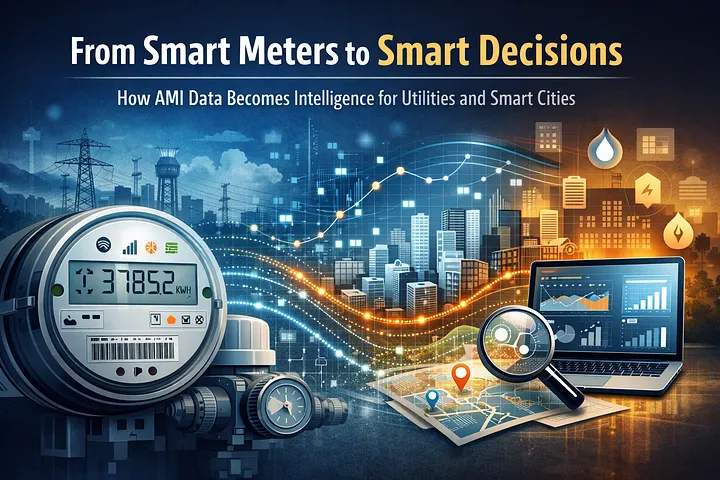
Advanced Metering Infrastructure (AMI) has enabled utilities to collect large volumes of consumption data at increasing frequency and granularity.
However, data alone does not create value.
The real opportunity for utilities and smart cities is to transform raw meter readings into information, insights and ultimately decisions that improve operational and strategic outcomes.
This transformation involves more than collecting data from smart meters. Data must be reliably transmitted, validated and structured before analytics can identify patterns, anomalies and operational opportunities.
The final step is turning those insights into action—such as maintenance scheduling, field service dispatch, customer notification, leak detection or resource optimization.
This article examines the journey from smart meter data collection to operational intelligence and highlights the key capabilities required to realize the full value of AMI.
Key Takeaways
- AMI data creates value only when it is transformed into information, insights and operational action.
- Reliable data collection, network performance and data completeness form the foundation for everything downstream.
- MDMS platforms play an important role in validating, estimating, editing, normalizing and structuring raw meter data.
- Analytics can support leak detection, abnormal consumption analysis, demand management, revenue protection and customer engagement.
- The greatest value is realized when analytics are integrated into operational workflows rather than remaining isolated in dashboards.
What This Article Covers
This article follows the transformation of AMI data from the moment it is generated by smart meters through to its use in operational and strategic decision-making.
The discussion covers four key stages: data collection, data management, analytics and interpretation, and operational decision-making.
It also examines practical AMI applications including leak and anomaly detection, demand management, revenue protection and customer engagement.
Finally, the article highlights the challenges utilities face when attempting to turn large volumes of meter data into meaningful intelligence, including data overload, siloed systems, limited analytics capability and integration complexity.
Practical Insights for Utilities
The first lesson is that AMI data quality begins at the meter and communication layer. Missing, delayed or inconsistent readings can propagate through the entire data pipeline and reduce the reliability of downstream analytics.
At scale, this becomes particularly important. A utility may manage millions of connected devices and billions of data points, making data reliability, synchronization and network performance fundamental system requirements rather than secondary considerations.
The second lesson is that raw meter data should not be confused with usable information. Data needs to be validated, cleaned, normalized and structured before it can reliably support analytics. This is one of the key roles of the Meter Data Management System (MDMS).
The third lesson is that analytics should be linked to specific operational outcomes. Detecting an abnormal consumption pattern is useful only when the utility can determine what action should follow—such as investigating a potential leak, scheduling field work or contacting a customer.
This creates an important distinction between a reporting system and an operational intelligence system. A dashboard can display information, but an effective AMI platform should help people make better and faster decisions.
Integration is therefore critical. Analytics outputs need to connect with operational systems and workflows, including maintenance scheduling, field service dispatch and customer communication.
The broader lesson is that utilities should design AMI around the complete data lifecycle rather than focusing only on meter connectivity. The objective is not simply to collect more data, but to convert reliable data into measurable operational value.
Read the Full Article on Medium
This page provides a concise overview of how AMI data moves from smart meters through data management and analytics to actionable utility intelligence.
The complete article explores the four-stage journey from data collection to decision-making, along with practical AMI use cases and the challenges utilities face when converting large volumes of meter data into operational value.
Continue reading the full article on Medium for the complete discussion.
Related Smart Metering Topics
- What Is Smart Metering? A Practical Guide for Utilities and Smart Cities
- What Is AMI (Advanced Metering Infrastructure)? Architecture, Components, and How It Works
- Smart Metering System Architecture: End-to-End Design for Utilities
- How Utilities Actually Use Smart Meter Data (Beyond Billing)