Smart Metering Fundamentals
NB-IoT vs LoRaWAN vs LTE-M: Choosing the Right IoT Connectivity for Smart Utilities
Understanding the practical trade-offs between cellular and private LPWAN connectivity for reliable, scalable utility metering.
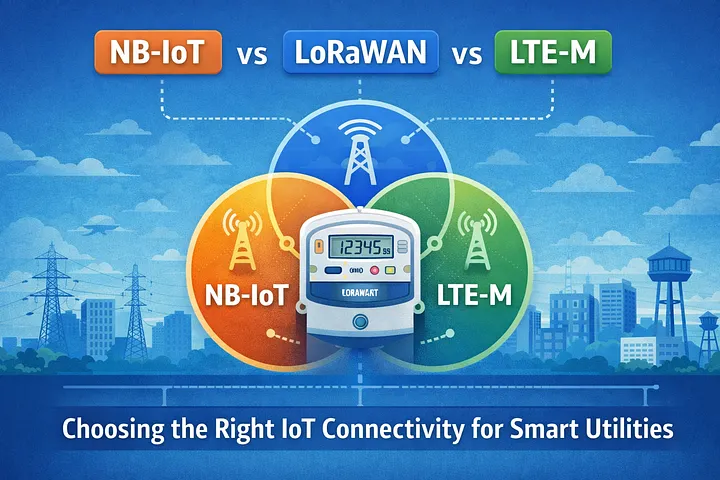
Choosing a communication technology is one of the most important architectural decisions in a smart metering deployment. The choice affects not only how meter data reaches the utility, but also battery life, network coverage, deployment cost, scalability and long-term operational requirements.
NB-IoT, LoRaWAN and LTE-M are all capable of supporting low-power IoT applications, but they are built around different network models and operating characteristics. NB-IoT and LTE-M use cellular infrastructure and licensed spectrum, while LoRaWAN typically relies on gateways and unlicensed spectrum.
For utility metering, the question is therefore not simply which technology is "best". The more useful question is which technology is best suited to the deployment environment, communication requirements, power budget, network strategy and operational model.
This article provides a practical comparison of NB-IoT, LoRaWAN and LTE-M, with particular attention to the factors that matter when moving from technology evaluation to real-world smart metering deployment.
Key Takeaways
- There is no single connectivity technology that is best for every smart metering deployment.
- NB-IoT, LTE-M and LoRaWAN differ fundamentally in network architecture, spectrum model, coverage strategy and device capabilities.
- Battery life depends on more than the nominal power consumption of the communication module; reporting frequency, network conditions and retransmissions also matter.
- Network ownership and deployment model are important considerations when comparing operator-managed cellular connectivity with privately deployed LPWAN networks.
- Utilities should evaluate connectivity against the complete lifecycle of the deployment rather than selecting a technology based only on laboratory specifications or initial hardware cost.
What This Article Covers
This article compares three important connectivity options for utility IoT and smart metering: NB-IoT, LoRaWAN and LTE-M.
The comparison looks at the characteristics that matter in real deployments, including coverage, power consumption, data requirements, scalability, network infrastructure, deployment complexity and operational considerations.
The objective is not to declare one technology the universal winner. Instead, the article provides a framework for understanding the trade-offs so that utilities can match connectivity technology to the requirements of a particular deployment.
Practical Insights for Utilities
Connectivity selection should begin with the operational requirements of the meter rather than with the technology itself.
For a battery-powered water meter, for example, the communication system is part of the overall energy budget. A technology that looks efficient under ideal conditions may behave differently when the device experiences weak coverage, repeated transmission attempts, network delays or more frequent reporting.
This is why connectivity decisions should be evaluated as part of the complete AMI architecture. Meter hardware, communication module, antenna, battery, network, Head-End System, data platform and operational processes all influence the eventual performance of the system.
For utilities, the best connectivity decision is therefore not necessarily the technology with the highest theoretical range or lowest module cost. It is the option that provides an appropriate balance of reliability, power consumption, coverage, scalability and long-term operational viability for the intended deployment.
Read the Full Article on Medium
This page provides a concise practical comparison of the three connectivity technologies. The complete article explores the technical differences and deployment trade-offs in greater detail.
Continue reading the full article on Medium for the complete discussion.
Related Smart Metering Topics
- What Is Smart Metering? A Practical Guide for Utilities and Smart Cities
- Smart Metering in Asia: Challenges, Deployment Lessons, and Real-World Constraints
- What Is AMI (Advanced Metering Infrastructure)? Architecture, Components, and How It Works
- What Is NB-IoT? A Practical Guide for IoT and Smart Metering Deployments