AMI Data Management
Meter Data Management Systems (MDMS) Explained: Turning Data into Information
How MDMS validates, organizes, stores and transforms smart meter data into reliable information for billing, analytics and utility operations.
Introduction
A smart meter can collect data. A Head-End System (HES) can communicate with the meter. But before that data becomes useful to a utility, it needs to be validated, organized, stored, processed and made available to the systems and people that need it.
This is where the Meter Data Management System (MDMS) plays a central role.
In a modern Advanced Metering Infrastructure (AMI) deployment, the MDMS sits between the communication layer and many of the utility's business and operational systems.
A simplified architecture is:
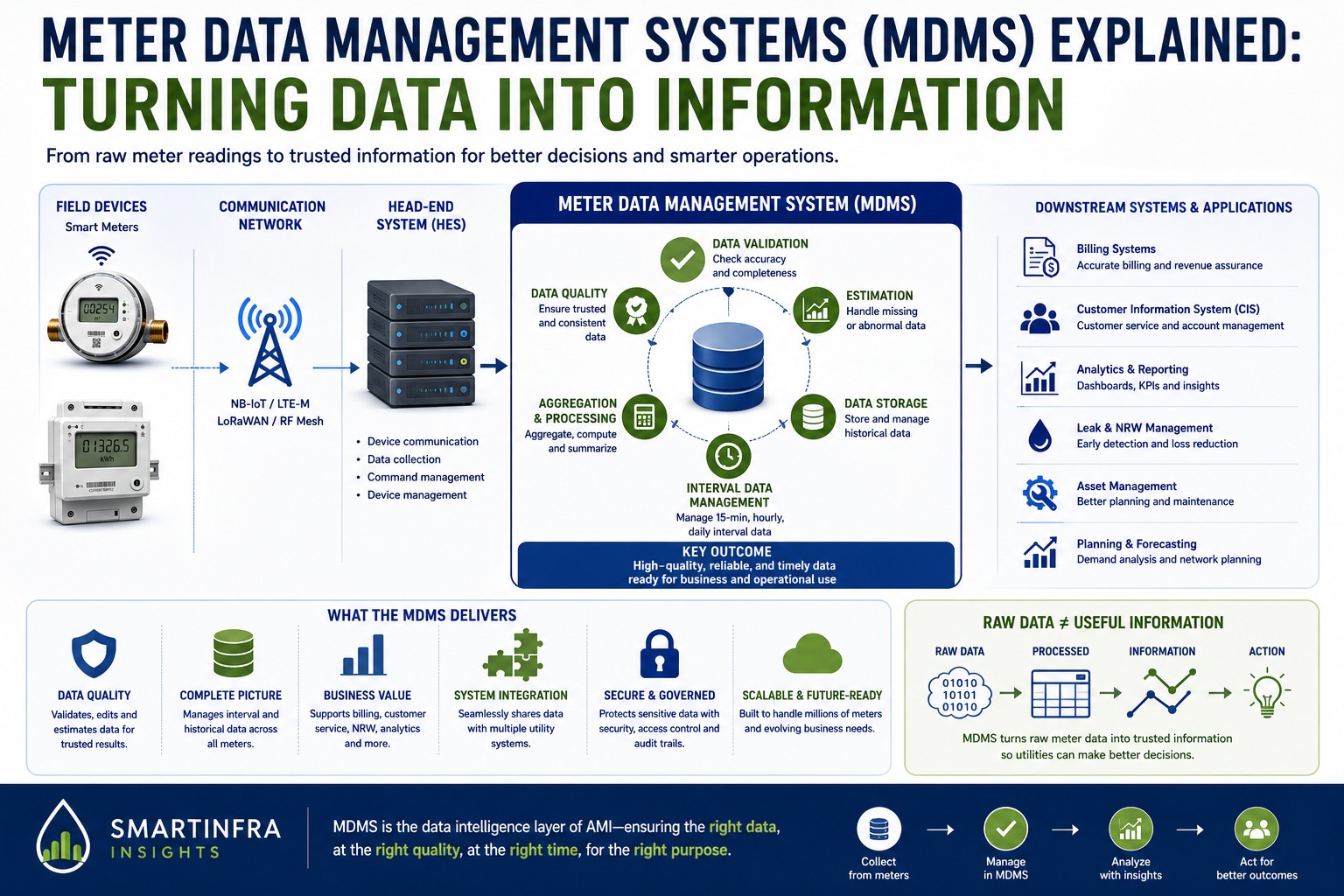
Smart Meter → Communication Network → HES → MDMS → Billing / Analytics / Customer / Operational Systems
The HES focuses primarily on communicating with field devices. The MDMS focuses on making the resulting meter data usable and trustworthy.
That distinction becomes increasingly important as AMI deployments grow from thousands of meters to hundreds of thousands or millions.
Key Takeaways
- MDMS is a data management and processing layer within AMI, not simply a database.
- Its core role is to turn raw meter readings into validated, structured and usable information.
- Data validation and estimation are different processes and should remain transparent.
- Historical meter data becomes increasingly valuable as utilities build longer consumption records.
- For water utilities, MDMS can support leak management, NRW analysis and network planning.
- Data quality is a system-level responsibility involving the meter, network, HES, MDMS and downstream analytics.
- Higher-frequency data is not automatically better because it increases communication, storage, processing and energy requirements.
- Scalability, integration, governance and lifecycle flexibility should be considered when selecting an MDMS.
What Is an MDMS?
A Meter Data Management System is a software platform designed to manage large volumes of meter data throughout its lifecycle.
Its responsibilities can include:
- Receiving meter data from the HES
- Validating incoming readings
- Detecting missing or abnormal data
- Estimating missing values where appropriate
- Storing historical meter data
- Managing interval data
- Supporting billing processes
- Providing data to analytics platforms
- Maintaining data quality and traceability
The MDMS therefore acts as a data management and processing layer within the AMI architecture.
It is not simply a database. Its value comes from turning large volumes of raw meter information into structured, validated data that the utility can use confidently.
Why Raw Meter Data Is Not Enough
Consider a utility with 500,000 smart water meters, with each meter reporting once per day.
That creates approximately 500,000 readings every day and more than 180 million readings over a year.
Now consider that some meters may:
- Miss a transmission
- Report duplicate data
- Have incorrect timestamps
- Experience communication interruptions
- Be replaced
- Change configuration
- Produce abnormal readings
Simply collecting the data is therefore not enough.
The utility needs to determine:
Can this reading be trusted?
This is one of the fundamental roles of an MDMS.
HES vs. MDMS
The distinction between HES and MDMS is one of the most important concepts in AMI architecture.
HES
The HES is primarily concerned with the question:
“Can I communicate with the meter?”
The HES manages functions such as:
- Device communication
- Data collection
- Commands
- Device status
- Communication retries
- Device management
MDMS
The MDMS focuses more on:
“What does the meter data mean, and can I trust it?”
It manages:
- Data validation
- Data processing
- Data storage
- Estimation
- Aggregation
- Data quality
- Data availability to downstream systems
The exact boundary can vary between architectures and products. Some platforms combine certain capabilities, while others keep them clearly separated.
The important point is to understand the functional responsibilities rather than relying only on product names.
The Journey From Reading to Information
Consider a smart water meter reporting a simple reading:
- Meter ID: 123456
- Timestamp: 02:00
- Consumption: 250 litres
The HES receives the data and passes it to the MDMS.
The MDMS may then determine:
- Is the meter valid?
- Is the timestamp correct?
- Is this reading duplicated?
- Does it follow the previous reading logically?
- Is the consumption value within a reasonable range?
- Is there a communication gap?
- Does the value need estimation or further investigation?
Only after these processes does the reading become useful for downstream applications.
The transformation can therefore be summarized as:
Raw Data → Validated Data → Information → Decision
Data Validation
Data validation is one of the most important MDMS functions.
Meter data can contain anomalies for many reasons, including:
- Communication failures
- Meter resets
- Incorrect configurations
- Clock synchronization problems
- Firmware issues
- Sensor abnormalities
- Network interruptions
An MDMS can apply predefined validation rules to identify suspicious readings.
For example, if a meter normally records between 500 and 2,000 litres per day but suddenly reports an extremely unusual value, the system may flag it for further analysis.
However, validation should not automatically mean rejection.
An unusual reading may be completely legitimate. A customer could genuinely have experienced unusually high consumption.
Good data management therefore needs to distinguish between:
Invalid data
and
Unusual but potentially valid data.
Estimation of Missing Data
Communication failures are inevitable in large AMI networks. A meter may fail to report for several hours or days.
Depending on the application, the MDMS may estimate missing values using defined rules.
Possible approaches can include:
- Historical consumption
- Previous and subsequent readings
- Similar periods
- Seasonal patterns
- Customer consumption profiles
The appropriate method depends on the purpose of the data. Billing, regulatory reporting, operational analytics and leak detection may have different requirements.
Most importantly, estimated values should remain distinguishable from actual meter readings.
Data quality requires transparency, not simply completeness.
Data Storage and Historical Records
AMI creates a long-term data asset.
Utilities may want to analyze consumption patterns over:
- Days
- Months
- Years
- Multiple billing cycles
For water utilities, historical data can support analysis such as:
- Seasonal consumption
- Customer usage patterns
- Minimum night flow
- Abnormal consumption
- Long-term demand trends
- District-level consumption
The value of AMI data can increase over time because the utility builds a richer historical picture of its network and customers.
Meter and Customer Relationships
Meter data does not exist in isolation.
The utility may need to associate a meter with:
- Customer
- Premise
- Account
- Service point
- Meter type
- Installation location
- District or zone
These relationships can change over time.
A meter may be replaced, a customer may move, a property may change ownership, or a meter may be reassigned to another service point.
The MDMS therefore needs to maintain data relationships and historical context.
Interval Data
Traditional meter reading may involve a single cumulative value. AMI can provide more detailed interval consumption.
Depending on the deployment, this might include:
- 15-minute data
- 30-minute data
- Hourly data
- Daily data
The appropriate interval depends on the utility's requirements.
More data is not automatically better.
Higher-frequency reporting increases:
- Communication traffic
- Storage requirements
- Processing requirements
- Device energy consumption
For battery-powered smart water meters, utilities should carefully consider whether the operational value of higher-frequency data justifies the additional energy and system requirements.
Turning Data Into Operational Insight
One of the most valuable roles of an MDMS is making validated meter data accessible to other applications.
Customer Service
Customer service teams can investigate consumption questions using actual historical data rather than relying solely on manual readings.
Billing
Validated consumption data can be provided to billing systems according to defined business rules.
Leak Management
Continuous or abnormal consumption patterns can be analyzed to identify potential leaks.
Non-Revenue Water Analysis
Aggregated consumption data can support comparisons between system input and customer consumption.
Network Planning
Historical consumption patterns can help utilities understand demand across different areas.
Analytics
Data scientists and analysts can use structured meter data for more advanced models.
The MDMS therefore becomes an important foundation for utility digital transformation.
MDMS and Non-Revenue Water
For smart water utilities, the MDMS can play an important role in understanding non-revenue water (NRW).
Consider a simplified water balance:
Water entering a defined district → Aggregated customer consumption → Comparison
The difference does not automatically represent leakage.
It may include:
- Meter inaccuracies
- Data gaps
- Unauthorized consumption
- Unbilled authorized consumption
- Timing differences
- Physical losses
This is where data quality becomes critical.
Poor-quality meter data can lead to poor NRW analysis. An MDMS helps establish a more reliable data foundation before advanced analytics are applied.
Data Quality Is a System-Level Issue
It is tempting to think that data quality is purely an MDMS responsibility. It is not.
Poor data can originate anywhere in the AMI system:
Meter
Incorrect measurement or configuration
↓
Communication
Data loss or transmission problems
↓
HES
Collection or device-management issues
↓
MDMS
Validation, processing and estimation
↓
Analytics
Incorrect conclusions if the underlying data is unreliable
Data quality must therefore be treated as a system-level responsibility.
An excellent MDMS cannot fully compensate for poor field data.
Scalability Matters
Like an HES, an MDMS needs to be designed for the expected scale of the deployment.
A system handling 10,000 meters is fundamentally different from one handling several million.
Utilities should consider:
- Number of meters
- Reading frequency
- Data retention period
- Peak ingestion rates
- Concurrent users
- Number of downstream systems
- Analytics requirements
- Future expansion
The important question is not simply:
“How many meters can the system support?”
It is:
“How much useful data can the complete architecture reliably process and make available?”
Integration With Other Utility Systems
The MDMS rarely operates independently.
It may need to exchange data with:
- Billing systems
- Customer Information Systems
- Enterprise Asset Management
- GIS
- CRM platforms
- Analytics platforms
- Leak management systems
- NRW platforms
- Data lakes
- Business intelligence tools
Integration architecture therefore matters enormously.
A technically capable MDMS can still create operational problems if information cannot move reliably between systems.
APIs and Data Access
Modern utilities increasingly expect data to be accessible through well-defined interfaces.
An MDMS may expose information through:
- APIs
- Web services
- Data exports
- Message queues
- Database interfaces
- Analytics platforms
The objective should not simply be to expose everything.
Utilities need appropriate controls around:
- Authentication
- Authorization
- Data privacy
- Performance
- Auditability
- Availability
Good data architecture balances accessibility with governance.
Cybersecurity and Data Governance
Meter data can contain sensitive information about customer behavior.
Consumption patterns may reveal occupancy patterns, daily routines, changes in usage and other aspects of customer behavior.
Utilities therefore need to consider cybersecurity and data governance throughout the MDMS lifecycle.
Important considerations include:
- Access control
- Encryption
- Authentication
- Audit trails
- Data retention
- Backup and recovery
- Role-based access
- Secure interfaces
The question is not only:
“Can we access the data?”
It is also:
“Who should be allowed to access it, and for what purpose?”
Common MDMS Mistakes
1. Treating the MDMS as Just a Database
An MDMS needs to manage data quality, relationships, processing and availability — not simply store readings.
2. Designing Only for the Initial Deployment
A system designed for today's meter population may become a constraint as the AMI network grows.
3. Ignoring Integration
An MDMS that cannot exchange information efficiently with billing, analytics and operational systems becomes another silo.
4. Assuming More Data Is Always Better
Higher-frequency data increases costs and complexity. Utilities should collect data that supports actual operational requirements.
5. Applying Analytics Before Fixing Data Quality
Advanced analytics cannot reliably compensate for poor underlying data.
Better analytics begin with better data.
What Utilities Should Evaluate When Selecting an MDMS
Data Quality
Can the system validate, estimate and manage anomalous data transparently?
Scalability
Can it handle the expected meter population, data volumes and future growth?
Integration
Can it exchange data reliably with existing and future utility systems?
Data Governance
Can the utility control access, retention, auditability and security?
Operational Use
Can business and operations teams obtain the information they actually need?
Analytics Readiness
Can validated data be made available to analytics and AI platforms without creating unnecessary duplication?
Lifecycle Flexibility
Can the architecture accommodate new meter types, communication technologies and changing business requirements?
The MDMS Is Becoming More Than a Meter Data Repository
Historically, meter data management was closely associated with billing.
Modern AMI changes that role.
Smart meter data can now support:
- Customer engagement
- Leak detection
- NRW management
- Network planning
- Operational intelligence
- Asset management
- Predictive analytics
- Demand forecasting
This means the MDMS is increasingly becoming a data foundation for utility transformation.
The challenge is ensuring that the data remains trustworthy, accessible, secure and relevant.
Conclusion
The MDMS is one of the most important components of a modern AMI architecture.
The HES connects to the field. The MDMS turns the resulting data into something the utility can trust and use.
Its role extends from validation and estimation to storage, integration, data quality and support for business and operational applications.
For smart water utilities, this is particularly important. A meter can provide accurate consumption information, but the real value emerges when that information is transformed into reliable operational knowledge — helping utilities understand consumption, identify potential losses, improve customer service and make better decisions.
The fundamental principle is simple:
Collecting data is not the same as creating value.
The real value of AMI begins when the utility can turn reliable meter data into reliable information — and then turn that information into action.
Read the Full Article on Medium
This article was originally published on Medium, where the full discussion explores how MDMS validates, manages and transforms smart meter data into reliable information for billing, analytics and utility operations.
Related Smart Metering Topics
- Head-End Systems (HES) Explained: The Communication Hub of AMI
- What Is AMI (Advanced Metering Infrastructure)? Architecture, Components, and How It Works
- Smart Metering System Architecture: End-to-End Design for Utilities
- From Smart Meters to Smart Decisions: How AMI Data Becomes Intelligence for Utilities and Smart Cities
- How Utilities Actually Use Smart Meter Data (Beyond Billing)
- From Data to ROI: Measuring the Business Value of AMI
- Cybersecurity in Smart Metering: Real Risks, System Weaknesses, and Practical Defenses
- Firmware Management in AMI: The Hidden Operational Challenge