Smart Metering Fundamentals
What Is AMI (Advanced Metering Infrastructure)? Architecture, Components, and How It Works
A practical guide to how smart meters, communication networks, HES, MDMS and utility systems work together in an AMI deployment.
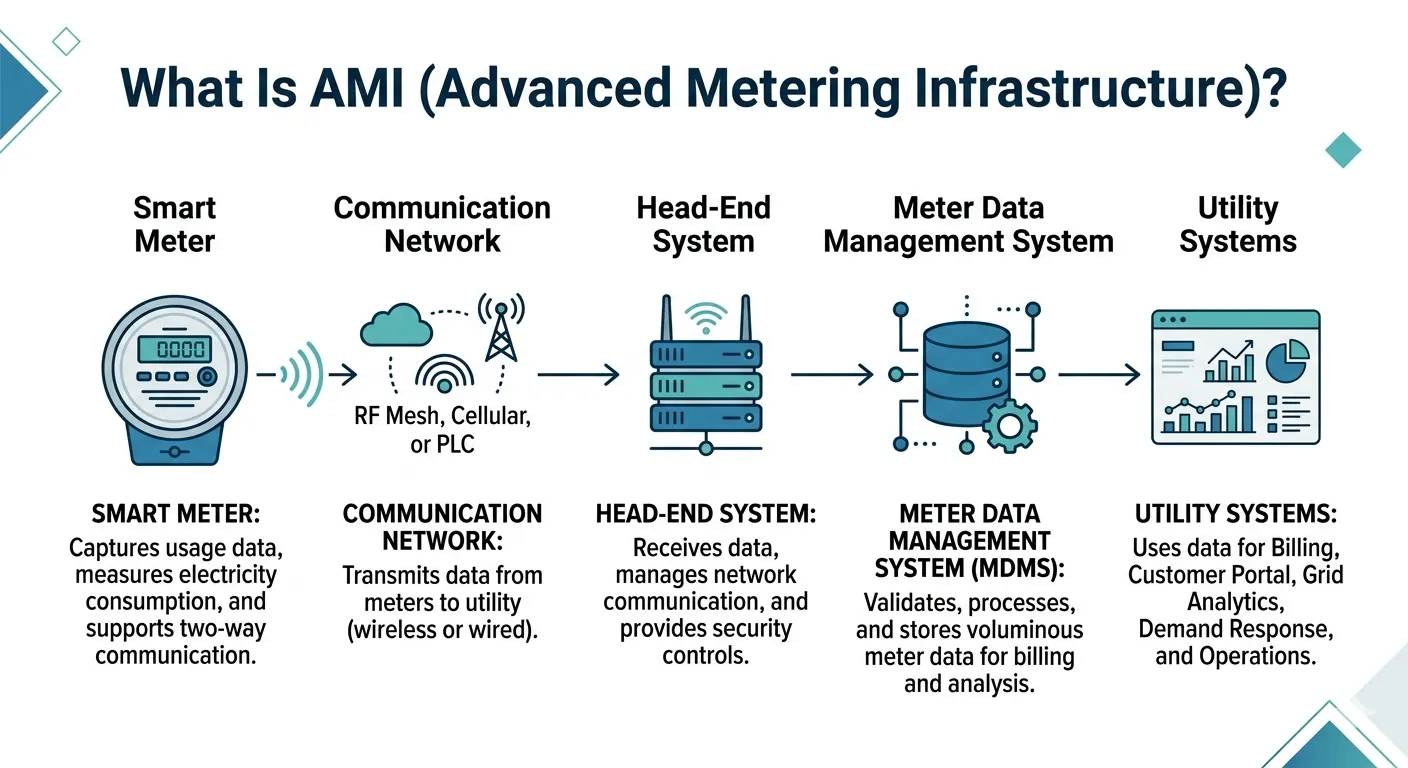
Advanced Metering Infrastructure (AMI) is the end-to-end system that connects smart meters with utility back-end platforms, enabling automated data collection, communication and operational visibility.
Unlike traditional metering, where meter readings may depend on manual collection and provide only limited visibility, AMI creates a connected digital infrastructure for collecting and managing meter data.
A typical AMI deployment combines smart meters, communication networks, a Head-End System (HES), a Meter Data Management System (MDMS) and enterprise utility systems.
These components work together to move information from the field into utility systems and support applications such as billing, analytics, monitoring and operational decision-making.
Understanding this end-to-end architecture is essential because AMI is not simply a smart meter installation. It is an integrated infrastructure in which field devices, communications, software and data systems must operate together.
Key Takeaways
- AMI is an end-to-end infrastructure that connects smart meters with utility back-end systems.
- A typical AMI architecture includes smart meters, communication networks, HES, MDMS and enterprise systems.
- AMI enables automated meter reading, remote monitoring and control, and interval-based data collection.
- The communication technology affects coverage, reliability and battery performance.
- HES manages communication with field devices, while MDMS validates, stores and prepares meter data for downstream applications.
- AMI can support billing, leak and anomaly detection, demand analysis, infrastructure monitoring and customer usage insights.
- Successful AMI deployments must address connectivity, battery life, system integration and data utilization—not just meter installation.
What This Article Covers
This article provides a practical introduction to Advanced Metering Infrastructure and explains how the major components of an AMI system work together.
It covers the difference between AMI and traditional metering, the architecture of an AMI system, the role of smart meters and communication networks, and the functions of HES, MDMS and enterprise systems.
The article also explains the end-to-end flow of meter data, common AMI benefits and use cases, and the practical challenges utilities encounter during real-world deployment.
Finally, it looks at AMI as a foundation for broader digital transformation and operational intelligence within modern utilities.
AMI System Architecture
AMI is typically implemented as a multi-layer architecture in which each component performs a specific role in the end-to-end data flow.
1. Smart Meters
Smart meters measure consumption, record interval data and transmit information to utility systems. Depending on the meter and application, they may also support event detection and remote configuration.
2. Communication Networks
Communication networks provide the connection between field meters and backend systems. Technologies can include cellular networks such as NB-IoT and LTE-M, RF mesh and LoRaWAN.
The choice of communication technology affects coverage, reliability and battery life.
3. Head-End System (HES)
The HES manages communication with field devices and handles functions such as data acquisition, device control and communication management.
4. Meter Data Management System (MDMS)
The MDMS processes and structures meter data for operational use. Typical functions include data validation, estimation and editing, data storage, and integration with billing and analytics systems.
5. Enterprise Systems
AMI integrates with wider utility platforms such as billing systems, customer information systems and asset management platforms, enabling meter data to become part of broader operational workflows.
How AMI Works End-to-End
AMI operates as a continuous data pipeline from the field to utility applications.
- Smart meters capture consumption and event data.
- The data is transmitted through the selected communication network.
- The Head-End System receives and manages communication with the meters.
- The MDMS validates, processes and structures the data.
- The resulting information is made available to billing, analytics and operational systems.
This transforms metering from periodic data collection into a connected infrastructure capable of providing continuous operational visibility.
Key Benefits and Use Cases
AMI provides utilities with capabilities that are difficult to achieve through traditional manual metering.
- Improved billing accuracy — automated consumption data reduces reliance on estimated readings.
- Operational efficiency — remote data collection reduces the need for manual meter reading.
- Faster issue detection — leaks, outages and abnormal consumption patterns can be identified earlier.
- Enhanced data visibility — utilities gain more detailed information about consumption behaviour.
Common applications include automated billing, leak and anomaly detection, demand analysis, infrastructure monitoring and customer usage insights.
Practical Challenges in AMI Deployments
The benefits of AMI depend on how well the complete system performs under real deployment conditions.
Connectivity Constraints
Network performance can vary significantly between high-rise buildings, underground meter installations and rural areas. Coverage on paper does not always translate into consistent field performance.
Battery Life Management
For battery-powered meters, energy consumption is influenced by factors such as signal strength, transmission frequency and network conditions.
System Integration
AMI often needs to integrate with existing utility platforms, including legacy systems that may not have been designed to handle high-frequency meter data.
Data Utilization
Collecting large quantities of meter data does not automatically create value. Utilities also need the analytics, processes and operational workflows required to turn that data into useful information.
AMI as a Foundation for Smart Utilities
AMI should be viewed as more than a metering upgrade. It provides a foundational digital infrastructure layer connecting field devices, communications and utility information systems.
Once reliable meter data becomes available, utilities can use it to support data-driven decision-making, predictive operations and integration with wider smart-city systems.
The long-term value of AMI therefore extends beyond automated meter reading. It can become an important enabler of digital transformation and operational intelligence.
Read the Full Article on Medium
This page provides a practical introduction to Advanced Metering Infrastructure and its role in modern utility operations.
The complete article explores AMI architecture, end-to-end data flow, key benefits, common use cases and the practical challenges utilities need to consider when deploying AMI at scale.
Continue reading the full article on Medium for the complete discussion.
Related Smart Metering Topics
- What Is Smart Metering? A Practical Guide for Utilities and Smart Cities
- NB-IoT vs LoRaWAN vs LTE-M: Choosing the Right IoT Connectivity for Smart Utilities
- Smart Metering in Asia: Challenges, Deployment Lessons, and Real-World Constraints
- From Smart Meters to Smart Decisions: How AMI Data Becomes Intelligence for Utilities and Smart Cities
- Why Smart Metering Pilots Fail at Scale — And How Utilities Can Avoid It
- Smart Metering System Architecture: End-to-End Design for Utilities
- AMR vs AMI: Key Differences, Benefits, and When to Use Each
- What Is NB-IoT? A Practical Guide for IoT and Smart Metering Deployments
- LoRaWAN Explained: Architecture, Use Cases, and Limitations in Real Deployments
- Head-End Systems (HES) Explained: The Communication Hub of AMI
- Meter Data Management Systems (MDMS) Explained: Turning Data into Information