Smart Metering Fundamentals
What Is Smart Metering? A Practical Guide for Utilities and Smart Cities
Understanding how smart meters, communications, data platforms and AMI work together to create a more connected utility.
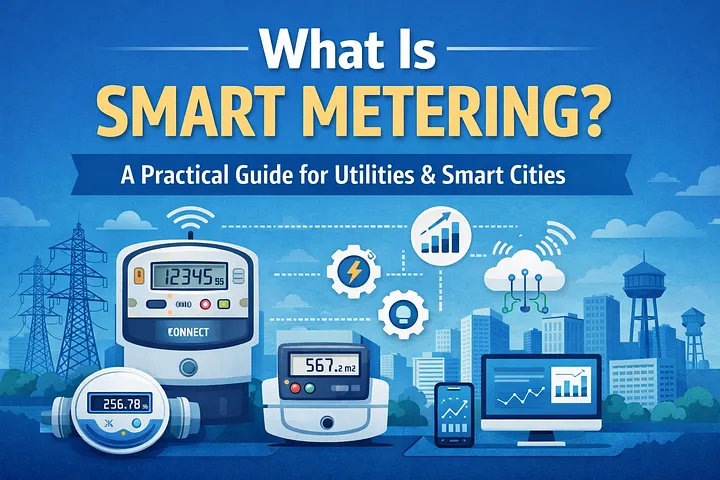
Smart metering is more than replacing a traditional meter with a digital one. It represents a shift in how utilities measure consumption, collect data, monitor networks and interact with customers.
At its simplest, a smart metering system combines a smart meter with communications, a Head-End System (HES), data management platforms and operational applications. Together, these components enable utilities to move from periodic manual meter reading toward automated, more frequent and actionable data collection.
For utilities, the value is not simply the ability to obtain meter readings remotely. A well-designed smart metering system can support better operational visibility, faster detection of abnormal consumption, improved billing processes, network monitoring and new digital services.
This practical guide introduces the fundamentals of smart metering and Advanced Metering Infrastructure (AMI), explains the major components of a typical system, and highlights the engineering and deployment considerations that utilities should understand before starting a smart metering programme.
Key Takeaways
- Smart metering is a complete system, not simply a digital replacement for a traditional meter.
- AMI connects meters, communication networks, Head-End Systems and data platforms into an integrated utility infrastructure.
- Communication technology, power consumption, network coverage and field conditions can significantly affect system performance.
- The value of smart metering comes from turning meter data into useful operational and customer insights.
- Successful deployments require consideration of the entire system lifecycle, from meter design and connectivity to data management, maintenance and long-term operations.
What This Article Covers
This article provides a practical introduction to the architecture and purpose of smart metering systems. It looks beyond the smart meter itself to explain how the meter, communications network, Head-End System (HES), Meter Data Management System (MDMS) and utility applications work together.
The discussion also introduces Advanced Metering Infrastructure (AMI) and explains why communication technology, system interoperability, data management and field deployment conditions are important considerations for utilities.
Rather than treating smart metering as a single technology, the article approaches it as an integrated infrastructure system that must remain reliable, scalable and maintainable over a long operational lifecycle.
Practical Insights for Utilities
One of the most important lessons in smart metering is that the meter is only one part of the overall system. A meter can perform well in laboratory conditions, but the success of a utility deployment depends on the interaction between hardware, communications, software, field conditions and operational processes.
For example, communication technology should not be selected based solely on theoretical coverage or bandwidth. Battery life, network availability, installation environment, reporting frequency, retry behaviour and long-term network evolution can all influence the real-world performance of a smart metering system.
The same principle applies to the data platform. Collecting millions of meter readings is not the end goal. Utilities need reliable data pipelines, appropriate validation and processing, integration with existing systems and operational processes that can turn the information into useful decisions.
This system-level perspective becomes increasingly important as utilities move from small pilots to large-scale deployments. What works for a few hundred meters may not necessarily remain practical when the deployment reaches tens or hundreds of thousands of endpoints.
Read the Full Article on Medium
This page provides a concise practical overview. The complete article explores the fundamentals of smart metering in greater detail, including the role of AMI, communications, data systems and utility operations.
Continue reading the full article on Medium for the complete discussion.
Related Smart Metering Topics
- NB-IoT vs LoRaWAN vs LTE-M: Choosing the Right IoT Connectivity for Smart Utilities
- Smart Metering in Asia: Challenges, Deployment Lessons, and Real-World Constraints
- From Smart Meters to Smart Decisions: How AMI Data Becomes Intelligence for Utilities and Smart Cities
- What Is AMI (Advanced Metering Infrastructure)? Architecture, Components, and How It Works