Smart Meter Data & Analytics
How Utilities Actually Use Smart Meter Data (Beyond Billing)
How utilities turn smart meter data into operational visibility, better decisions and practical value beyond traditional meter reading and billing.
Introduction
Smart meters generate much more information than a traditional meter reading. Depending on the deployment, utilities may receive consumption profiles, flow events, alarms, communication status, battery information and other operational indicators.
The important question is therefore not simply how much data a utility can collect, but how that information can support day-to-day operations and better decisions.
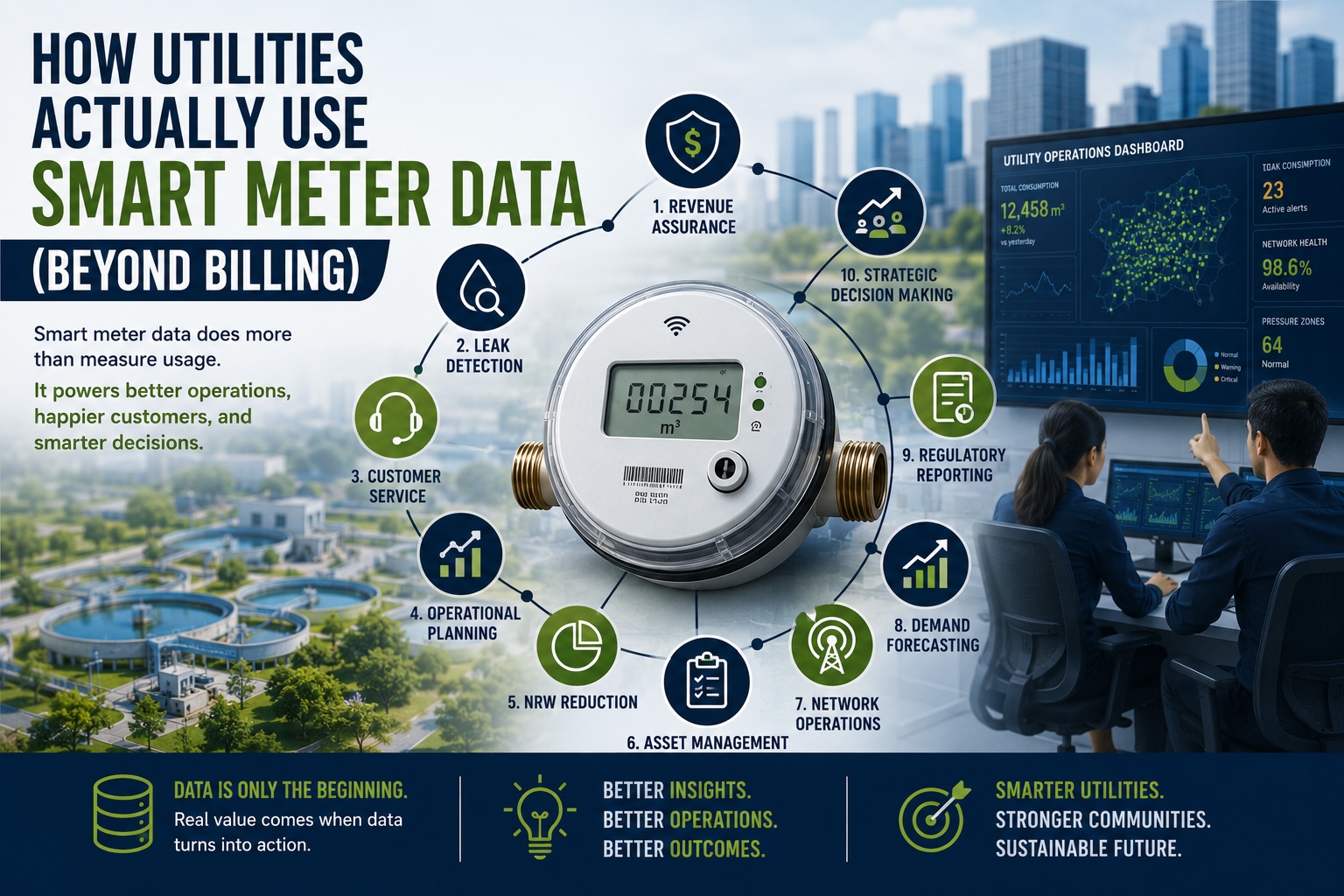
Billing remains an important application, but smart meter data can also support revenue assurance, leak detection, customer service, operational planning, non-revenue water reduction, asset management, network operations and strategic decision making.
Key Takeaways
- Smart meter data has applications well beyond billing.
- Continuous data provides utilities with greater operational visibility.
- Water utilities can use meter data to support leak detection and NRW reduction.
- Data can support customer service, maintenance, planning and network operations.
- The value of AMI depends on turning data into information, insight and action.
- Utilities do not necessarily need more data; they need better ways to prioritize and use the data they already have.
Beyond Traditional Meter Reading
Traditional meter reading primarily answers one question: how much was consumed?
Smart metering expands this view. Utilities can begin to understand when consumption occurs, where abnormal patterns appear, whether assets are behaving normally, how communication infrastructure is performing and which customers or locations may require attention.
This changes the role of metering from a periodic billing function into an operational information source.
How Utilities Use Smart Meter Data
1. Revenue Assurance
Smart meter data can help utilities identify unusual consumption behavior, possible tampering, reverse flow events, meter stoppage and unexpectedly low consumption.
Earlier visibility allows abnormal situations to be investigated before they remain unresolved through multiple billing cycles.
2. Leak Detection
For water utilities, leak detection is one of the important operational applications of continuous consumption data.
Patterns such as continuous overnight flow, unexpected high consumption, abnormal usage profiles and district-level anomalies can provide useful signals for investigation.
Smart meter data does not replace field investigation, but it can help utilities identify where investigation should begin.
3. Customer Service
Meter data provides customer service teams with greater visibility when customers question their bills or consumption.
Historical consumption, usage profiles, unusual events and service interruptions can help utilities investigate issues using available data rather than relying immediately on field visits.
Customers can also gain greater transparency into their own consumption patterns.
4. Operational Planning
Smart meter data can support operational planning by revealing peak demand periods, seasonal changes, high-growth areas and changing customer behavior.
These insights can help utilities prioritize maintenance activities and make planning decisions using observed consumption patterns rather than assumptions alone.
5. Non-Revenue Water Reduction
Smart meter data can contribute to NRW reduction when combined with broader water network information.
When used alongside District Metered Areas (DMAs), consumption information can help utilities compare production and consumption, identify abnormal districts, prioritize investigations and evaluate improvement programmes.
Smart meters alone do not eliminate NRW. Their value is in providing better information to support a systematic loss-reduction process.
6. Asset Management
Smart meter data can also support condition-based asset management.
Utilities may identify ageing meters, declining meter performance, communication failures or abnormal battery behavior.
This creates an opportunity to move beyond replacement decisions based purely on asset age and toward maintenance and investment decisions informed by actual operating conditions.
7. Network Operations
AMI provides visibility into the performance of the communications infrastructure supporting the metering system.
Examples include communication availability, gateway performance, network congestion, device connectivity and alarm frequency.
This information can help operations teams identify communication problems earlier and address them before they affect a larger population of devices.
8. Demand Forecasting
Historical smart meter data can support more detailed demand analysis.
Utilities can examine daily consumption patterns, seasonal variation, weather influence and customer growth.
Better forecasting can then support infrastructure planning and capital investment decisions.
9. Regulatory Reporting
Trusted meter data can also support reporting related to water conservation, service reliability, customer service, network performance and operational efficiency.
Having reliable data available from the operational system can improve the consistency and quality of reporting.
10. Strategic Decision Making
At the management level, smart meter data can contribute to decisions about investment priorities, resource allocation, infrastructure planning and digital transformation.
The objective is not to make every decision data driven simply because data exists. It is to use reliable information where it can improve the quality and confidence of important decisions.
From Data to Action
Collecting data does not automatically create value.
The practical progression is:
Data → Information → Insight → Action → Business Value
A utility may have millions of readings available, but the operational benefit remains limited if those readings are not converted into information that teams can understand and act upon.
This is why the success of an AMI programme cannot be measured only by the number of meters connected or the volume of data collected.
Common Challenges
Utilities can collect extensive amounts of data and still struggle to extract meaningful value from it.
- Data overload
- Disconnected software systems
- Limited analytics capability
- Poor data quality
- Unclear operational ownership
These challenges demonstrate that smart metering is not purely a technology problem. Processes, people and organizational readiness are also important parts of the value chain.
What Field Experience Shows
Across AMI deployments, a recurring observation is that utilities rarely need more data simply for the sake of collecting it.
The more practical challenge is deciding which information matters, how it should be interpreted and which teams should act on it.
Organizations that focus initially on a small number of meaningful operational outcomes can establish a clearer path from data to action. As analytics capabilities mature, additional applications can then be introduced progressively.
From Smart Data to Intelligent Utilities
As analytics and artificial intelligence capabilities mature, smart meter data can support increasingly advanced applications.
- Predictive maintenance
- AI-assisted leak detection
- Demand prediction
- Automated operational optimization
- Digital twins
The underlying principle remains the same: the value of AMI depends less on the quantity of data collected than on how effectively the utility transforms information into operational intelligence.
Conclusion
Smart meters may have started as a way to automate meter reading, but their role can extend much further once the data becomes part of utility operations.
For water utilities, this can include leak detection, NRW analysis, customer service, asset management, network operations and planning, alongside the traditional billing function.
The central lesson is straightforward: successful AMI programmes are not defined only by how many meters are installed or how much data is collected. Their longer-term value depends on how effectively that data improves decisions and supports measurable operational outcomes.
Read the Full Article on Medium
This article was originally published on Medium, where the full discussion explores how utilities use smart meter data across operations, customer service, leak detection, NRW reduction, asset management and strategic decision making.
Related Smart Metering Topics
- From Data to ROI: Measuring the Business Value of AMI
- From Smart Meters to Smart Decisions: How AMI Data Becomes Intelligence for Utilities and Smart Cities
- What Is AMI (Advanced Metering Infrastructure)? Architecture, Components, and How It Works
- Smart Metering System Architecture: End-to-End Design for Utilities
- Why AMI Systems Fail: A System-Level Breakdown (Technology, Data, Organization)
- Smart Metering in Asia: Challenges, Deployment Lessons, and Real-World Constraints
- Smart Meter Battery Life Explained: Why “10 Years” Is Not Just a Specification
- Firmware Management in AMI: The Hidden Operational Challenge