Smart Metering Cybersecurity
Cybersecurity in Smart Metering: Real Risks, System Weaknesses, and Practical Defenses
A practical look at the real cybersecurity weaknesses that can emerge across smart meters, communication networks, HES, MDMS, integrations and operational users.
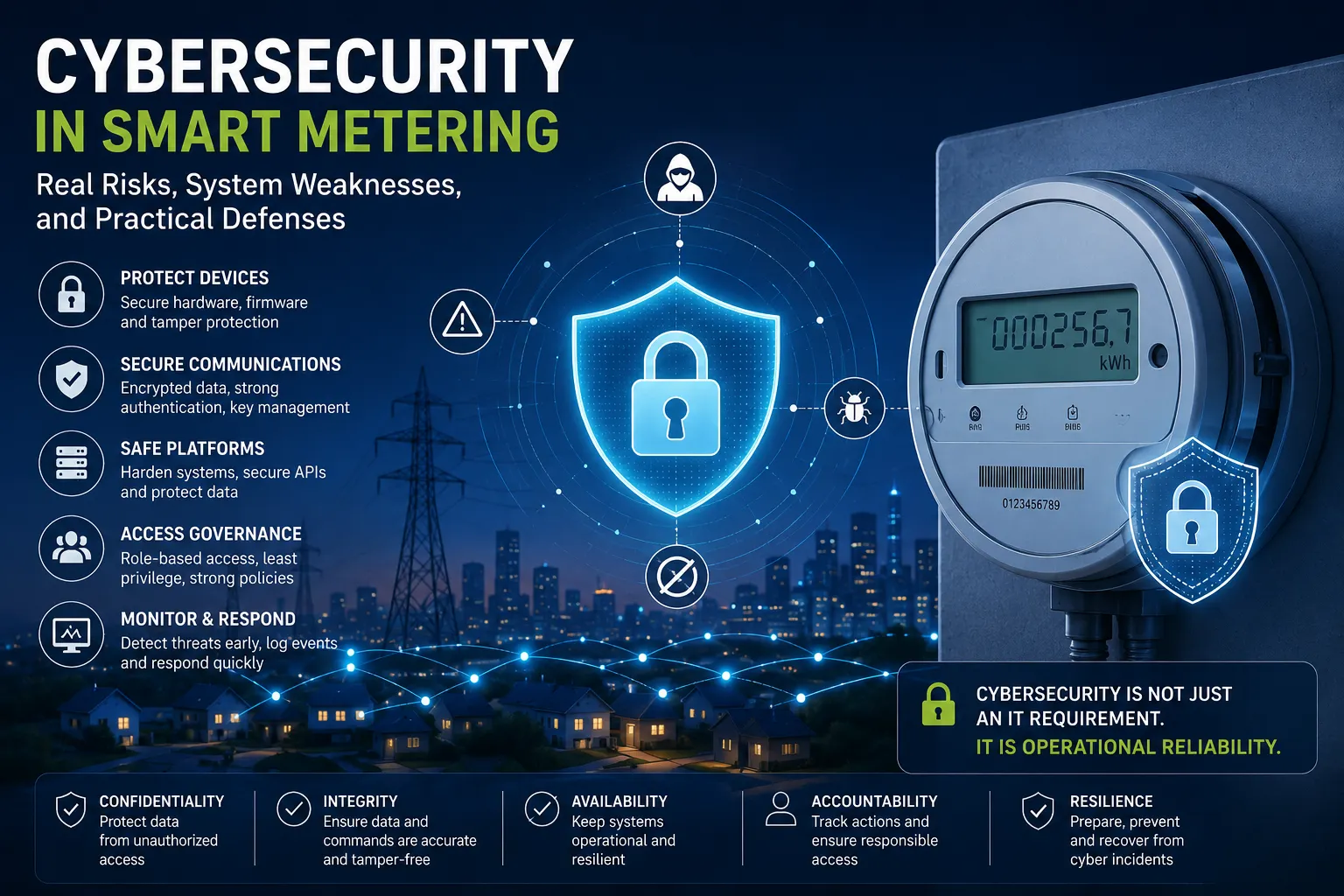
Smart metering systems are designed to improve visibility, efficiency and operational control.
They enable utilities to collect data remotely, automate processes, detect leaks or abnormal consumption, and support more informed decisions.
At the same time, they introduce something utilities did not previously have at scale: a significantly larger digital attack surface.
A traditional mechanical meter operates largely in isolation. A smart meter, by contrast, becomes part of a connected ecosystem involving communication networks, software systems, cloud platforms, analytics, firmware updates and operational users.
Cybersecurity in smart metering is therefore not simply about encrypting data or preventing hacking. It is about protecting a system that utilities may depend on for operational continuity over many years.
Key Takeaways
- Cybersecurity in smart metering extends across the entire AMI ecosystem, not just the meter.
- Weak credentials, excessive privileges and poor access governance can create significant exposure.
- Firmware integrity and secure update mechanisms are critical because firmware controls device behaviour.
- Network segmentation and secure integrations help contain the impact of a compromised system.
- Security assumptions can become outdated as software, cryptographic standards, vendors and attack methods evolve.
- Effective cybersecurity requires layered defenses, monitoring, governance and long-term lifecycle management.
Why Cybersecurity Matters in Smart Metering
Smart metering systems increasingly support important utility operations.
They influence:
- Billing and revenue accuracy
- Consumption visibility
- Leak detection and alarms
- Remote commands and control
- Customer engagement systems
- Operational analytics
A disruption to these systems can affect more than IT infrastructure. It may influence service reliability, operational efficiency and public trust.
Smart metering systems can also remain operational for long lifecycles. Security decisions made during procurement may therefore persist long after deployment.
Cybersecurity becomes a long-term engineering and operational consideration rather than a one-time technical exercise.
Understanding the Smart Metering Attack Surface
Cybersecurity risks in smart metering rarely originate from a single component.
Instead, vulnerabilities can emerge across the entire AMI ecosystem.
1. Smart Meters — Edge Devices
Smart meters are physical devices installed in homes, buildings, chambers and remote infrastructure.
Potential risks include:
- Physical tampering
- Exposed debug interfaces
- Weak authentication mechanisms
- Firmware vulnerabilities
2. Communication Networks
NB-IoT, LoRaWAN, LTE-M, RF mesh and other connectivity layers transport data between field devices and backend systems.
Potential risks may include:
- Interception attempts
- Insecure credential handling
- Spoofed devices
- Replay attacks
- Insecure network configuration
3. Head-End Systems
HES platforms communicate with devices and manage commands.
Potential risks include:
- Unauthorized access
- Weak authentication policies
- Insecure APIs
- Excessive privileges
4. MDMS, Analytics and Enterprise Systems
Data management platforms, dashboards, cloud systems and enterprise integrations introduce additional exposure.
Potential risks include:
- Exposed APIs
- Data leakage
- Poor access governance
- Insecure integrations
5. Operational Users and Third Parties
Employees, contractors, vendors and service providers may require access to different parts of the system.
In practice, human access can become one of the largest security risks when privileges and account lifecycles are not properly managed.
What Actually Goes Wrong in Real Deployments
Cybersecurity discussions often focus on sophisticated attack scenarios. In practice, many security issues are caused by relatively basic weaknesses.
1. Weak Credentials and Access Control
Default passwords, shared credentials and poorly managed user privileges remain recurring problems.
- Administrator access may be overly broad
- Vendor accounts may remain active indefinitely
- Credentials may be shared between teams
A sophisticated attack is not always necessary when access controls are weak.
2. Firmware Integrity Is Underestimated
Firmware is effectively the operating logic of a smart meter.
If compromised, it may affect:
- Measurement behaviour
- Communication logic
- Alarms and events
- Operational reliability
Important questions include:
- Can firmware updates be authenticated?
- Are updates cryptographically signed?
- Is rollback protection implemented?
- Who can authorize updates?
As systems scale, firmware governance becomes increasingly important.
3. Poor Network Segmentation
In mature environments, smart metering systems are typically isolated from broader IT environments.
When metering systems, enterprise applications, vendor access and operational networks become too closely interconnected, the potential for lateral movement increases if one system is compromised.
Cybersecurity is therefore strengthened not only through prevention, but also through containment.
4. APIs and Integrations Create Hidden Exposure
Modern smart metering systems rarely operate in isolation.
They may connect to:
- Billing systems
- Mobile applications
- Dashboards
- Customer portals
- Analytics platforms
Every integration introduces additional attack surface.
Exposed or poorly secured APIs can therefore create security weaknesses that were not initially anticipated during deployment.
5. Security Assumptions Age Over Time
One of the least discussed cybersecurity risks is time.
A system that appears secure at deployment may become vulnerable later because:
- Cryptographic standards evolve
- Software becomes outdated
- Vendors discontinue support
- Attack methods improve
Smart metering lifecycles are long. Cybersecurity therefore requires ongoing management rather than a “deploy once” mindset.
Security in Smart Metering Happens in Layers
No single control makes a smart metering system secure.
Cybersecurity is typically strengthened through multiple defensive layers.
Device Security
Focus areas include:
- Secure boot mechanisms
- Tamper detection
- Firmware signing
- Hardware security protections
The goal is to reduce device-level compromise.
Communication Security
Communication channels should prioritize:
- Encryption
- Authentication
- Secure credential handling
- Replay protection
Security must protect both confidentiality and trust.
Platform and Application Security
HES, MDMS and analytics environments should emphasize:
- Role-based access control
- Secure APIs
- Logging and auditability
- Vulnerability management
Cybersecurity becomes increasingly important as systems integrate with more applications and services.
Access Governance
Utilities benefit from clearly defining:
- Who can access what
- Approval workflows
- Vendor access boundaries
- Account lifecycle management
Cybersecurity failures can emerge from governance gaps as well as technical weaknesses.
Monitoring and Incident Response
No system is perfectly secure.
Utilities should therefore ask not only how an incident can be prevented, but also:
If something goes wrong, how quickly can it be detected and contained?
Monitoring, logging and response planning matter as much as prevention.
Cybersecurity Trade-Offs Utilities Often Miss
Security decisions frequently involve trade-offs.
More Communication Security May Increase Complexity
Stronger encryption and authentication mechanisms can influence computational requirements, power consumption and device complexity.
Operational Convenience May Reduce Security
Shared accounts or overly broad access can simplify operations while increasing exposure.
More Integrations Increase Functionality — and Exposure
Every connected system creates additional dependencies and potential attack surfaces.
Cybersecurity therefore becomes an optimization exercise rather than an isolated technical objective. The challenge is balancing operational practicality with acceptable risk.
Practical Cybersecurity Principles for Utilities
1. Treat Cybersecurity as a System Problem
Security is not only about meters. It includes networks, applications, firmware, integrations and people.
2. Assume Operational Change Will Happen
Reporting intervals, integrations, vendors and operational requirements evolve.
Security architecture should anticipate change.
3. Prioritize Governance, Not Only Technology
Strong processes can reduce risk alongside technical controls.
4. Design for Containment
Some failures may occur despite preventive controls. The objective should therefore also include limiting their potential impact.
5. Build for Lifecycle Management
Smart metering systems remain operational for years. Security planning should reflect long-term realities rather than only the initial deployment.
Common Mistakes in Smart Metering Cybersecurity
- Treating encryption as “complete security”
- Relying on default credentials
- Underestimating firmware governance
- Granting excessive access privileges
- Overlooking vendor and third-party access
- Ignoring long-term maintenance requirements
- Assuming pilot security automatically scales
Many cybersecurity weaknesses emerge gradually rather than dramatically.
Conclusion
Smart metering cybersecurity is not simply about preventing attacks.
It is about protecting operational continuity across systems expected to remain active for years.
The real challenge is rarely a single vulnerability. Cybersecurity outcomes usually reflect how well utilities manage the interaction between devices, communication networks, software systems, governance, vendors and operational processes.
Cybersecurity should therefore be treated as a long-term system discipline rather than a compliance checkbox.
In smart metering, cybersecurity is ultimately not just an IT issue. It is part of infrastructure reliability.
Read the Full Article on Medium
This article was originally published on Medium, where the full discussion explores the real cybersecurity risks, system weaknesses and practical defenses relevant to smart metering deployments.
Related Smart Metering Topics
- What Is AMI (Advanced Metering Infrastructure)? Architecture, Components, and How It Works
- Smart Metering System Architecture: End-to-End Design for Utilities
- NB-IoT vs LoRaWAN vs LTE-M: Choosing the Right IoT Connectivity for Smart Utilities
- What Is NB-IoT? A Practical Guide for IoT and Smart Metering Deployments
- NB-IoT vs LoRaWAN in Real Deployments: What Actually Happens in the Field
- Smart Metering in Asia: Challenges, Deployment Lessons, and Real-World Constraints
- Smart Meter Battery Life Explained: Why “10 Years” Is Not Just a Specification
- From Smart Meters to Smart Decisions: How AMI Data Becomes Intelligence for Utilities and Smart Cities