AMI Business Value
From Data to ROI: Measuring the Business Value of AMI
How utilities can move beyond collecting meter data and connect AMI information to operational decisions, measurable outcomes and long-term business value.
Introduction
Advanced Metering Infrastructure (AMI) is often justified through promises of operational efficiency, improved customer service, and better decision-making.
Utilities invest in smart meters, communication networks, software platforms, and analytics capabilities with the expectation that these technologies will deliver measurable business benefits.
However, after deployment, many organizations encounter a surprisingly difficult question:
How do we measure whether our AMI investment is actually creating value?
Collecting data is relatively easy.
Demonstrating business outcomes is much harder.
Many AMI programs successfully deploy technology but struggle to connect that technology to measurable operational improvements and financial returns.
The true value of AMI is not found in the meters themselves or the volume of data collected. It is found in how information is translated into decisions, actions, and business outcomes.
Key Takeaways
- AMI value does not come from data collection alone.
- Business value emerges when data is translated into decisions, actions and measurable outcomes.
- AMI benefits can span revenue assurance, operational efficiency, customer experience, asset management, network operations and sustainability.
- Tangible and intangible benefits should both be considered when evaluating AMI value.
- ROI measurement should begin with clearly defined business objectives.
- KPIs should focus on outcomes rather than simply technology performance.
- A baseline is necessary before improvements can be demonstrated.
- AMI value should be monitored continuously because benefits evolve over time.
- Organizational adoption is essential for converting technology investment into business value.
- The journey from data to ROI requires continuous improvement rather than a one-time calculation.
Why Measuring AMI Value Is More Difficult Than It Appears
Unlike traditional infrastructure investments, AMI rarely produces value from a single source.
The benefits are distributed across multiple departments and operational functions.
For example:
- meter reading costs may decrease
- billing accuracy may improve
- field visits may be reduced
- leak detection may improve
- customer complaints may decline
- outage response may become faster
Each benefit may be relatively small on its own.
Collectively, however, they can create substantial value.
The challenge is that these benefits often emerge gradually and across different parts of the organization.
As a result, utilities can underestimate the total impact of AMI.
In some cases, benefits exist but are never formally measured.
In other cases, expectations were poorly defined from the beginning, making success difficult to evaluate.
Understanding the AMI Value Chain
AMI does not create value simply because data is collected.
Value emerges through a sequence of connected activities:
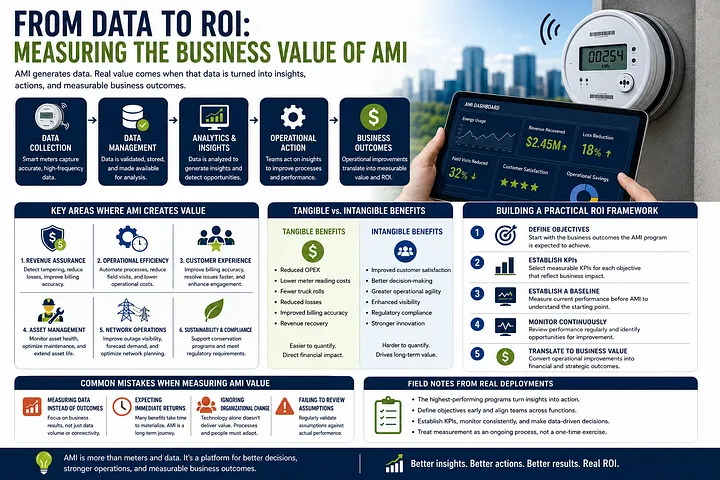
Data Collection → Data Management → Analytics → Operational Action → Business Outcome
Each step is important.
Smart meters collect data.
Systems validate and store the information.
Analytics identify patterns and opportunities.
Operations teams take action.
Those actions generate measurable business results.
If any step breaks down, the value chain weakens.
A utility may collect millions of data points daily, but if that information is never translated into operational decisions, little business value is created.
The objective is therefore not simply to collect data.
The objective is to improve outcomes.
Key Areas Where AMI Creates Business Value
1. Revenue Assurance
One of the common business drivers for AMI is improving revenue protection.
Smart metering can help utilities:
- detect meter tampering
- identify abnormal consumption
- improve billing accuracy
- reduce estimated bills
- improve collection confidence
Better visibility into consumption patterns can reduce revenue leakage and improve financial performance.
For many utilities, this becomes one of the more measurable AMI benefits.
2. Operational Efficiency
Manual processes are often expensive and difficult to scale.
AMI enables automation across many routine activities.
Examples include:
- automated meter reading
- remote service activation
- remote disconnect and reconnect
- automated exception reporting
- reduced field visits
The resulting savings can directly reduce operational expenditure.
These improvements are often among the easier benefits to quantify because they can be compared against historical labor and operational costs.
3. Customer Experience
Customers increasingly expect greater visibility and transparency regarding utility usage.
AMI can support:
- more accurate billing
- improved dispute resolution
- faster issue investigation
- consumption insights
- self-service applications
Customer satisfaction can be harder to quantify financially, but it can still contribute significantly to overall business value.
4. Asset Management
Utilities manage large numbers of physical assets across extensive service areas.
AMI data can provide insights into asset performance and operational conditions.
Examples include:
- identifying abnormal usage patterns
- monitoring equipment health
- detecting leaks
- supporting maintenance planning
- improving asset utilization
Better information can lead to more informed investment and maintenance decisions.
Over time, this can contribute to longer asset life and lower operational costs.
5. Network Operations
Smart meter data can support broader network management activities.
Benefits may include:
- improved outage visibility
- faster fault identification
- demand forecasting
- load analysis
- system planning
Operational improvements in these areas can produce substantial long-term value, particularly in large-scale deployments.
6. Sustainability and Regulatory Objectives
Utilities face increasing pressure to improve resource efficiency and environmental performance.
AMI can support:
- water conservation initiatives
- energy efficiency programs
- consumption awareness
- emissions reduction strategies
- regulatory reporting requirements
These benefits may not always generate immediate financial returns, but they can contribute to strategic objectives and long-term value creation.
Tangible and Intangible Benefits
When evaluating ROI, it is useful to distinguish between tangible and intangible benefits.
Tangible Benefits
Tangible benefits are usually easier to measure.
- reduced meter reading costs
- fewer truck rolls
- lower operational expenditure
- reduced losses
- improved billing accuracy
- reduced revenue leakage
Intangible Benefits
Intangible benefits are harder to quantify but remain important.
- improved customer satisfaction
- enhanced organizational visibility
- improved decision-making
- greater operational agility
- improved regulatory compliance
- stronger innovation capability
Although these benefits may not appear directly in financial calculations, they can significantly influence long-term organizational performance.
Successful AMI programs recognize that both categories matter.
Building a Practical ROI Framework
Many organizations attempt to measure too many metrics simultaneously.
This can create complexity without improving understanding.
A more practical approach is to establish a structured measurement framework.
1. Define Business Objectives
Start by identifying what the AMI program is expected to achieve.
Examples may include:
- reducing operational costs
- reducing non-revenue water
- improving billing performance
- improving customer engagement
- improving outage management
2. Establish Key Performance Indicators
Each objective should be supported by measurable KPIs.
Examples include:
- meter reading cost reduction
- billing accuracy improvement
- reduction in field visits
- leak detection rates
- customer complaint reduction
- outage response times
KPIs should focus on outcomes rather than technology metrics.
3. Establish a Baseline
ROI cannot be measured without understanding starting conditions.
Before deployment, utilities should document:
- current operational costs
- current performance levels
- existing process efficiency
- customer service metrics
Without a baseline, improvement becomes difficult to demonstrate.
4. Monitor Performance Continuously
Value measurement should not be a one-time exercise.
AMI benefits often evolve over time.
Regular reviews help identify:
- emerging opportunities
- operational improvements
- changing priorities
- areas requiring corrective action
Translate Outcomes into Business Value
Ultimately, improvements should be linked to measurable business impact.
Examples include:
- labor cost savings
- reduced losses
- reduced maintenance costs
- improved revenue collection
- deferred infrastructure investment
This is the step that connects operational improvements to financial outcomes.
Without this connection, AMI performance may remain a collection of technical and operational metrics rather than a clear business case.
Common Mistakes When Measuring AMI ROI
Measuring Data Instead of Outcomes
Utilities sometimes focus on:
- number of meters connected
- communication success rates
- volume of collected data
These are useful operational metrics, but they do not necessarily demonstrate business value.
Expecting Immediate Returns
Some AMI benefits appear quickly.
Others emerge gradually over several years.
AMI should therefore be viewed as a long-term transformation initiative rather than a short-term technology project.
Ignoring Organizational Change
Technology alone rarely delivers value.
Organizations must adapt processes and workflows to take advantage of new capabilities.
Without operational adoption, much of the potential value remains unrealized.
Failing to Review Assumptions
Business cases often rely on assumptions regarding savings and performance improvements.
These assumptions should be reviewed periodically against actual results.
Field Notes from Real Deployments
Across many utility projects, one observation appears consistently:
The highest-performing AMI programs are not necessarily those with the most advanced technology.
They are usually the ones that most effectively convert information into action.
Successful utilities typically:
- define objectives early
- establish measurable KPIs
- integrate data into operations
- continuously refine processes
- actively monitor outcomes
By contrast, organizations that focus primarily on technology deployment can struggle to demonstrate measurable business value.
The difference is rarely the data itself.
The difference is how the organization uses it.
Conclusion
AMI generates enormous amounts of information.
But data alone does not create value.
Business value emerges when information leads to better decisions, improved processes, and measurable operational outcomes.
Utilities that approach AMI as a business transformation initiative rather than simply a metering project can build a clearer path from technology investment to measurable value.
The journey from data to ROI is not automatic.
It requires clear objectives, measurable outcomes, organizational commitment, and continuous improvement.
When these elements come together, AMI becomes far more than a data collection system.
It becomes a platform for operational excellence, financial performance, and long-term utility transformation.
Read the Full Article on Medium
This article was originally published on Medium, where the full discussion explores how utilities can connect AMI data to operational outcomes and measurable business value.
Related Smart Metering Topics
- From Smart Meters to Smart Decisions: How AMI Data Becomes Intelligence for Utilities and Smart Cities
- What Is AMI (Advanced Metering Infrastructure)? Architecture, Components, and How It Works
- Smart Metering System Architecture: End-to-End Design for Utilities
- Smart Meter Rollout Strategy: Phased vs Full Deployment
- Utility Procurement for AMI: How to Avoid Costly Mistakes
- Why Smart Metering Pilots Fail at Scale — And How Utilities Can Avoid It
- Why AMI Systems Fail: A System-Level Breakdown (Technology, Data, Organization)
- Smart Metering in Asia: Challenges, Deployment Lessons, and Real-World Constraints