AMI Operations
Firmware Management in AMI: The Hidden Operational Challenge
Why firmware management becomes a critical operational discipline as smart metering deployments scale and devices remain in the field for many years.
Introduction
When utilities discuss Advanced Metering Infrastructure (AMI), attention usually goes to meters, communications, data collection, analytics and system integration.
Firmware rarely receives the same level of attention. Yet in large-scale deployments, firmware management can become one of the most important operational challenges.
A smart meter is effectively a field-deployed computing platform that may remain operational for ten years or more. During that lifecycle, firmware may need to evolve to address defects, cybersecurity risks, changing business requirements, interoperability improvements and other operational needs.
Updating a small number of devices is relatively simple. Managing firmware across hundreds of thousands or millions of devices is a fundamentally different challenge.
Firmware management therefore becomes less of a one-time technical task and more of an ongoing operational discipline.
Key Takeaways
- Smart meters may remain deployed for a decade or more, making firmware a long-term operational concern.
- Firmware affects measurement, communications, event handling, security, battery optimization, diagnostics and alarms.
- Firmware updates may be required for defects, cybersecurity, new business requirements and performance improvements.
- Device diversity, connectivity constraints and deployment scale make large-scale updates operationally complex.
- OTA capability reduces the need for physical intervention, but effective governance is still essential.
- Version visibility, testing, controlled rollout and rollback planning reduce firmware deployment risk.
- Firmware integrity is closely connected to AMI cybersecurity.
- Firmware management should be treated as a lifecycle capability rather than a one-time activity.
Why Firmware Matters in Smart Metering
Firmware controls how a smart meter behaves throughout its operational life.
It governs areas such as:
- measurement logic
- communication behavior
- event handling
- security functions
- battery optimization
- diagnostics and alarms
A meter installed today may still be operating many years from now. During that period, utilities may need to improve functionality, correct defects, address cybersecurity risks, optimize performance or support evolving system requirements.
Without effective firmware management, maintaining long-term system performance becomes increasingly difficult.
The Reality of Long-Lifecycle Infrastructure
Unlike smartphones or consumer devices, smart meters cannot easily be recalled or replaced when software issues are discovered.
Meters may be installed in residential properties, commercial buildings, underground chambers and remote infrastructure locations. Physical access can therefore be costly, disruptive or impractical.
As deployments scale, even relatively minor firmware issues can become significant operational concerns.
A defect affecting 100 devices may be manageable. The same defect affecting 500,000 devices becomes an entirely different operational problem.
This is why firmware management deserves attention during AMI planning rather than only after deployment.
Why Firmware Updates Become Necessary
1. Correcting Software Defects
No complex software is completely free from defects. Real-world operation can reveal unexpected conditions that were not identified during development and testing.
Examples may include:
- communication anomalies
- event processing issues
- battery optimization problems
- interoperability challenges
Firmware updates provide a way to address these issues without replacing the underlying hardware.
2. Addressing Cybersecurity Risks
Cybersecurity requirements evolve continuously. New vulnerabilities may be discovered in communication stacks, encryption libraries, authentication mechanisms or operating environments.
Firmware updates can therefore become an essential component of long-term cybersecurity maintenance.
A device that is secure today may require updates later to remain secure as threats and security requirements evolve.
3. Supporting New Business Requirements
Operational requirements can change after a system has already been deployed.
Utilities may introduce:
- new tariff structures
- additional alarms
- enhanced analytics requirements
- new reporting intervals
Firmware updates can provide flexibility to support evolving requirements without replacing deployed assets.
4. Improving Performance and Efficiency
Experience from real deployments can reveal opportunities for optimization.
Updates may improve:
- battery life
- communication efficiency
- retry logic
- data handling
Even relatively small improvements can produce meaningful benefits when applied across a large installed base.
Why Firmware Management Becomes Difficult at Scale
Updating a few devices is straightforward. Updating an entire AMI network is considerably more complex.
Device Diversity
AMI environments may contain multiple meter models, firmware versions, communication technologies and deployment phases.
Over time, utilities can inherit a diverse installed base. Maintaining visibility and consistency across these devices becomes increasingly difficult.
Connectivity Constraints
Not every device operates under ideal communication conditions.
Some meters may be located in weak-signal environments, underground installations or remote locations. Firmware delivery can therefore become slower, less predictable or more resource-intensive than expected.
Operational Risk
Every firmware update introduces some degree of operational risk.
Potential concerns include:
- incomplete updates
- communication failures
- unexpected device behavior
- compatibility issues
For utilities, firmware deployment may therefore need to be treated with the same caution as other critical operational changes.
Scale Multiplies Everything
A problem affecting a small number of devices may be manageable. The same issue affecting hundreds of thousands of meters can generate customer impact, operational disruption, increased support workload and field intervention costs.
Scale changes the nature of firmware management from a technical exercise into an operational discipline.
The Importance of Over-the-Air (OTA) Updates
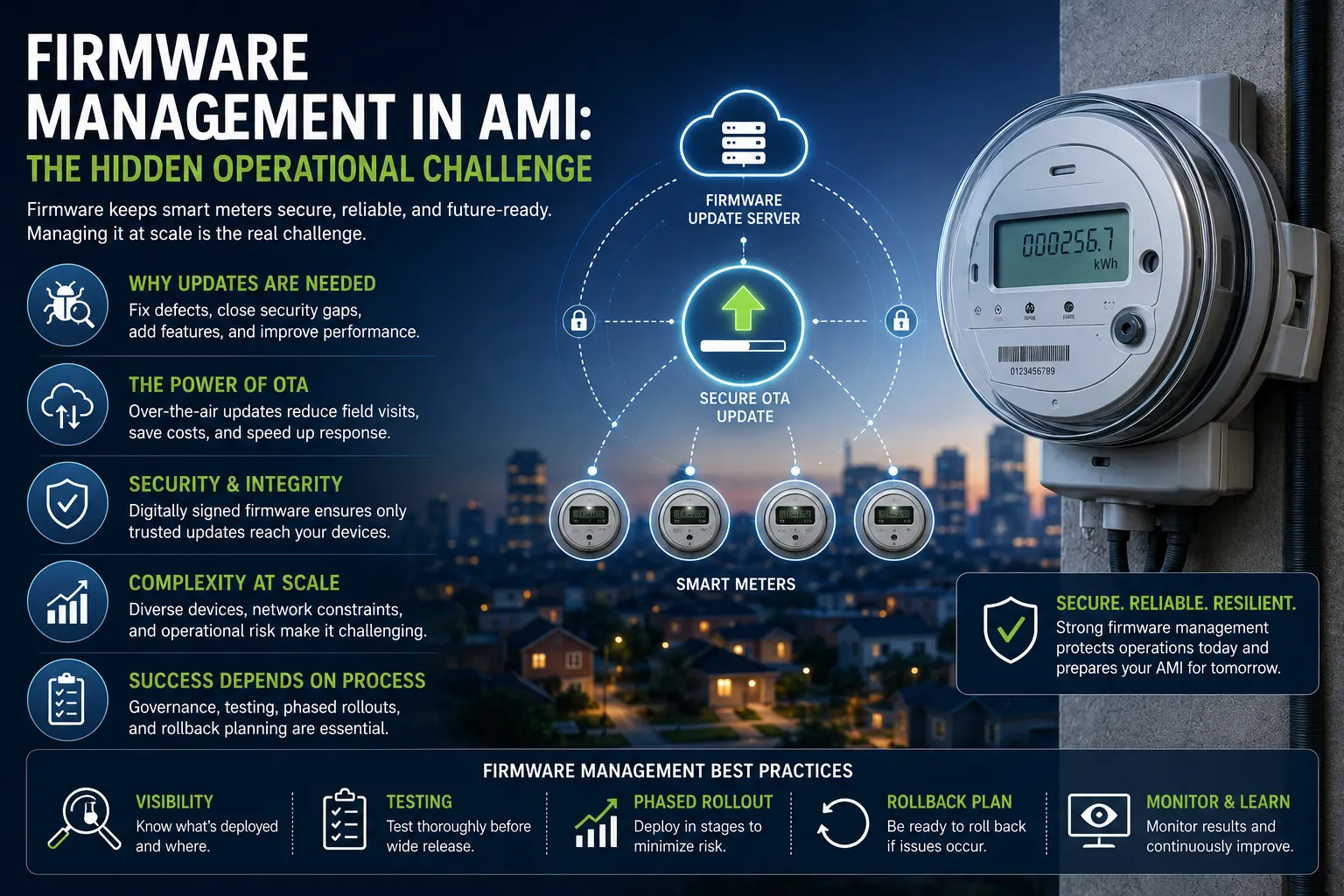
Modern AMI systems increasingly rely on Over-the-Air (OTA) firmware updates.
OTA capabilities allow utilities to update devices remotely without requiring physical access to every meter.
Potential benefits include:
- reduced field visits
- lower maintenance costs
- faster issue resolution
- improved cybersecurity responsiveness
However, OTA capability alone is not enough.
The quality of firmware governance often determines whether OTA updates become an operational advantage or a source of additional risk.
What Effective Firmware Governance Looks Like
Effective firmware management is a structured process rather than an occasional technical activity.
Version Control and Visibility
Utilities should maintain visibility into deployed firmware versions, deployment status and update history.
Without accurate records, troubleshooting and operational decision-making become significantly harder.
Testing Before Deployment
Firmware updates should be validated before broad rollout.
Common approaches include:
- laboratory testing
- pilot deployments
- phased releases
Testing helps identify unexpected issues before they affect large populations of devices.
Controlled Rollouts
Large deployments rarely need to update every device simultaneously.
Updates can instead be deployed gradually through pilot groups, geographic phases or selected device populations.
This provides an opportunity to observe results and reduce operational exposure before wider deployment.
Rollback Planning
Not every update will perform exactly as expected.
Utilities benefit from having clear recovery procedures when issues emerge. A defined rollback strategy can significantly reduce operational impact.
Cybersecurity and Firmware Integrity
Firmware management and cybersecurity are increasingly connected.
Utilities should consider questions such as:
- Are firmware updates authenticated?
- Are updates digitally signed?
- Can unauthorized firmware be installed?
- Is update activity auditable?
Secure firmware processes help protect both individual devices and the broader AMI infrastructure.
Firmware governance can therefore become an important cybersecurity control within a smart metering ecosystem.
Common Firmware Management Mistakes
Treating Firmware as a One-Time Activity
Firmware management continues throughout the operational life of the system. Treating it as something completed during commissioning creates a long-term gap.
Underestimating Operational Complexity
Managing updates across a large device population requires planning, visibility and governance.
Updating Too Aggressively
Rapid deployment may increase operational exposure when an update has not been sufficiently validated.
Updating Too Slowly
Delaying necessary updates can increase security and reliability concerns.
Focusing Only on Technology
Firmware management is not only a technical problem. Processes, governance and operational readiness are equally important.
Field Notes from Real Deployments
Across infrastructure projects, firmware management can receive relatively little attention during procurement.
The focus is often placed on hardware specifications, communication technologies and software platforms. Only after deployment does the organization discover that maintaining firmware across a large device population requires dedicated processes, planning and operational discipline.
A recurring lesson is that firmware management rarely becomes visible when everything works well.
It becomes highly visible when it does not.
The ability to update devices safely, securely and efficiently can therefore influence how successfully an AMI system adapts over time.
Conclusion
Firmware management is one of the least visible yet most important aspects of operating a modern AMI system.
Smart meters are not static assets. They are connected devices expected to evolve throughout long operational lifecycles.
As deployments scale, firmware management becomes more than a software maintenance activity. It becomes a capability that influences cybersecurity, reliability, operational efficiency and long-term system sustainability.
Establishing strong firmware governance early provides a foundation for adapting, improving and protecting smart metering systems over time.
In AMI, firmware may be invisible to customers. Operationally, however, it is one of the most important components of the system.
Read the Full Article on Medium
This article was originally published on Medium, where the full discussion explores why firmware management becomes an increasingly important operational challenge as AMI deployments scale.
Related Smart Metering Topics
- What Is AMI (Advanced Metering Infrastructure)? Architecture, Components, and How It Works
- Smart Metering System Architecture: End-to-End Design for Utilities
- Cybersecurity in Smart Metering: Real Risks, System Weaknesses, and Practical Defenses
- Smart Meter Battery Life Explained: Why “10 Years” Is Not Just a Specification
- NB-IoT vs LoRaWAN in Real Deployments: What Actually Happens in the Field
- NB-IoT vs LoRaWAN vs LTE-M: Choosing the Right IoT Connectivity for Smart Utilities
- Smart Metering in Asia: Challenges, Deployment Lessons, and Real-World Constraints
- Why Smart Metering Pilots Fail at Scale — And How Utilities Can Avoid It