Introduction
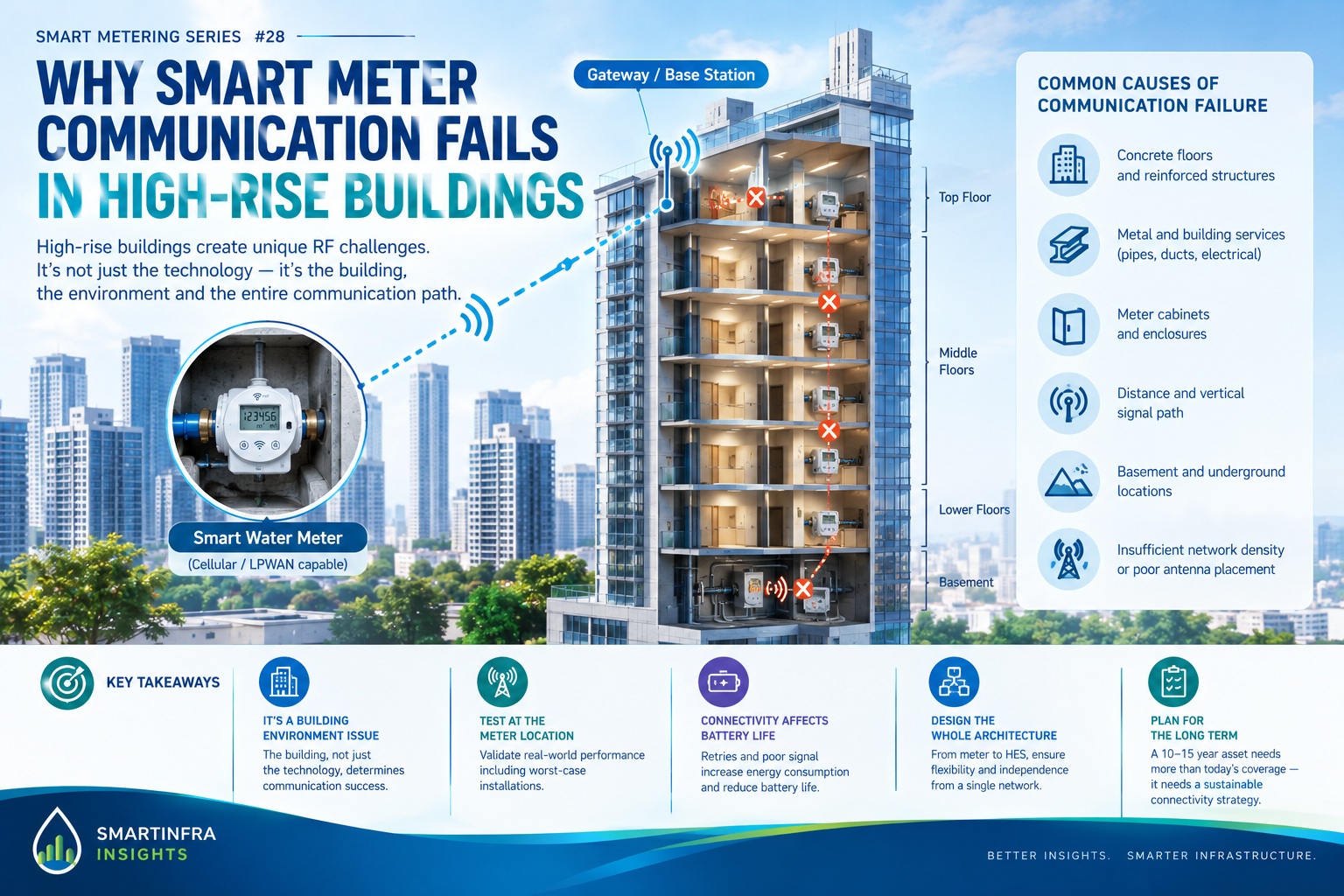
High-rise buildings can appear to be ideal environments for smart metering. Hundreds or thousands of meters may be concentrated within a relatively small geographic area, making automated data collection particularly attractive.
Yet the same buildings can create some of the most difficult communication environments for smart meters. A meter may be relatively close to a gateway or cellular site and still experience poor connectivity because radio performance is affected by the actual installation environment.
Concrete floors, reinforced structures, metal cabinets, pipes, service shafts, basements, building geometry and antenna placement can all influence the communication path.
The key question is therefore not simply whether a communication technology has long range. It is whether the complete communication architecture can reliably reach meters from their actual installed locations.
Key Takeaways
- High-rise buildings create a different RF environment from open or low-density deployments.
- Building materials, meter cabinets, basements and antenna installation can significantly affect communication performance.
- General building coverage does not necessarily mean reliable meter-level coverage.
- Poor RF conditions can increase retries and communication activity, affecting battery life.
- LPWAN range figures alone do not predict performance at difficult meter locations.
- The complete meter assembly — including antenna and enclosure — should be tested in the real installation environment.
- High-rise deployments should consider network architecture, not only individual meter range.
- Communication reliability must be monitored after deployment rather than validated only during commissioning.
- Utilities should design and test around worst-case meter locations rather than average conditions.
Why High-Rise Buildings Create a Different RF Environment
Smart meters in high-rise buildings may be installed inside apartments, common meter cabinets, corridors, riser shafts, service rooms, basements or underground parking areas.
The communication path can therefore pass through multiple physical barriers before reaching a gateway or cellular network. A signal that performs well in an open outdoor environment may behave very differently inside a reinforced building.
This means high-rise deployments should be treated as a specific RF environment rather than simply another version of a city-wide smart metering rollout.
It Is Not Just About Concrete
Reinforced concrete is an important factor, but it is only part of the picture. Steel structures, metal cabinets, doors, pipes, ducts, electrical equipment, underground structures, building geometry and meter enclosure materials can all affect signal propagation.
The physical installation of the meter is therefore part of the communication system. Radio design cannot be completely separated from mechanical installation.
Vertical Distance and Basement Locations Matter
High-rise communication paths are often vertical rather than horizontal. A gateway may need to communicate with meters several floors above or below, with floor slabs, shafts, service compartments and internal structures affecting the path.
Basement and underground meters can be particularly difficult. A meter may effectively be communicating through multiple structural layers before reaching the outdoor network.
Coverage should therefore be tested at the actual meter location rather than inferred from nearby outdoor coverage.
Why Building Coverage Is Not the Same as Meter Coverage
A mobile phone working inside a building does not automatically mean that a battery-powered smart meter will communicate reliably from a meter cabinet or basement.
The devices may have different antenna designs, transmit power, receiver sensitivity, operating frequencies, enclosures, orientations, communication schedules and battery constraints.
A smartphone user can also move closer to a window or another part of the building. A water meter generally cannot. Once installed, its physical location may remain unchanged for many years.
Network availability should therefore be evaluated at the meter, not only at the building.
Communication Reliability and Battery Life Are Connected
High-rise communication problems become particularly important for battery-powered smart meters.
When RF conditions are difficult, a device may need to retry transmissions, wait for responses or increase communication activity. Each additional communication attempt consumes energy.
This creates a direct relationship:
RF conditions → Communication behaviour → Battery life
A communication design that achieves connectivity through constant retries may technically work while still creating an unacceptable lifecycle outcome.
The objective should therefore be reliable connectivity within an acceptable energy budget, rather than simply maximum connectivity.
LPWAN Range Does Not Eliminate Building Challenges
LPWAN technologies are attractive for smart metering because they are designed for long-range, low-power communication. However, long range should not be interpreted as universal coverage.
Actual performance depends on factors such as frequency, link budget, antenna efficiency, transmit power, receiver sensitivity, network density, building construction, meter location, interference and installation conditions.
A better engineering question is:
What communication margin remains at the worst-case meter location?
The Complete Meter Assembly Matters
A communication module may support the required network, but that does not guarantee that the complete meter will perform reliably after installation.
Antenna performance can change when the antenna is installed inside an enclosure, close to metal, near pipes, against concrete, inside a confined cabinet or in a different orientation from the original design assumption.
RF validation should therefore include the complete meter assembly, including the actual antenna, enclosure and installation configuration.
Sometimes the Architecture Needs to Change
High-rise communication problems cannot always be solved by improving the meter itself.
Depending on the deployment model, possible architectural approaches include:
- Improved gateway placement
- Additional gateways
- External antennas
- Different antenna locations
- Multiple communication paths
- Alternative frequency selection
- Building-level network planning
- Hybrid communication architectures
A gateway-based architecture may allow network designers to position gateways where radio conditions are favourable, while direct cellular communication removes the need for a local gateway but places greater importance on cellular coverage at each meter.
Neither approach is universally better. The appropriate architecture depends on the building, meter locations, network requirements, operational model and economics.
High-Rise Deployments Create a Scaling Challenge
A small pilot involving a few dozen meters can produce a misleadingly positive result if it takes place in favourable locations.
Production deployment may involve hundreds of buildings, thousands of meters and many different combinations of construction materials, basement configurations, meter cabinets and network conditions.
This creates an important concept: building-to-building variability.
A communication architecture that performs well in one development may not perform identically in another. High-rise pilots should therefore test the range of installation environments expected in the eventual deployment.
Communication Reliability Must Be Measured Over Time
A successful commissioning event does not prove long-term reliability. Building facilities can change, new equipment can be installed, network conditions can change and meter cabinets can be modified.
Useful operational metrics include:
- Daily communication success rate
- Signal quality
- Retry frequency
- Offline duration
- Battery impact
- Message latency
- Data completeness
- Firmware update success
- Alarm delivery performance
These measurements help utilities determine whether communication failures are random, location-specific, building-specific or systemic.
Not Every Missing Reading Is an RF Problem
A missing meter reading does not automatically mean poor signal strength.
The complete path may look like:
Meter → Network → HES → MDMS → Application
A problem at any point can appear to the utility as missing data. Possible causes include meter firmware, connectivity configuration, network registration, gateway capacity, HES processing, retries, backend integration, data validation or application processing.
High-rise troubleshooting therefore requires an end-to-end view. The utility needs to distinguish between a meter that could not communicate and a meter that communicated successfully but whose data did not reach the application.
Design Around the Worst-Case Meter
Average performance is not enough in a difficult smart metering environment.
Utilities should deliberately identify the:
- Worst floor
- Worst meter room
- Worst basement location
- Worst enclosure
- Worst antenna orientation
- Worst network condition
These conditions should then be validated deliberately rather than testing only convenient locations.
The principle is simple: design around the difficult meters, not the easy ones.
Procurement Should Reflect the Real Environment
Communication performance should be included explicitly in smart metering procurement requirements.
Utilities should consider asking suppliers to demonstrate:
- Coverage: Can the architecture reach the expected meter locations?
- Reliability: What communication success rate can realistically be achieved?
- Battery impact: How does poor connectivity affect energy consumption?
- RF validation: Has the complete meter assembly been tested?
- Building diversity: Has the solution been tested across different building types?
- Failure handling: What happens when a meter is temporarily offline?
- Monitoring: Can communication problems be identified by meter and location?
- Scalability: Can thousands of meters operate without excessive retries or network congestion?
This moves procurement beyond asking whether a technology is supported and toward asking whether the complete solution works in the intended environment.
A Practical High-Rise Deployment Approach
A robust deployment can follow a staged engineering process:
- Map the building — identify floors, basements, shafts, cabinets and communication obstacles.
- Classify installation environments — group meters according to RF difficulty.
- Conduct site surveys — measure representative and worst-case locations.
- Test the complete meter — include the actual enclosure, antenna and installation orientation.
- Validate battery impact — measure retries, communication frequency and energy consumption.
- Test multiple buildings — include different construction types and configurations.
- Monitor after deployment — use operational data to identify communication patterns.
- Optimize the architecture — adjust gateways, antennas, network configuration or installation practices where necessary.
This approach is more reliable than selecting a communication technology first and attempting to make it work afterward.
The Building Is Part of the Network
One of the most important lessons from high-rise smart metering is that the meter, communication network and building should not be treated as completely separate engineering problems.
The relationship can be viewed as:
Building → RF Environment → Connectivity → Energy → Data Reliability → Utility Operations
The building affects the RF environment. The RF environment affects connectivity and retries. Communication behaviour affects energy consumption and battery life. Communication reliability affects data availability, which ultimately affects how the utility can use the system.
High-rise smart metering is therefore a system engineering problem rather than simply a communication technology selection exercise.
Range Is Not Reliability
Coverage, range and theoretical link budget are useful engineering parameters, but utilities ultimately need something more practical:
Can the meter deliver trusted data consistently throughout its operating life?
A technology may have excellent theoretical range but perform poorly in a particular building. Another architecture may require additional infrastructure while providing a more predictable communication environment.
There is no universal answer. The appropriate solution depends on the physical environment, network architecture, frequency, antenna design, installation conditions, battery budget and operational requirements.
Conclusion
High-rise buildings expose a fundamental reality of smart metering: connectivity is not determined by technology alone. It is determined by the interaction between technology and environment.
Concrete, steel, basements, meter cabinets, antenna placement, building geometry and network architecture can all influence the final result.
For utilities, the practical lesson is straightforward: test communication where the meter will actually live, test the difficult locations, measure reliability over time, understand battery impact and design the complete path from the meter to the utility application.
The strongest high-rise smart metering solutions are not necessarily those with the longest advertised range. They are the ones engineered around the real building environment and able to continue delivering reliable data after deployment.
In high-rise smart metering, the building is part of the network.