AMI Deployment
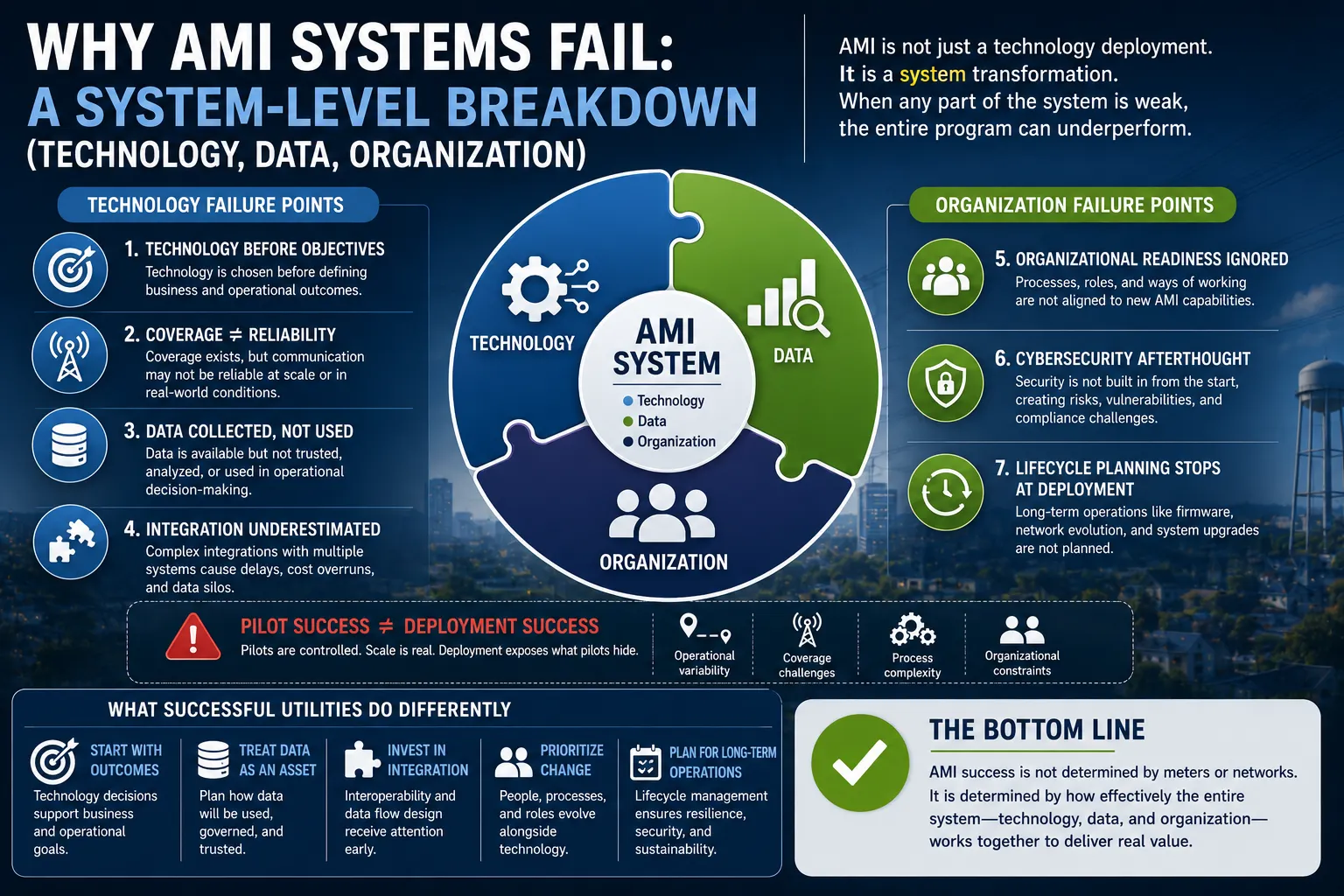
Why AMI Systems Fail: A System-Level Breakdown (Technology, Data, and Organization)
Why technically functional AMI deployments can still struggle to deliver business value when technology, data, processes and organizational readiness are not aligned.
Introduction
Utilities invest heavily in Advanced Metering Infrastructure (AMI) with the expectation of improving operational efficiency, reducing losses, increasing visibility and enabling better data-driven decision-making.
Yet an AMI initiative can struggle even when the meters communicate, the network functions and data reaches the platform.
The underlying issue is that AMI is not simply a technology deployment. It is a system transformation involving technology, data, processes and organizational readiness.
When one of these elements is overlooked, a technically functional deployment may still fail to achieve its intended objectives.
Key Takeaways
- AMI failure does not necessarily mean that the technology stops working.
- Business value can be limited by poor data quality, low adoption, weak integration or organizational readiness.
- Technology should support defined business outcomes rather than drive the strategy.
- Communication coverage does not automatically mean operational reliability.
- Collecting data is not enough; data must become part of operational decision-making.
- Integration effort is often more complex than initially expected.
- Cybersecurity and lifecycle management need to be considered from the beginning.
- Pilot success does not automatically translate into large-scale deployment success.
- Long-term AMI outcomes depend on technology, data, operations and governance working together.
What Does AMI Failure Actually Look Like?
When people hear "AMI failure," they may imagine a complete system outage.
In practice, failure can be much more subtle.
- low user adoption
- poor data quality
- operational teams reverting to manual processes
- inability to achieve expected ROI
- escalating maintenance costs
- cybersecurity concerns
- customer dissatisfaction
In these situations, the system may technically work. The organization simply fails to realize the value it expected from the investment.
AMI Is a System, Not a Product
A common mistake is treating AMI primarily as a meter procurement exercise.
In reality, an AMI environment consists of multiple interconnected layers:
- smart meters
- communication networks
- head-end systems
- MDMS platforms
- enterprise integrations
- operational processes
- people and governance
A weakness in any one of these layers can affect the overall outcome.
This is one reason why a successful pilot does not necessarily translate into a successful large-scale deployment.
Failure Point #1: Technology Is Chosen Before Objectives Are Defined
Many AMI discussions begin with NB-IoT, LoRaWAN, RF mesh, meter specifications, battery life and communication coverage.
These are important technical considerations. However, technology should support business objectives rather than define them.
A utility should first establish what operational outcomes it is trying to achieve.
Examples may include:
- reducing non-revenue water
- improving billing accuracy
- reducing manual meter reading
- improving outage visibility
- enhancing customer engagement
Once the objectives are clear, technology choices can be evaluated against those requirements.
When technology decisions drive strategy instead of supporting strategy, the resulting deployment can become misaligned with the organization's actual needs.
Failure Point #2: Coverage Exists, Reliability Does Not
Communication coverage is an important consideration in AMI, but coverage and operational reliability are not the same thing.
Questions that matter include:
- How stable is communication?
- How often do retransmissions occur?
- How does performance change during peak periods?
- What happens in underground installations?
- What happens when network conditions change?
A network that performs well during a pilot may behave differently when deployed across thousands of devices in varied environments.
Large-scale deployment exposes communication conditions and operational variability that a controlled pilot may not fully reveal.
Failure Point #3: Data Is Collected But Not Used
Another common AMI disappointment occurs after deployment.
The utility successfully collects large amounts of meter data, but little operational value is extracted from it.
Organizations may discover that:
- dashboards are underutilized
- data quality issues exist
- analytics capabilities are limited
- operational teams continue using existing workflows
Collecting data does not automatically create insight.
The value emerges when data becomes part of operational decision-making and changes how the organization works.
Failure Point #4: Integration Is Underestimated
AMI systems rarely operate in isolation.
They may need to connect with billing systems, GIS platforms, customer portals, ERP systems, outage management systems and analytics environments.
These integrations can prove more challenging than anticipated.
Data formats, ownership boundaries, system limitations and organizational responsibilities can all create delays and complexity.
In many projects, the effort required for integration exceeds the expectations established during the early stages of the project.
Failure Point #5: Organizational Readiness Is Ignored
Technology can be deployed relatively quickly. Organizational change typically takes longer.
AMI can change how people work across multiple parts of a utility.
- field operations become more data-driven
- meter reading processes evolve
- maintenance workflows change
- customer service teams gain new information
Without appropriate change management, users may continue operating as though AMI does not exist.
The result can be a technically successful deployment with limited business impact.
Failure Point #6: Cybersecurity Is Treated as an Afterthought
As AMI systems become increasingly connected, cybersecurity becomes an important part of system design and operation.
Common challenges include:
- weak access governance
- unmanaged firmware
- insecure integrations
- inadequate monitoring
- poor vendor access control
Cybersecurity is more difficult to retrofit after an operational system has already been deployed.
It therefore needs to be considered from the beginning of the AMI lifecycle rather than treated as a later addition.
Failure Point #7: Lifecycle Planning Stops at Deployment
Many organizations focus intensely on getting an AMI system deployed. Less attention may be given to what happens afterward.
AMI systems can operate for 10–15 years or longer. During that period, utilities need to manage issues such as:
- firmware updates
- battery performance
- network evolution
- cybersecurity risks
- system upgrades
- vendor changes
Deployment is therefore not the finish line.
It is the beginning of the operational lifecycle.
Why Pilots Often Succeed While Large-Scale Deployments Struggle
A recurring pattern in AMI projects is that pilot success does not guarantee deployment success.
Pilots often benefit from:
- focused attention
- ideal installation locations
- dedicated project resources
- controlled environments
Large-scale deployments introduce operational variability, coverage challenges, process complexity and organizational constraints.
Scaling therefore exposes weaknesses that a pilot environment may not reveal.
What Successful Utilities Do Differently
They Start With Business Outcomes
They define operational objectives first and then select technologies that support those objectives.
Technology becomes an enabler rather than the driver of strategy.
They Treat Data as an Asset
They establish clear plans for how AMI data will be used before deployment begins.
They Invest in Integration Early
System interoperability is addressed from the beginning rather than treated as a later project phase.
They Prioritize Organizational Change
Processes and people evolve alongside the technology.
They Plan for Long-Term Operations
Deployment is viewed as the beginning of a lifecycle rather than the end of a project.
Field Notes from Real Deployments
One of the most consistent observations across AMI projects is that technical challenges can sometimes be easier to address than organizational challenges.
Coverage can be improved. Firmware can be updated. Systems can be optimized.
Changing processes, responsibilities and organizational habits is usually more difficult.
The key lesson is that AMI outcomes depend not only on the sophistication of the technology, but on how effectively technology, data, operations and governance evolve together.
Conclusion
AMI failures are rarely caused by a single problem.
More often, they result from misalignment between technology, data and organizational readiness.
A technically successful deployment does not automatically create business value. That value emerges when systems, processes and people work together toward clearly defined objectives.
Approaching AMI as a long-term transformation program rather than simply a technology project provides a framework for managing the broader operational requirements of smart metering.
In the end, AMI success is not determined solely by meters or networks. It depends on how effectively the entire system operates as one.
Read the Full Article on Medium
This article was originally published on Medium, where the full discussion examines the technology, data and organizational factors that can determine whether AMI systems deliver their intended value.
Related Smart Metering Topics
- What Is AMI (Advanced Metering Infrastructure)? Architecture, Components, and How It Works
- Smart Metering System Architecture: End-to-End Design for Utilities
- From Smart Meters to Smart Decisions: How AMI Data Becomes Intelligence for Utilities and Smart Cities
- Why Smart Metering Pilots Fail at Scale — And How Utilities Can Avoid It
- Smart Metering in Asia: Challenges, Deployment Lessons, and Real-World Constraints
- Cybersecurity in Smart Metering: Real Risks, System Weaknesses, and Practical Defenses
- Firmware Management in AMI: The Hidden Operational Challenge
- NB-IoT vs LoRaWAN in Real Deployments: What Actually Happens in the Field