Smart Metering Deployment
Smart Meter Battery Life Explained: Why “10 Years” Is Not Just a Specification
Why real-world smart meter battery life depends on communication, signal quality, firmware, usage patterns and deployment conditions — not battery capacity alone.
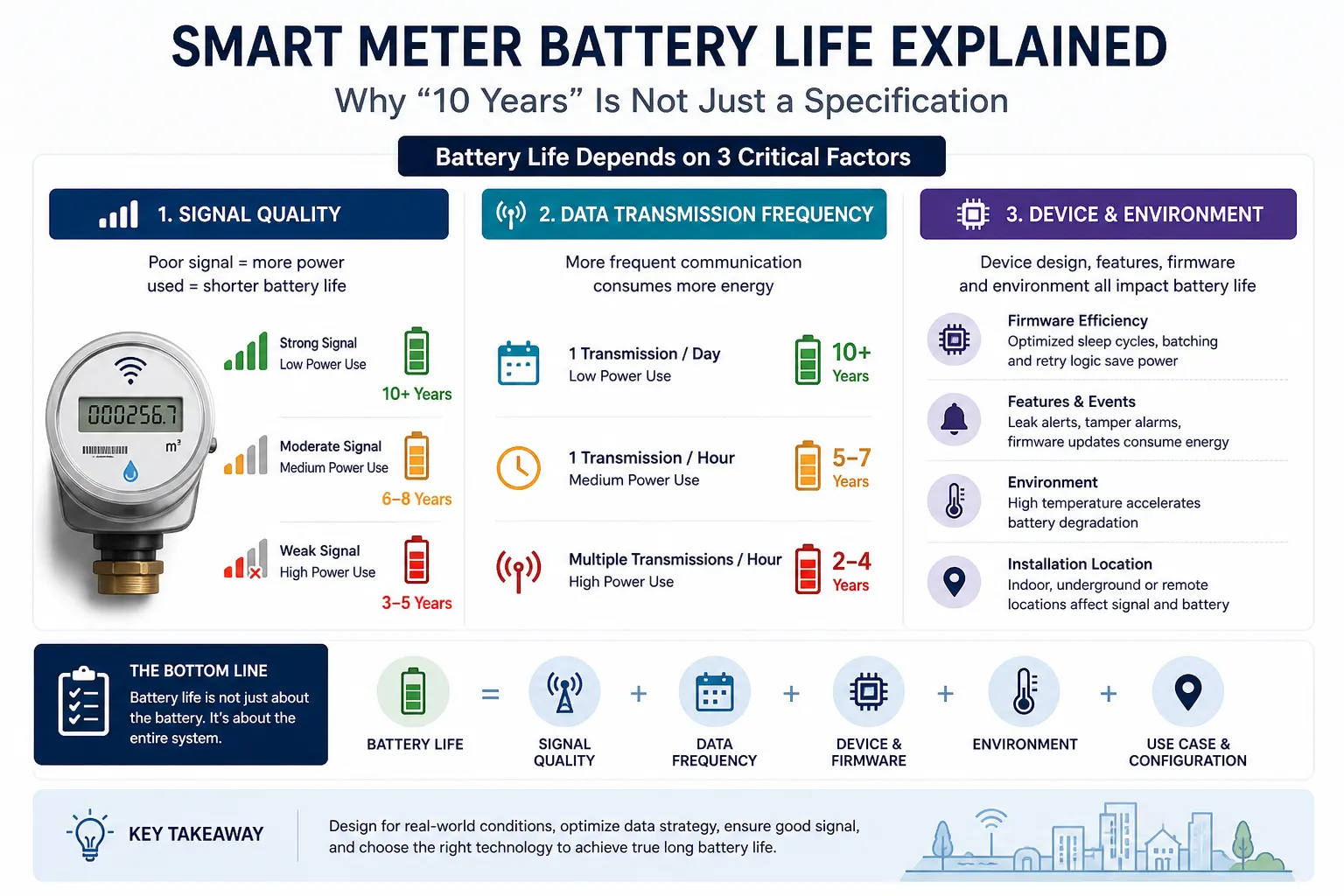
Battery life is one of the most frequently quoted specifications in smart metering. Many devices are marketed with claims such as “up to 10 years battery life”. Yet achieving that lifespan in a real deployment is far from guaranteed.
Battery performance depends not only on the battery itself, but on how the overall system is designed, configured and operated. Communication behaviour, signal conditions, reporting frequency, firmware logic and environmental factors can all influence real-world performance.
For utilities deploying large numbers of meters, battery life therefore becomes more than a product specification. It becomes an operational and financial consideration.
Key Takeaways
- A “10-year battery life” figure is a conditional design target, not a guarantee.
- Communication behaviour is one of the largest drivers of energy consumption in connected smart meters.
- Poor network conditions can significantly accelerate battery drain through higher transmission effort, retransmissions and longer connection times.
- Reporting frequency, firmware behaviour and device functionality all influence battery consumption.
- Temperature, installation environment and infrastructure constraints can create significant differences between laboratory expectations and field performance.
- Battery life should be evaluated as a system-level outcome involving the device, network, firmware, usage pattern and environment.
Why Battery Life Matters in Smart Metering
Smart meters are typically deployed at large scale, often in locations that are difficult or costly to access once installed.
Unlike consumer electronics, smart meters are expected to operate for years with minimal maintenance while continuing to provide reliable communication and data.
When battery performance falls short of expectations, the consequences extend beyond the device itself:
- Increased field maintenance and replacement costs
- Reduced system reliability and data continuity
- Operational disruption across large deployments
For utilities, battery life therefore becomes a long-term operational consideration rather than simply a procurement specification.
What “10-Year Battery Life” Actually Means
The “10-year” figure is usually based on a defined set of operating assumptions rather than every possible deployment condition.
Typical assumptions may include:
- Stable network coverage
- Low transmission frequency, such as once per day
- Moderate temperature
- Minimal event-driven communication
Under such controlled conditions, devices can achieve long operating lifespans, depending on the design and operating profile.
However, these assumptions do not necessarily represent every real-world deployment.
Once a system moves beyond controlled conditions, variability in connectivity, installation environment and operational requirements can affect battery performance.
Key Factors That Determine Battery Life
1. Data Transmission Frequency
Communication is one of the largest energy consumers in a connected smart meter.
More frequent readings generally result in higher battery consumption, while event-based alerts introduce additional communication activity.
- Daily transmission → longer potential lifespan
- Hourly transmission → significantly greater communication activity
- Event-based alerts → additional energy consumption
Even relatively small changes in reporting requirements can therefore influence long-term battery performance.
2. Network Conditions
Signal quality is a critical but often overlooked factor in battery life.
In weak-signal environments, devices may increase transmission power, retransmissions may occur, and connection time may increase. These behaviours can significantly increase energy consumption.
The issue is particularly relevant in locations such as underground chambers, basements and dense urban environments.
Poor signal conditions can therefore explain why identical devices may show different battery performance across different deployments.
3. Communication Technology
Different communication technologies have different power and deployment characteristics.
- NB-IoT: Optimized for wide-area coverage, but power consumption can increase under poor signal conditions.
- LoRaWAN: Can support low-power operation, but performance depends on network design and deployment environment.
- LTE-M: Provides higher throughput and functionality, with typically higher power consumption than lower-throughput approaches.
The important point is that communication technology should be evaluated in the context of the actual deployment rather than by theoretical power characteristics alone.
4. Firmware and Device Behavior
Battery life is also heavily influenced by how the device operates.
Important firmware behaviours include sleep cycles, retry logic, data batching and event handling.
Poorly optimized firmware can keep communication hardware active for longer or trigger unnecessary transmissions.
5. Environmental Conditions
Real-world environmental conditions can affect battery performance over the operating life of the meter.
- High temperature → faster battery degradation
- Low temperature → reduced available capacity
- Humidity → potential long-term reliability concerns
These factors can be underestimated when battery performance is evaluated primarily under controlled laboratory conditions.
6. Device Features and Functionality
Additional functionality can also increase energy consumption.
- Leak detection
- Tamper alerts
- Remote valve control
- Firmware updates
The more functionality a battery-powered device performs, the greater the potential energy demand.
Battery Life Is a System Outcome
Battery life is rarely determined by a single component.
Instead, it emerges from the interaction between:
Device + Network + Firmware + Usage Pattern + Environment
A high-capacity battery alone does not guarantee long operational life.
The same meter model can perform differently across projects because communication conditions, reporting requirements, firmware behaviour and environmental conditions are different.
Expected vs Real-World Performance
In practice, battery outcomes can vary across deployment conditions.
- Ideal conditions: Performance may remain close to the stated specification.
- Typical deployments: Some reduction from the ideal specification may occur.
- Challenging environments: Battery life can be reduced more significantly.
The main drivers of deviation are often signal quality and transmission frequency, although firmware, environmental conditions and device functionality also contribute.
The important lesson is that a battery-life figure should always be interpreted together with the conditions under which that figure was achieved.
Design Principles for Maximizing Battery Life
Optimize Data Strategy
Only collect and transmit data as frequently as the operational requirement actually demands.
Design for Signal Quality
Coverage planning is critical. Simply confirming that a network is available does not necessarily mean that every installation location will provide favourable operating conditions.
Align Technology with Deployment
Communication technology should be selected according to the real deployment environment, required functionality and expected operating profile.
Prioritize Firmware Efficiency
Minimize unnecessary communication activity and optimize sleep cycles, retry behaviour and event handling.
Plan for Real Environments
Battery-life planning should account for the conditions in which meters will actually operate.
Important considerations include:
- Installation location
- Temperature
- Infrastructure constraints
- Network conditions
- Expected reporting requirements
A battery-life target that is realistic for the deployment environment is more useful than a theoretical figure based only on controlled test conditions.
Field Notes from Real Deployments
Several recurring patterns become visible once smart metering systems move beyond pilot scale.
Battery Issues Often Trace Back to Poor Connectivity
Meters operating in weak-signal areas can consume significantly more energy because of retransmissions and prolonged communication activity.
Data Requirements Increase After Deployment
Utilities may increase reporting frequency over time as operational requirements evolve. Such changes can directly affect battery consumption.
Firmware Behavior Is Often Underestimated
Inefficient retry logic, wake cycles and communication handling can reduce battery lifespan even when the underlying battery has adequate capacity.
Specifications Are Sometimes Taken Too Literally
A “10-year” specification is often interpreted as a guaranteed operating life when it should instead be understood in the context of its underlying assumptions and operating conditions.
Conclusion
The “10-year battery life” specification is not inherently misleading — but it is conditional.
Real-world battery performance depends on how the overall system is designed, configured and operated over time.
Utilities should therefore treat battery life as a system-level engineering consideration rather than a fixed device specification.
In smart metering, battery life is not just about the battery. It is ultimately a reflection of deployment and operational decisions.
Read the Full Article on Medium
This article was originally published on Medium, where the full discussion explores the practical factors that influence smart meter battery life in real-world deployments.
Related Smart Metering Topics
- What Is Smart Metering? A Practical Guide for Utilities and Smart Cities
- NB-IoT vs LoRaWAN vs LTE-M: Choosing the Right IoT Connectivity for Smart Utilities
- What Is NB-IoT? A Practical Guide for IoT and Smart Metering Deployments
- Smart Metering in Asia: Challenges, Deployment Lessons, and Real-World Constraints
- Why Smart Metering Pilots Fail at Scale — And How Utilities Can Avoid It
- Smart Metering System Architecture: End-to-End Design for Utilities