Smart Water Metering
Smart Water vs. Smart Electricity Metering: Why One Size Doesn't Fit All
Why smart water and electricity metering share common AMI objectives but require different approaches to power, connectivity, data, deployment, firmware and long-term operations.
Introduction
Smart metering is often discussed as though the same technology can be applied across every utility sector. While smart water and smart electricity metering share the broad objective of collecting consumption information remotely, the engineering and operational constraints are quite different.
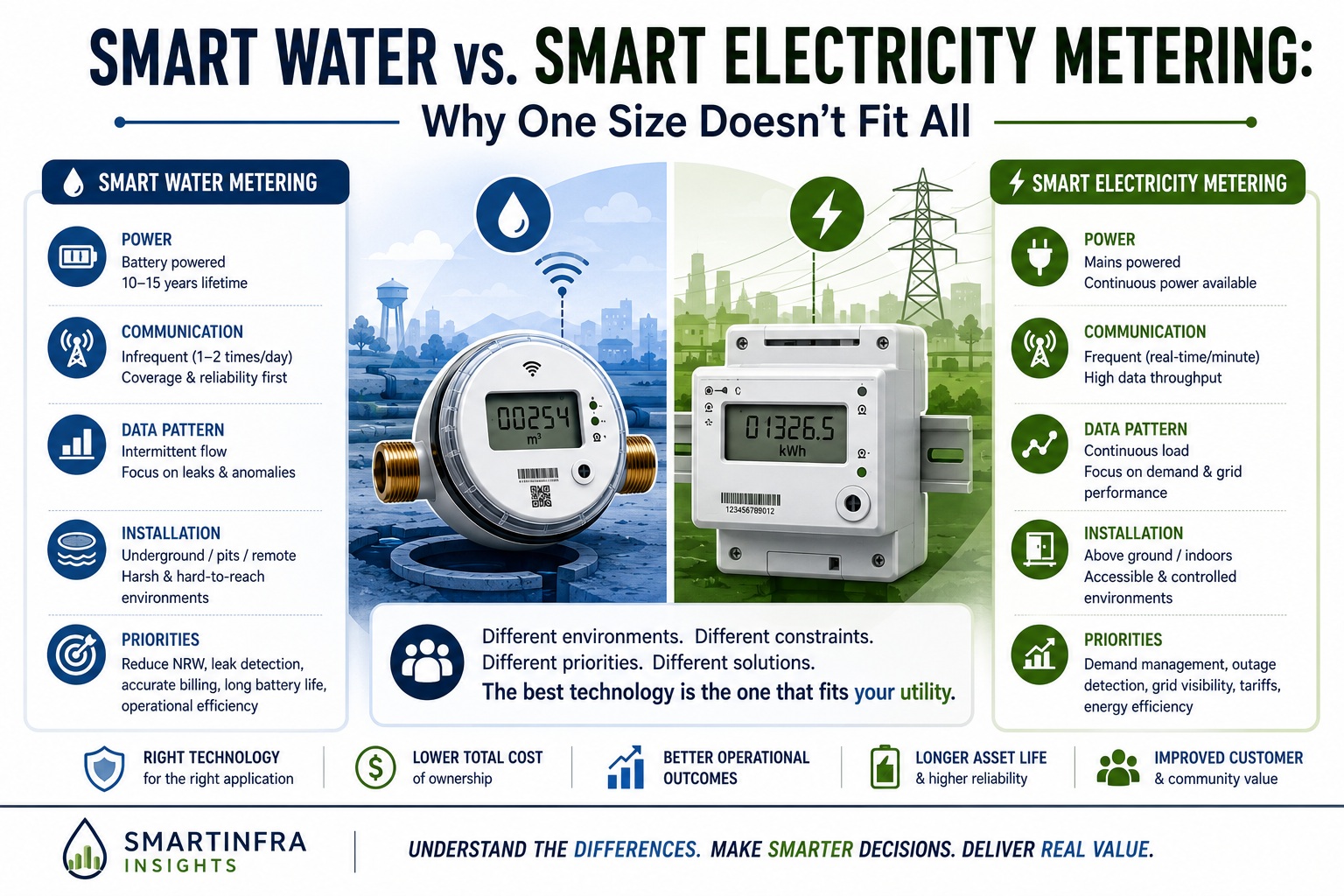
Electricity meters normally have continuous access to electrical power, while many smart water meters operate from batteries for 10–15 years. Electricity AMI may require frequent communication for grid visibility and demand management, whereas water AMI often prioritizes reliable daily reporting, leak detection and long battery life.
These differences influence almost every layer of the solution, from device design and connectivity to firmware, maintenance and operational workflows.
Key Takeaways
- Smart water and electricity metering share common objectives but operate under different constraints.
- Power availability is one of the most important differences between the two environments.
- Water metering places much greater emphasis on battery life and low-power communication.
- Electricity AMI often supports more frequent data exchange and grid-related applications.
- Installation conditions can make communication particularly challenging for water meters.
- Technology selection should follow utility objectives and deployment conditions rather than sector assumptions.
- There is no universal smart metering architecture that fits every utility.
Similar Objectives, Different Constraints
Both smart water and electricity metering can support:
- Remote meter reading
- Improved billing accuracy
- Reduced manual meter reading
- Faster fault detection
- Better customer visibility
- Operational efficiency
- Digital utility transformation
The difference is how these objectives need to be achieved.
A solution designed around continuous electrical power and frequent communications may not translate directly to a battery-powered water meter expected to operate for many years in an underground chamber.
Power Availability Changes the Design
Smart Electricity Meters
Electricity meters are generally connected directly to the electrical supply. This provides the power required for frequent communication, greater local processing and continuous operation.
Power consumption is therefore usually less dominant as a system-level design constraint.
Smart Water Meters
Many smart water meters are battery powered and expected to operate for 10–15 years without battery replacement.
This makes energy consumption a fundamental design consideration.
- Deep-sleep operation
- Efficient radio usage
- Optimized firmware
- Low-power sensing
- Controlled communication frequency
For water metering, battery life is not simply a device specification. It influences communication strategy, firmware behavior and maintenance planning throughout the deployment lifecycle.
Communication Requirements Are Different
Electricity AMI may support applications such as:
- Near real-time monitoring
- Demand response
- Outage detection
- Voltage monitoring
- Load management
These applications can require relatively frequent communication.
Water utilities more commonly prioritize:
- Daily consumption reporting
- Leak detection
- Tamper alerts
- Reverse-flow detection
- Occasional configuration updates
For many water applications, minute-by-minute communication is unnecessary. Communication reliability and energy efficiency can therefore be more important than maximum reporting frequency.
Data Characteristics Also Differ
Electricity consumption can change continuously throughout the day. Utilities may analyse load profiles, peak demand, voltage quality, current imbalance and power factor.
Water consumption behaves differently. Long periods of zero or low consumption can occur, while continuous flow can itself become an important signal.
Water analytics may therefore focus on:
- Continuous flow
- Possible leaks
- Backflow
- Tampering
- Abnormal consumption
The difference is not simply the amount of data collected. It is the type of operational question that the data needs to answer.
Installation Environment Matters
Electricity meters are commonly installed in buildings, electrical cabinets, meter rooms or accessible utility enclosures where communication conditions may be relatively predictable.
Water meters can be installed in:
- Underground chambers
- Roadside pits
- Basements
- Moist or flooded environments
- Remote rural locations
These environments can introduce poor radio coverage, moisture, corrosion and difficult physical access.
Consequently, smart water communication solutions often place greater emphasis on coverage and penetration than on high bandwidth.
Communication Technology Selection
The technologies considered by each sector can overlap, but the selection criteria can be different.
Water utilities may evaluate technologies such as:
- NB-IoT
- LoRaWAN
- Wireless M-Bus
- Proprietary RF
- LTE-M for selected applications
Electricity utilities may also use:
- RF Mesh
- Power Line Communication (PLC)
- Cellular networks
- Fibre networks
- Private LTE
The important point is that there is no universally superior technology. The appropriate choice depends on deployment conditions, communication requirements, power availability and operational objectives.
Operational Priorities Influence Architecture
Electricity utilities often focus on:
- Demand management
- Outage restoration
- Grid visibility
- Renewable integration
- Time-of-use tariffs
Water utilities typically place greater emphasis on:
- Reducing non-revenue water
- Leak detection
- Accurate billing
- Minimizing field visits
- Extending battery life
- Improving customer service
These priorities directly influence architecture, device requirements and investment decisions.
Firmware Strategy Is Also Different
Firmware management reflects the underlying power constraints.
Electricity meters generally have continuous power available, allowing firmware updates to be larger or more frequent where required.
Water meters must balance firmware improvements against battery consumption. Communication sessions, processing and update activities can all affect energy usage.
Firmware strategy therefore needs to consider not only functionality and security, but also the operational lifespan of the battery-powered device.
Maintenance Considerations
The maintenance model also changes between the two sectors.
Electricity meters generally have less concern about battery replacement, although firmware, calibration and regulatory requirements remain important.
Water meter maintenance can involve:
- Battery longevity
- Environmental protection
- Communication performance
- Mechanical wear
- Physical accessibility
When thousands of water meters are deployed across difficult-to-access locations, maximizing operational life can have a significant effect on long-term maintenance effort.
Cybersecurity Remains Important in Both
Both water and electricity AMI require cybersecurity throughout the system lifecycle.
Electricity infrastructure is closely connected to grid stability and critical infrastructure, while water systems increasingly depend on connected devices, remote monitoring and digital platforms.
Key considerations include:
- Protecting customer data
- Securing communication channels
- Authenticating devices
- Protecting firmware and software
- Preventing unauthorized configuration changes
- Maintaining operational continuity
The risk profile may differ, but the principle is common: cybersecurity should be designed into the system rather than added after deployment.
Common Misconceptions
“Water AMI is simply electricity AMI with a different meter.”
The battery constraints, communication patterns, installation environments and operational objectives require different design decisions.
“More frequent communication always provides more value.”
Not necessarily. For many water applications, once- or twice-daily reporting may provide sufficient operational information while preserving battery life.
“The same communication technology works equally well everywhere.”
Technology performance depends on deployment conditions, coverage, power requirements, operational objectives and lifecycle expectations.
Practical Lessons from Real Deployments
- Battery constraints influence almost every design decision. Power optimization is central to long-life smart water deployments.
- Communication reliability can matter more than communication frequency. Reliable daily data can provide greater operational value than unreliable high-frequency reporting.
- Environmental conditions cannot be ignored. Underground installations, dense urban environments and remote locations can all affect communication performance.
- Utility objectives should drive technology choices. Technology should support the required operational outcome rather than determine the outcome by itself.
Conclusion
Smart water and smart electricity metering share many AMI principles, but they operate under different technical and operational constraints.
Electricity AMI is often shaped by grid visibility, energy management and frequent communication. Water AMI places greater emphasis on long battery life, reliable connectivity, leak detection and operational efficiency.
Understanding these differences helps utilities establish realistic requirements and avoid transferring assumptions from one sector directly into another.
There is no universal smart metering solution. The starting point should always be the utility's operational requirements, deployment environment and long-term objectives.
Read the Full Article on Medium
This article was originally published on Medium, where the full discussion compares smart water and electricity metering across power, communication, data, deployment environment, firmware, maintenance and operational requirements.
Related Smart Metering Topics
- Smart Meter Battery Life Explained: Why “10 Years” Is Not Just a Specification
- NB-IoT vs LoRaWAN in Real Deployments: What Actually Happens in the Field
- NB-IoT vs LoRaWAN vs LTE-M: Choosing the Right IoT Connectivity for Smart Utilities
- What Is NB-IoT? A Practical Guide for IoT and Smart Metering Deployments
- LoRaWAN Explained: Architecture, Use Cases, and Limitations in Real Deployments
- Smart Metering System Architecture: End-to-End Design for Utilities
- What Is AMI (Advanced Metering Infrastructure)? Architecture, Components, and How It Works
- From Data to ROI: Measuring the Business Value of AMI