AMI Cost & ROI
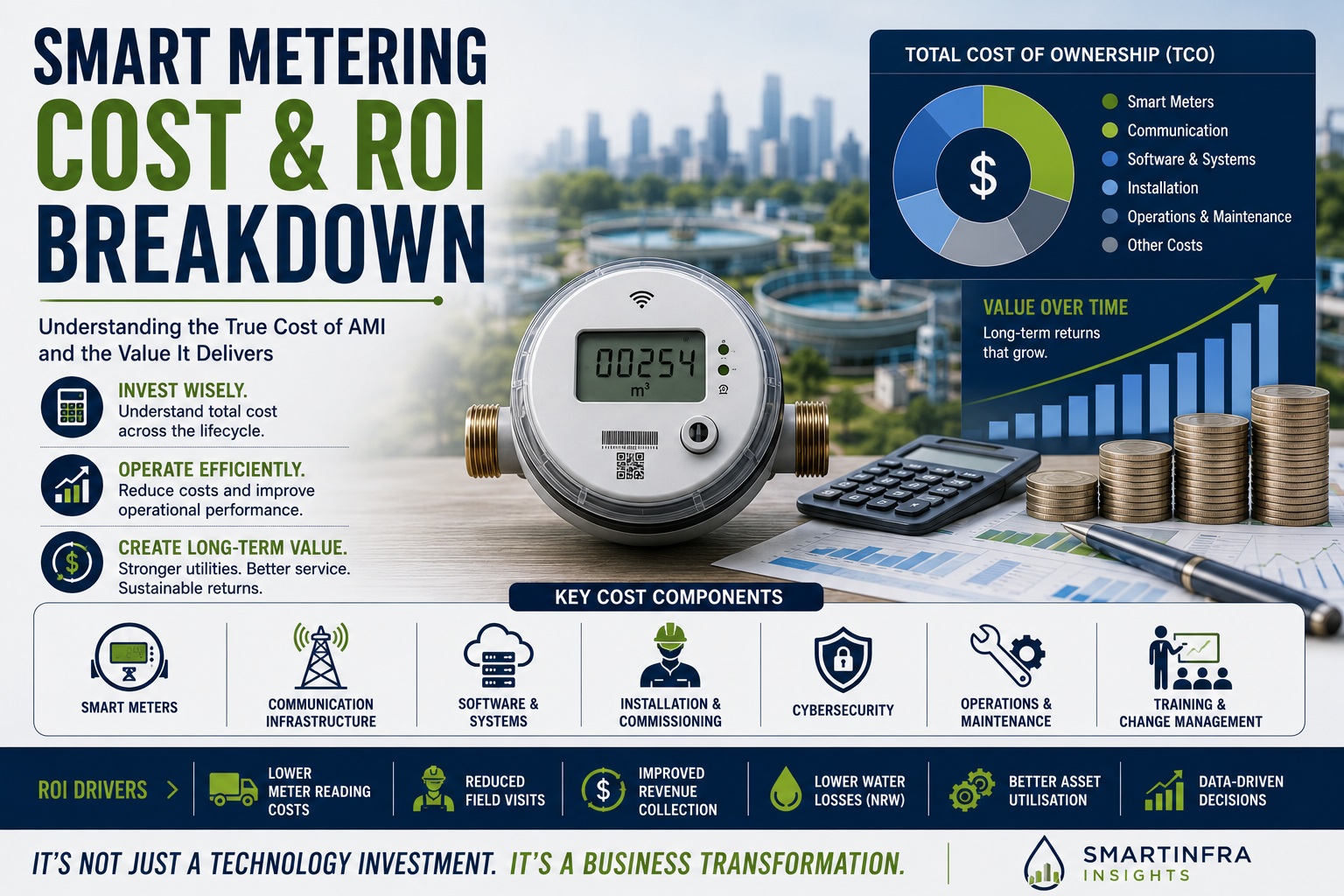
Smart Metering Cost & ROI Breakdown: Understanding the True Cost of AMI
Why the purchase price of smart meters is only one part of the AMI business case, and how utilities can evaluate lifecycle cost against long-term operational value.
Introduction
When utilities evaluate Advanced Metering Infrastructure (AMI), one of the first questions is usually straightforward: how much will it cost?
The difficulty is that AMI is not simply a meter procurement exercise. The overall programme can include meters, communications, backend systems, integration, installation, cybersecurity and years of ongoing operation and support.
At the same time, the return is not limited to automated meter reading. The business case can include lower operating costs, reduced field activity, improved revenue collection, lower water losses, better asset utilization and broader operational improvements.
A realistic AMI business case therefore needs to consider both sides of the equation: total lifecycle cost and long-term value.
Key Takeaways
- The smart meter purchase price represents only one component of AMI cost.
- Total Cost of Ownership includes both capital investment and recurring operational expenditure.
- AMI can generate value through labour savings, fewer field visits, revenue improvement, water-loss reduction and better asset utilization.
- Some important AMI benefits are operational or strategic rather than immediately financial.
- ROI calculations can fail when they ignore organizational change, ongoing costs or the time required for benefits to materialize.
- A strong AMI business case starts with operational objectives and measurable KPIs rather than technology alone.
Looking Beyond the Meter Price
One of the easiest mistakes in AMI procurement is to compare the purchase price of meters as though the meter represents the entire system.
A complete AMI deployment can involve:
- Smart meters
- Communication infrastructure
- Head-End System (HES)
- Meter Data Management System (MDMS)
- Enterprise system integration
- Installation and commissioning
- Cybersecurity
- Ongoing support and maintenance
As deployment scale increases, software, communications and operational processes can become significant parts of the overall investment.
Understanding Total Cost of Ownership
Total Cost of Ownership (TCO) looks beyond the initial purchase and considers the costs of operating the system throughout its lifecycle.
Capital Investment
- Smart meters
- Communication modules
- Gateways or network infrastructure
- Servers or cloud services
- Software licences
- System integration
- Installation
Operational Costs
- Communication service fees
- Software maintenance
- Firmware management
- Cybersecurity monitoring
- Field support
- Battery replacement where applicable
- System upgrades
- Technical training
Some costs occur once, while others continue for the entire life of the system. Both need to be considered when assessing the financial sustainability of an AMI programme.
Where AMI Can Generate Financial Returns
The business case for AMI is rarely based on a single benefit. Value can accumulate across several operational areas.
Reduced Meter Reading Costs
Automated data collection can reduce the recurring costs associated with manual meter reading, including vehicles, fuel, field personnel, scheduling and data entry.
Reduced Field Visits
Remote meter data and system capabilities can reduce the need for some customer-premise visits for activities such as meter reading, consumption verification and diagnostics.
Fewer field visits can translate into lower operating costs and more efficient use of field resources.
Improved Revenue Collection
More timely and accurate meter data can support improved billing accuracy, reduce estimated bills, accelerate issue resolution and help identify potential revenue leakage.
Lower Water Losses
For water utilities, AMI can contribute to NRW reduction by providing information that supports faster leak detection, abnormal consumption identification, customer notifications and better district monitoring.
AMI does not eliminate water losses by itself. Its contribution is to provide better information that enables earlier and more targeted intervention.
Better Asset Utilization
AMI data can support decisions around meter replacement, maintenance scheduling, network planning and investment prioritization.
Over time, better information can help utilities allocate capital and operational resources more effectively.
Benefits That Are Harder to Measure
Not every AMI benefit appears immediately as a direct financial saving.
- Improved customer satisfaction
- Greater operational visibility
- Faster decision making
- Improved regulatory reporting
- Greater organizational resilience
These benefits can be difficult to express in a simple financial model, but they can still contribute significantly to the long-term value of the programme.
Calculating Return on Investment
At its simplest, an AMI ROI assessment compares the financial benefits generated by the programme against its total lifecycle cost.
Potential benefits can include:
- Labour savings
- Reduced operating expenditure
- Increased revenue
- Reduced water losses
- Deferred infrastructure investment
The cost side should include the full AMI lifecycle rather than only the procurement stage.
The purpose of the model is not necessarily to create a perfectly precise financial forecast. It is to establish whether the programme can generate sustainable value over time and to make the underlying assumptions visible.
Why Some ROI Calculations Fail
1. Looking Only at Initial Cost
The lowest purchase price does not necessarily result in the lowest lifecycle cost.
A system with higher initial investment may have different operating, maintenance or replacement requirements over its useful life.
2. Ignoring Organizational Change
Technology delivers value only when supported by trained people, effective processes and clear governance.
If operational teams do not adopt new workflows, expected efficiency improvements may not materialize.
3. Overestimating Immediate Benefits
Some AMI benefits can appear relatively quickly, while others may require several years before their full value becomes measurable.
A credible business case should therefore use realistic assumptions about when benefits will actually occur.
4. Underestimating Operational Costs
Recurring costs such as communications, software maintenance, cybersecurity, firmware updates and technical support can continue long after deployment.
Leaving these items outside the business case can make the projected ROI appear stronger than the eventual operational reality.
Building a Strong AMI Business Case
A robust AMI business case should begin with the utility's operational objectives rather than the technology itself.
Useful questions include:
- Which operational problems are we trying to solve?
- Which costs can realistically be reduced?
- Which benefits can be measured?
- Which KPIs will demonstrate success?
- How will benefits be reviewed after deployment?
The business case should also remain a living reference throughout the programme. Actual performance can be compared with the original assumptions and the model refined as the deployment matures.
What Field Experience Shows
Across AMI programmes, a recurring observation is that long-term value is not determined simply by choosing the lowest-cost technology.
Projects that create stronger operational value tend to have clearly defined business objectives, realistic financial assumptions, phased benefit measurement, strong operational adoption and continuous performance review.
The technology enables the transformation, but operational execution is what ultimately turns the investment into measurable value.
Conclusion
AMI is a significant infrastructure investment, but its true cost extends well beyond the price of the meter.
The same applies to its return. Automated meter reading is only one potential benefit. Reduced operating costs, fewer field visits, improved revenue collection, lower water losses, better asset utilization and stronger operational visibility can all contribute to the overall business case.
Utilities therefore need to evaluate AMI across its full lifecycle, balancing total cost of ownership against realistic and measurable benefits.
The objective is not simply to minimize what AMI costs today. It is to understand whether the system can continue creating meaningful operational and financial value throughout its lifecycle.
Read the Full Article on Medium
This article was originally published on Medium, where the full discussion examines AMI lifecycle costs, financial returns, ROI challenges and how utilities can build stronger long-term business cases.
Related Smart Metering Topics
- From Data to ROI: Measuring the Business Value of AMI
- Utility Procurement for AMI: How to Avoid Costly Mistakes
- Smart Meter Rollout Strategy: Phased vs Full Deployment
- Why Smart Metering Pilots Fail at Scale — And How Utilities Can Avoid It
- Why AMI Systems Fail: A System-Level Breakdown (Technology, Data, Organization)
- How Utilities Actually Use Smart Meter Data (Beyond Billing)
- From Smart Meters to Smart Decisions: How AMI Data Becomes Intelligence for Utilities and Smart Cities
- What Is AMI (Advanced Metering Infrastructure)? Architecture, Components, and How It Works