Smart Meter Deployment
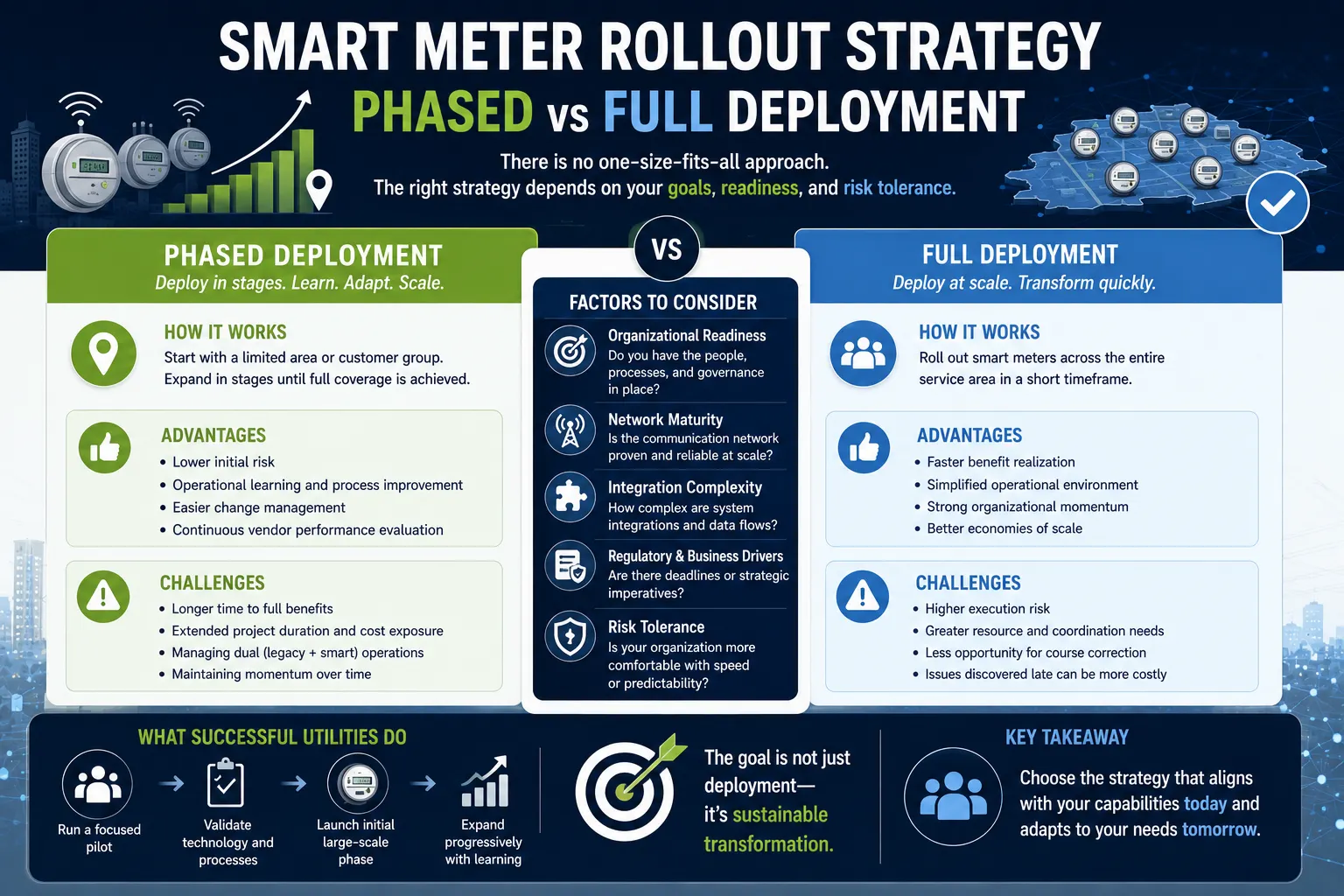
Smart Meter Rollout Strategy: Phased vs Full Deployment
How utilities can balance rollout speed, operational learning, risk, organizational readiness and long-term scalability when deploying smart meters at scale.
Introduction
One of the most important decisions in any smart metering program is not the choice of meter, communication technology, or software platform.
It is deciding how the deployment will be executed.
Utilities typically face two broad approaches:
- phased deployment
- full-scale deployment
Both strategies can succeed. Both can fail.
The difference often lies in how well the rollout strategy aligns with the utility’s objectives, operational readiness, risk tolerance, and available resources.
While technology receives much of the attention during planning, deployment strategy often determines whether a project remains manageable as it scales.
Key Takeaways
- Rollout strategy is a major AMI decision alongside technology, architecture and integration.
- Phased deployment provides more opportunity for learning, adjustment and controlled scaling.
- Full deployment can accelerate benefit realization and simplify the transition to a smart metering environment.
- Phased deployment can extend the project timeline and create temporary mixed operating models.
- Full deployment requires stronger organizational readiness, resources and execution coordination.
- A successful pilot does not automatically determine the right large-scale rollout strategy.
- Organizational readiness, network maturity, integration complexity, business drivers and risk tolerance should influence the decision.
- Many large programs combine elements of both approaches: focused pilot, initial large-scale phase, then progressive expansion.
- Deployment plans should remain flexible as real-world conditions emerge.
Why Rollout Strategy Matters
Smart metering projects are rarely simple technology installations.
They often involve:
- large-scale field operations
- communication network deployment
- system integration
- customer engagement
- process transformation
- long-term operational support
A rollout strategy affects how risks are managed, how quickly benefits are realized, and how effectively lessons learned can be applied.
The decision influences the project long before the first meter is installed.
What Is a Phased Deployment?
A phased deployment introduces smart meters gradually across selected areas, customer groups, or operational zones.
For example, a utility may deploy:
- one city at a time
- one district at a time
- residential customers before commercial customers
- high-priority areas first
The deployment expands in stages until full coverage is achieved.
Rather than attempting to transform the entire organization at once, the utility learns and adapts throughout the process.
Advantages of a Phased Deployment
Lower Initial Risk
Problems discovered during early phases can be corrected before larger investments are made.
Issues involving communication coverage, installation processes, integrations, or data quality are easier to manage when fewer devices are involved.
Operational Learning
Every deployment reveals unexpected challenges.
Field teams gain experience. Processes mature. System configurations improve.
Lessons from earlier phases can be incorporated into later stages.
Easier Change Management
Utilities often underestimate the organizational impact of AMI.
A phased rollout gives operations teams, customer service personnel, and management time to adapt.
Better Vendor Performance Monitoring
Performance can be evaluated continuously rather than only after large-scale commitments have been made.
Challenges of a Phased Deployment
Longer Time to Benefits
Full operational benefits may take years to achieve.
Until deployment reaches significant scale, some business cases remain partially realized.
Extended Project Duration
Longer projects may face:
- changing requirements
- evolving technology
- shifting budgets
- organizational changes
Maintaining momentum becomes important.
Multiple Operating Models
During transition periods, utilities often manage both conventional and smart metering environments simultaneously.
This can increase operational complexity.
What Is a Full Deployment?
A full deployment aims to replace a large percentage of meters within a relatively short timeframe.
The objective is rapid transformation rather than gradual evolution.
Utilities pursuing this strategy often seek to accelerate:
- operational efficiency gains
- billing improvements
- data availability
- customer engagement capabilities
The deployment may occur across entire service territories within a compressed schedule.
Advantages of a Full Deployment
Faster Benefit Realization
The organization gains access to smart metering capabilities sooner.
Business benefits can begin accumulating earlier.
Simplified Operational Environment
The transition period between traditional and smart metering is shorter.
Utilities avoid managing mixed operating models for extended periods.
Strong Organizational Momentum
Large programs often receive significant executive attention and organizational focus.
This can accelerate decision-making and resource allocation.
Better Economies of Scale
Procurement, installation, logistics, and project management activities may benefit from larger deployment volumes.
Challenges of a Full Deployment
Higher Execution Risk
Problems discovered late can affect a much larger portion of the deployment.
Mistakes become more expensive to correct.
Greater Resource Requirements
Large-scale rollouts require substantial coordination across:
- field operations
- IT teams
- vendors
- contractors
- customer service functions
The organization must be ready from the beginning.
Less Opportunity for Course Correction
When deployment progresses rapidly, there may be limited time to adjust processes, architectures, or deployment methods.
Why Pilots Do Not Automatically Answer the Question
Many utilities conduct pilot projects before deployment.
Pilots are valuable.
However, pilot success does not necessarily indicate whether phased or full deployment is the better strategy.
Pilots typically occur under controlled conditions.
Deployment introduces challenges that pilots may not reveal:
- workforce scaling
- logistics management
- coverage variability
- customer communication
- operational complexity
The rollout strategy must account for realities that emerge only at scale.
Factors That Should Influence the Decision
There is no universal answer.
Several factors should guide deployment strategy.
Organizational Readiness
A utility with strong project governance, experienced teams, and mature processes may be better positioned for aggressive deployment.
Organizations still building internal capabilities may benefit from a phased approach.
Network Maturity
Communication infrastructure should be sufficiently validated before large-scale rollout begins.
Coverage maps alone are rarely enough.
Real-world performance matters.
Integration Complexity
Projects involving extensive integration with billing, GIS, ERP, customer portals, and analytics systems often benefit from gradual expansion.
Regulatory and Business Drivers
Some projects face deadlines driven by regulation, policy initiatives, or strategic objectives.
These factors may favor faster deployment.
Risk Tolerance
Different organizations have different appetites for risk.
Some prioritize speed.
Others prioritize predictability.
Both approaches can be valid.
What Successful Utilities Often Do
In practice, many successful deployments combine elements of both approaches.
They avoid deploying everything simultaneously, but they also avoid remaining in pilot mode indefinitely.
A common pattern is:
- Conduct a focused pilot.
- Validate technology and processes.
- Deploy an initial large-scale phase.
- Expand progressively using lessons learned.
This creates a balance between learning and execution.
The utility gains confidence without sacrificing momentum.
Field Notes from Real Deployments
Across smart metering projects, one recurring lesson stands out:
The deployment strategy should match organizational capability.
A technically excellent solution can struggle if the rollout exceeds the organization’s ability to manage change.
Conversely, overly cautious deployments can delay benefits and create unnecessary complexity.
The most successful programs often focus less on choosing the “perfect” strategy and more on maintaining flexibility as conditions evolve.
Deployment plans frequently require adjustment once real-world conditions emerge.
Conclusion
The choice between phased deployment and full deployment is ultimately a risk management decision.
Phased deployment emphasizes learning, flexibility, and gradual scaling.
Full deployment emphasizes speed, transformation, and rapid realization of benefits.
Neither approach is inherently superior.
The most appropriate strategy depends on organizational readiness, operational maturity, business objectives, and risk tolerance.
Successful smart metering programs recognize that deployment is not simply a technical exercise.
It is an organizational transformation that requires balancing speed, learning, and long-term sustainability.
Read the Full Article on Medium
This article was originally published on Medium, where the full discussion examines the practical trade-offs between phased and full smart meter deployment.
Related Smart Metering Topics
- What Is AMI (Advanced Metering Infrastructure)? Architecture, Components, and How It Works
- Smart Metering System Architecture: End-to-End Design for Utilities
- Why Smart Metering Pilots Fail at Scale — And How Utilities Can Avoid It
- Why AMI Systems Fail: A System-Level Breakdown (Technology, Data, and Organization)
- Smart Metering in Asia: Challenges, Deployment Lessons, and Real-World Constraints
- NB-IoT vs LoRaWAN in Real Deployments: What Actually Happens in the Field
- Firmware Management in AMI: The Hidden Operational Challenge
- Cybersecurity in Smart Metering: Real Risks, System Weaknesses, and Practical Defenses