Utility Connectivity
Private LTE for Utilities: When Does It Make Sense?
A practical look at Private LTE, public cellular, lifecycle flexibility, RF performance, battery life, HES independence and the business case for utility connectivity.
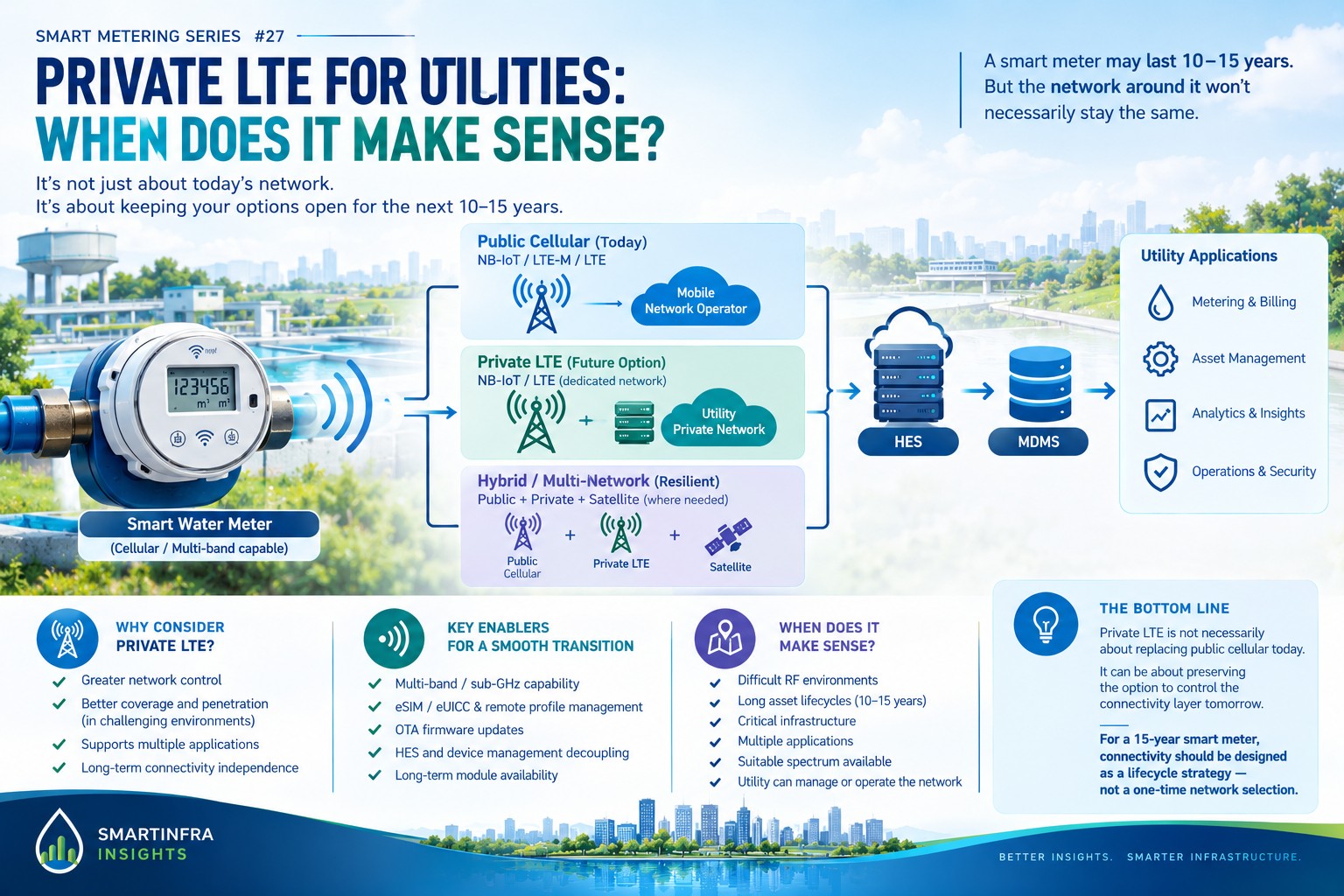
Introduction
A smart water meter may be designed to operate for 10–15 years.
But can the network connecting that meter be expected to remain unchanged for the same period?
This is an increasingly important question for utilities deploying cellular smart metering.
Public NB-IoT and other cellular IoT technologies can be highly attractive for AMI. They provide wide-area coverage, use established mobile infrastructure and allow utilities to connect large numbers of meters without building their own telecommunications network.
For many deployments, that remains a practical approach.
But a long-life smart meter creates a different strategic problem.
The meter may remain physically operational for more than a decade while the communications environment around it can change several times during that period.
Mobile network strategies evolve. Spectrum can be reorganized. Network technologies change. Commercial arrangements change. Operators change. Coverage priorities change.
This creates a fundamental question:
Should a utility design its smart metering system around today's public cellular network, or should it preserve the option to control the connectivity layer in the future?
This is where Private LTE becomes interesting.
Not necessarily as a replacement for public cellular from Day 1, but as a potential long-term connectivity strategy.
Key Takeaways
- Smart meter and network lifecycles do not necessarily align.
- Public cellular remains attractive because it provides established infrastructure, coverage and managed connectivity without requiring the utility to own the network.
- Private LTE provides greater control over coverage, capacity, authentication, traffic policies and network operations, but also transfers more responsibility to the utility.
- Private LTE does not necessarily mean using private connectivity exclusively; a public-to-private transition can be part of a longer-term architecture.
- Cellular module selection, spectrum, antenna design, enclosure losses and network density all affect real-world performance.
- RF performance can indirectly affect battery life because poor connectivity increases retries, signalling and radio activity.
- eSIM/eUICC, OTA and HES independence can help preserve future connectivity flexibility.
- The business case should consider total lifecycle cost and operational risk rather than comparing only monthly connectivity fees with network infrastructure costs.
- Private LTE becomes more attractive when difficult RF environments, long asset lifecycles, multiple applications and the need for greater network control come together.
- For many deployments, public NB-IoT or other managed connectivity may remain appropriate.
- The strategic objective is not necessarily to predict the future network technology correctly, but to keep future connectivity options open.
The Smart Meter May Outlive the Network Strategy
One of the easiest assumptions to make during an AMI project is that the connectivity selected during procurement will remain the connectivity used throughout the meter's operational life.
That assumption deserves more attention.
Consider a simplified deployment:
2026
Smart meters are installed using public NB-IoT.
2030
The meters are still operating normally.
2035
The utility's connectivity requirements, network environment or commercial arrangements have changed.
2040
Many of the original meters may still be physically serviceable.
The challenge is that the meter's lifecycle and the communications network's lifecycle are not necessarily synchronized.
This is a form of lifecycle mismatch.
The physical asset may have a 10–15 year design life. The battery may be engineered around that same period. Firmware may continue to evolve through OTA updates.
But the utility may not control the underlying public network.
This does not mean public cellular networks are unsuitable for long-term AMI.
It means utilities should avoid assuming that today's connectivity model is automatically guaranteed for the entire lifecycle.
Why Public NB-IoT Is Still Attractive
Before discussing Private LTE, it is important to recognize why public cellular remains such a strong option.
A public mobile network already provides much of the infrastructure required for connectivity.
The utility can potentially benefit from:
- Existing network coverage
- Established telecommunications infrastructure
- Large-scale network operations
- SIM/eSIM-based device authentication
- Managed connectivity
- Lower utility-owned infrastructure requirements
- Faster deployment
- Mature cellular device ecosystems
For a battery-powered water meter transmitting periodic readings, these advantages can be substantial.
The utility does not necessarily need to own a cellular network simply to collect meter data.
This is why the discussion should not be framed simply as:
Public cellular versus Private LTE — which technology is better?
The more useful question is:
What level of network control does the utility need over the expected lifecycle of the AMI system?
What Changes With Private LTE?
Private LTE introduces a different operating model.
Instead of depending entirely on a mobile network operator, the utility — or a managed private-network provider acting on its behalf — can operate a dedicated cellular network for its infrastructure.
Depending on the architecture and regulatory environment, this can provide greater control over:
- Coverage
- Network capacity
- Device admission
- Authentication
- Traffic policies
- Quality of service
- Network monitoring
- Connectivity management
- Operational priorities
This can be particularly relevant when communications become part of the utility's operational infrastructure rather than simply a data transport service.
But there is an important trade-off.
More control also means more responsibility.
A private network requires investment, spectrum planning, infrastructure, cybersecurity, monitoring, maintenance, upgrades and lifecycle management.
Private LTE should therefore not be treated as a free upgrade to public cellular.
It is a different architecture and operating model.
Private LTE Does Not Necessarily Mean “Private Only”
This is one of the most important concepts.
A utility does not necessarily need to choose between:
100% public cellular
and
100% private cellular.
There can be an intermediate strategy.
The AMI architecture can be designed so that public cellular is used initially while preserving the possibility of introducing private cellular later.
Conceptually:
Today
Smart Meter → Public Cellular → HES → MDMS
Future option
Smart Meter → Private Cellular → HES → MDMS
The application systems do not necessarily need to know — or care — which underlying network is carrying the traffic.
That separation is valuable.
The HES should manage devices and communications without becoming tightly coupled to one particular network ownership model.
Similarly, the meter's application and device-management architecture should not be unnecessarily dependent on a particular carrier.
This is the principle of architectural decoupling.
Designing for a Public-to-Private Transition
If a utility wants to preserve this option, the decision needs to be made early.
It is much easier to design for future connectivity flexibility before thousands or millions of meters are installed than to retrofit the fleet later.
Several areas deserve attention.
Cellular Module Selection
The cellular module should be evaluated against the expected lifecycle of the meter.
Questions include:
- How long will the module remain available?
- Which cellular technologies does it support?
- Which relevant frequency bands are supported?
- Can it operate across different network configurations?
- Can the module firmware be updated?
- Is the module ecosystem expected to remain viable over the AMI lifecycle?
A module selected purely because it works with today's network may create unnecessary constraints later.
Sub-GHz Cellular Spectrum
For many utility deployments, sub-GHz cellular spectrum can be particularly interesting because lower frequencies generally offer favorable propagation characteristics.
This can be valuable when meters are installed:
- Underground
- Inside meter chambers
- Behind walls
- Inside cabinets
- In basements
- In dense urban environments
- In locations with difficult radio paths
However, frequency alone does not determine performance.
Actual RF performance depends on the complete link budget, including:
- Transmit power
- Receiver sensitivity
- Antenna efficiency
- Antenna placement
- Cable and enclosure losses
- Interference
- Network density
- Propagation environment
- Installation conditions
A lower-frequency network can provide favorable propagation, but poor antenna implementation or inadequate network planning can still produce poor results.
This is why connectivity should be treated as a network engineering problem, not simply a technology-selection exercise.
The Meter Enclosure Can Be the Real Network Challenge
Smart water meters are often installed in environments that are much more hostile to radio communication than laboratory conditions suggest.
A meter may be located inside:
- Underground chambers
- Covered pits
- Concrete structures
- Metal cabinets
- Ground-level enclosures
- Building service rooms
The radio signal must travel through the actual installation environment.
This creates a critical distinction between:
Coverage on a network map
and
Connectivity at the meter.
A network can appear to have excellent geographic coverage while individual meters experience poor signal quality because of their physical installation.
This is one reason Private LTE can become attractive for some utility environments.
A utility that controls the network can potentially engineer coverage and capacity around the actual infrastructure rather than relying entirely on a pre-existing public network footprint.
But this advantage should be demonstrated through field measurements.
A pilot should test the worst installation conditions, not just convenient test locations.
Network Density Matters Too
Another common misconception is that spectrum alone determines connectivity performance.
It does not.
Consider two networks operating at similar frequencies. One has carefully engineered coverage, sufficient base-station density and adequate link margin. The other has sparse infrastructure and marginal coverage.
The radio frequency may be similar, but the field performance can be very different.
For AMI, network planning should therefore consider:
- Meter density
- Building density
- Terrain
- Installation depth
- Antenna performance
- Expected traffic
- Network capacity
- Coverage margin
- Retransmissions
- Peak communication periods
Private LTE provides more control, but the utility also becomes more responsible for getting the engineering right.
Private LTE and Battery Life
There is an important connection between network architecture and smart meter battery life.
A water meter does not consume energy only when it sends useful application data.
Poor RF conditions can result in:
- Retransmissions
- Longer connection procedures
- Additional signalling
- Repeated communication attempts
- Extended radio activity
All of these can affect energy consumption.
The relationship can be thought of as:
Poor RF environment
↓
More communication effort
↓
More retries and radio activity
↓
Higher energy consumption
↓
Potentially shorter battery life
This is why a 15-year battery specification cannot be evaluated independently from the communication architecture.
Battery engineering, firmware behavior, radio performance and network design are interconnected.
What About NB-IoT in a Private Network?
The terminology can become confusing here.
Private LTE does not automatically mean private NB-IoT.
A utility needs to determine exactly what cellular technology and network architecture the private deployment will support.
Relevant questions include:
- Is NB-IoT required?
- Is LTE connectivity sufficient?
- What spectrum is available?
- Does the selected infrastructure support the required IoT functionality?
- Are the meters compatible?
- How will devices authenticate?
- How will SIM/eSIM profiles be managed?
- How will the private network connect to the HES?
- How will roaming or fallback be handled if required?
The important principle is:
Do not specify “Private LTE” as a solution without specifying the actual connectivity requirements of the meter fleet.
The network architecture and device architecture must be designed together.
Keep the HES Independent
The transition from public to private connectivity also has implications beyond the radio network.
The HES sits between the field devices and the utility's backend systems.
Ideally, the HES should abstract much of the underlying connectivity complexity.
Conceptually:
Meter → Connectivity → HES → MDMS → Applications
If the connectivity layer changes from one network environment to another, the rest of the AMI system should require as little change as practical.
This becomes increasingly important as utilities operate multi-vendor environments.
The HES should not become permanently tied to:
- One MNO
- One connectivity technology
- One modem supplier
- One meter manufacturer
- One network architecture
A well-designed system creates boundaries between these layers.
eSIM and Remote Connectivity Management
Device identity is another important consideration.
For a large smart-meter fleet, physically changing SIM cards is impractical.
This is where eSIM/eUICC-based approaches can become strategically useful, depending on the deployment architecture.
Remote profile management can potentially allow connectivity arrangements to evolve without physically accessing every meter.
This does not solve every migration problem.
A device still needs compatible hardware, firmware, network support and appropriate provisioning.
But it can reduce one important form of physical dependency.
For a meter expected to remain installed for 10–15 years, that flexibility can be valuable.
OTA Becomes Part of the Strategy
A future connectivity transition may require changes to:
- Modem firmware
- Device firmware
- Configuration
- Network profiles
- Security credentials
- Communication parameters
If meters cannot be safely updated remotely, the cost of a network transition can become enormous.
This means OTA capability should not be considered only as a cybersecurity or maintenance feature.
It can also become an asset-lifecycle enabler.
The combination of:
Long-life hardware + Remote firmware management + Flexible connectivity
can give utilities substantially more options over the lifetime of the AMI deployment.
The Economics of Private LTE
The business case should be evaluated over the full lifecycle.
Public cellular typically shifts much of the infrastructure investment and operational responsibility to the network operator.
Private LTE moves more of that responsibility toward the utility.
The cost model therefore changes.
Public Cellular
- Connectivity fees
- SIM/eSIM management
- Operator dependency
- Contractual arrangements
- Coverage availability
- Future network changes
Private LTE
- Spectrum
- Radio infrastructure
- Core network
- Backhaul
- Site infrastructure
- Network management
- Cybersecurity
- Maintenance
- Upgrades
- Technical resources
- Lifecycle replacement
The correct comparison is therefore not simply:
Monthly SIM cost vs. Private LTE equipment cost.
It should be:
Total cost and operational risk over the expected AMI lifecycle.
A private network may be difficult to justify for a small deployment with simple connectivity requirements.
It can become more relevant when the same infrastructure supports many utility applications and when long-term network control has significant operational value.
When Does Private LTE Make Sense?
There is no universal answer.
Private LTE becomes more attractive when several conditions come together.
1. Difficult RF Environments
The utility operates large numbers of devices in locations where reliable coverage is difficult.
2. Long Asset Lifecycles
Meters and connected assets are expected to remain deployed for 10–15 years or more.
3. Connectivity Is Operationally Important
Communication reliability affects more than periodic data collection.
4. Multiple Applications Can Share the Network
Metering, telemetry, operational monitoring and other connected assets can potentially use the same infrastructure.
5. The Utility Needs Greater Control
Coverage, capacity, security, device access or operational policies require greater control than the public network model provides.
6. Suitable Spectrum Is Available
The regulatory and spectrum environment supports an economically viable private-network deployment.
7. The Utility Can Operate or Manage the Network
The organization has the resources — or a capable managed-service partner — to operate the infrastructure over its lifecycle.
When Does It Not Make Sense?
Private LTE is not automatically the right answer.
Public cellular may remain appropriate when:
- Coverage is already strong
- The application has modest data requirements
- The number of devices is relatively small
- The utility does not need dedicated network control
- Network ownership would add unnecessary complexity
- Suitable private spectrum is unavailable
- The additional lifecycle cost cannot be justified
In these situations, the utility may be better served by public NB-IoT, LTE-M or another appropriate connectivity technology.
The objective should always be fit for purpose, not technology ownership.
What Utilities Should Ask During Procurement
Perhaps the most useful change in procurement is to stop asking only:
“Does the meter support NB-IoT?”
Instead, ask a broader set of lifecycle questions.
Connectivity
- Which cellular bands are supported?
- Which network configurations are supported?
- Can the device operate across different network environments?
Hardware Lifecycle
- How long will the cellular module remain available?
- What is the manufacturer's long-term support strategy?
Device Management
- Does the meter support secure OTA updates?
- Can connectivity parameters be remotely managed?
Identity
- Can SIM/eSIM/eUICC approaches be supported?
- How is device identity managed over the lifecycle?
System Architecture
- Is the HES independent of the underlying network?
- Can the utility change connectivity providers without redesigning the entire AMI system?
Migration
- If the public cellular environment changes, what options does the utility have?
- Can the meter remain in service without physical replacement?
These questions can reveal architectural limitations that may not appear in a conventional meter specification.
The Bigger Lesson: Avoid Connectivity Lock-In
A 15-year smart meter is more than a metering device.
It is a long-lived connected asset.
Its value depends on several layers continuing to work together:
Meter → Firmware → Connectivity → HES → MDMS → Analytics → Utility Operations
If one layer becomes obsolete or commercially unavailable, the rest of the system can be affected.
This is why utilities should think about architectural independence.
The objective is not to predict exactly which network technology will dominate ten years from now.
That prediction is difficult.
The objective is to design today's system so that tomorrow's connectivity options remain open.
Private LTE Is a Strategic Option, Not a Default
Private LTE can provide utilities with greater control over connectivity, coverage and network operations.
But that does not mean every utility should build a private cellular network.
For many smart-metering deployments, public NB-IoT or other managed connectivity options may remain appropriate.
The more interesting strategy is sometimes to use public cellular without becoming permanently dependent on it.
That requires decisions at the beginning of the AMI project:
- Select suitable cellular hardware
- Consider relevant sub-GHz capabilities
- Separate connectivity from application architecture
- Keep HES interfaces flexible
- Use remote device management
- Plan for OTA updates
- Consider eSIM/eUICC where appropriate
- Evaluate future network migration
- Assess lifecycle cost rather than only initial CAPEX
The utility may never need Private LTE.
But if the architecture preserves the option to introduce it later, the utility has created something valuable:
Choice.
The Question to Ask Before Deployment
Private LTE is often presented as a question of network technology.
For long-life smart metering, it is better viewed as a question of lifecycle strategy.
The important question is not:
“Should we deploy Private LTE today?”
It is:
“If our connectivity strategy changes five or ten years from now, can our meters continue operating without replacing the fleet?”
That question changes how the entire AMI architecture is designed.
Public cellular may be the right answer today.
Private cellular may become the right answer tomorrow.
Or the utility may ultimately use a combination of connectivity technologies.
The most resilient architecture is therefore not necessarily the one that predicts the future correctly.
It is the one that keeps its options open when the future turns out differently.
For a 15-year smart meter, connectivity should be designed as a lifecycle strategy — not a one-time network selection.
Conclusion
Private LTE can provide utilities with greater control over connectivity, coverage, capacity and network operations.
But the decision to deploy it should not begin with the technology itself.
It should begin with the utility's operational requirements, asset lifecycle, RF environment, network-control requirements, available spectrum, applications and total lifecycle economics.
For many smart water deployments, public cellular may remain the most practical connectivity model.
For others, particularly where difficult RF conditions, long asset lifecycles, multiple applications and greater network control come together, private connectivity may warrant closer evaluation.
There is also a middle path: design today's public-cellular AMI architecture so that future connectivity options remain open.
That requires attention to:
- Cellular module selection
- RF and antenna design
- HES independence
- eSIM/eUICC
- OTA capability
- Device lifecycle management
- Network migration
- Total cost of ownership
The key principle is simple:
The utility does not need to predict the future network correctly. It needs to avoid designing itself out of future options.
Read the Full Article on Medium
This article was originally published on Medium, where the full discussion explores Private LTE, public cellular, lifecycle flexibility, RF performance, battery life, HES independence, eSIM, OTA and the economics of utility connectivity.
Related Smart Metering Topics
- NB-IoT vs LoRaWAN vs LTE-M: Choosing the Right IoT Connectivity for Smart Utilities
- NB-IoT vs LoRaWAN in Real Deployments: What Actually Happens in the Field
- What Is NB-IoT? A Practical Guide for IoT and Smart Metering Deployments
- Smart Meter Battery Life Explained: Why “10 Years” Is Not Just a Specification
- OTA Firmware Update Challenges in AMI: Why Updating Millions of Smart Meters Is Harder Than It Looks
- Head-End Systems (HES) Explained: The Communication Hub of AMI
- Interoperability in Multi-Vendor AMI Systems
- Utility Procurement for AMI: How to Avoid Costly Mistakes