AMI Operations
OTA Firmware Update Challenges in AMI: Why Updating Millions of Smart Meters Is Harder Than It Looks
Why OTA firmware management becomes a system-level challenge when updating large fleets of battery-powered smart meters across real-world communication networks.
Introduction
Firmware is relatively easy to update when a device is sitting on an engineer's desk.
Connect a cable, load the firmware, restart the device and verify that it works.
Now consider doing the same thing to hundreds of thousands or millions of smart meters installed across a city.
Many may be underground, operating on batteries and connected through communication networks that are not always reliable. The meters may also be expected to remain in service for 10–15 years.
The problem changes completely.
This is where Over-the-Air (OTA) firmware management becomes one of the most important and underestimated capabilities in an AMI system.
OTA is not simply a convenient way to send a new firmware file.
It is a system-level challenge involving:
- Reliability
- Security
- Communication
- Battery consumption
- Device architecture
- Fleet operations
The real question is:
How can a utility safely change software inside thousands or millions of field devices without physically touching them — and without turning a software update into a hardware replacement exercise?
Key Takeaways
- Firmware updates are inevitable in long-lived AMI deployments because bugs, vulnerabilities, communication changes and new requirements will emerge.
- OTA should be treated as an end-to-end operational capability rather than simply a firmware feature.
- Battery-powered smart water meters require careful management of the additional energy consumed during firmware updates.
- Poor network conditions can make large firmware transfers much more difficult than normal meter readings.
- Fail-safe firmware architecture, such as dual-bank designs, can reduce the risk of rendering a meter unusable.
- Rollback and recovery must be designed before large-scale deployment.
- Firmware integrity and authenticity are both important; integrity alone does not prove that an image is trustworthy.
- Full and differential firmware updates involve different trade-offs between simplicity, data volume, energy consumption and complexity.
- OTA campaigns should be staged and throttled rather than updating the entire fleet simultaneously.
- Utilities need reliable firmware inventory and campaign-level monitoring.
- The most valuable OTA testing focuses on failure scenarios rather than only successful updates.
Why Smart Meter Firmware Needs to Be Updated
A modern smart meter is no longer a static measuring instrument.
It contains embedded processors, communication modules, sensors, memory, security functions and increasingly sophisticated software.
Over a long deployment lifecycle, firmware updates may become necessary for several reasons.
Bug Fixes
Software defects may only become visible after field deployment.
Firmware updates can address issues involving:
- Communication
- Measurement processing
- Memory management
- Unexpected resets
- Data handling
- Battery management
Communication Improvements
Network conditions and communication technologies can change over the life of an AMI deployment.
Firmware may need to improve:
- Network registration
- Retry handling
- Signal management
- Communication timing
- Protocol compatibility
- Data transmission efficiency
Security Patches
Security vulnerabilities can emerge years after meters have been installed.
If the device cannot be securely updated, a vulnerability discovered later in the lifecycle can become a major operational problem.
New Features
Utilities may eventually require capabilities that were not included in the original deployment.
Examples can include:
- New data parameters
- Additional diagnostics
- Improved event detection
- New communication functions
- Enhanced leak detection
- New device-management capabilities
This creates a fundamental requirement:
The smart meter must be designed for change.
OTA Is Not Just “Sending a New Firmware File”
A simplistic OTA architecture might look like:
Firmware File → Network → Meter
A production AMI system is much more complicated.
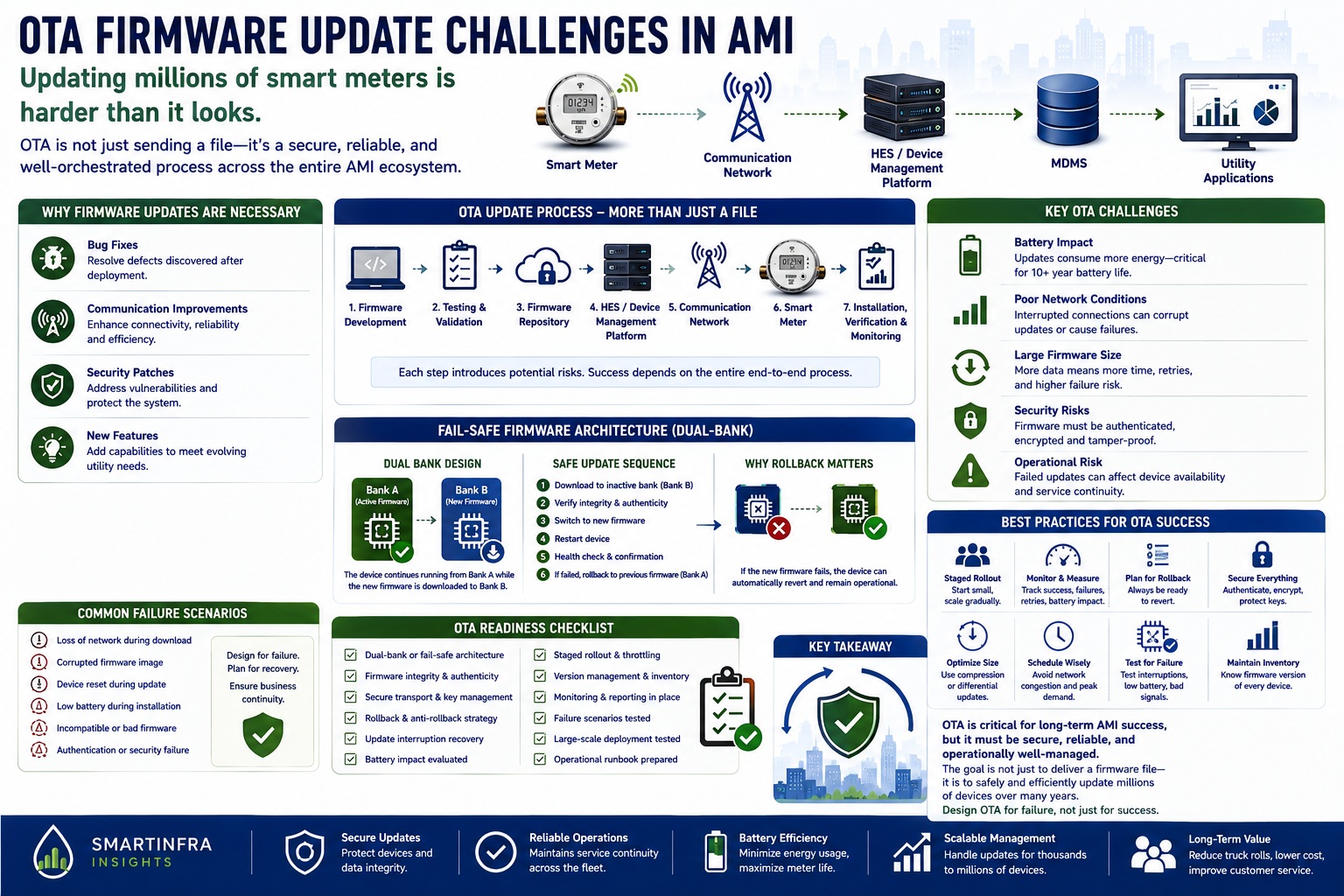
A typical OTA process involves:
Firmware Development
↓
Testing & Validation
↓
Firmware Repository
↓
HES / Device Management Platform
↓
Communication Network
↓
Smart Meter
↓
Installation & Verification
↓
Monitoring & Rollback
Every stage introduces potential failure.
The firmware itself may be correct, but:
- Communication can fail
- The meter can lose power
- The update can be interrupted
- The wrong firmware can be selected
- The device can reject the image
- The new firmware can contain an unexpected defect
OTA should therefore be treated as an end-to-end operational capability.
The Battery Problem
Battery-powered smart water meters introduce another major challenge.
An OTA update requires communication, and communication consumes energy.
Firmware updates can require substantially more communication than normal meter reading.
Consider a meter that normally reports once per day. Its normal communication pattern may be relatively predictable.
An OTA update could require:
- Device wake-up
- Network connection
- Authentication
- Firmware download
- Packet retransmission
- Image verification
- Flash programming
- Restart
- Post-update communication
A large firmware image can therefore represent a significant increase in energy consumption.
For a mains-powered device this may be less important.
For a battery-powered meter expected to operate for ten years or more, it can be critical.
The OTA strategy therefore needs to consider:
Firmware size + communication quality + retry rate + update frequency + battery capacity
—not simply whether OTA is supported.
Poor Network Conditions Change Everything
An OTA process that works well in a laboratory can behave very differently in the field.
Smart meters may be installed:
- Underground
- Inside meter chambers
- In basements
- Inside buildings
- Behind concrete structures
- In weak cellular coverage areas
- In locations affected by interference
A normal daily reading may succeed even under marginal communication conditions.
A large firmware transfer is different.
A firmware update may require many more packets and therefore provide more opportunities for failure.
If the connection drops halfway through the transfer, the system needs a safe recovery mechanism.
The meter must not be left in an unusable state simply because communication was interrupted.
The Importance of Fail-Safe Firmware Architecture
One of the most important design decisions is how firmware is stored inside the device.
A robust approach is to use two firmware banks.
A simplified architecture is:
Bank A — Active Firmware
Bank B — New Firmware
The meter continues operating from Bank A while the new firmware is downloaded into Bank B.
Once the complete image has been received, the device can:
- Verify the firmware
- Check its integrity
- Validate its authenticity
- Switch to the new firmware
- Restart
- Confirm successful operation
If the new firmware fails to start correctly, the device can potentially revert to the previous firmware.
This is fundamentally safer than overwriting the only working firmware image.
Why Rollback Matters
Imagine updating 100,000 meters.
The first 1,000 appear successful.
Then an unexpected software problem is discovered.
What happens next?
Without a rollback strategy, the utility may face a serious operational problem.
With a properly designed rollback mechanism, the system can:
Detect failure → Stop rollout → Restore previous firmware
This leads to an important principle:
Never assume that a firmware update will always succeed. Design for failure before designing for success.
Firmware Integrity Is Not Enough
A firmware image can become corrupted during transmission.
The meter therefore needs to verify the image before activation.
This can involve integrity mechanisms such as checksums or cryptographic hashes.
But integrity alone is not sufficient.
An attacker could potentially provide a perfectly intact but malicious firmware image.
Modern OTA architectures should therefore also consider firmware authenticity.
The device needs to determine:
“Was this firmware actually released by an authorized source?”
Digital signatures and secure key management become important here.
A secure OTA process therefore needs to address:
- Authentication
- Firmware integrity
- Firmware authenticity
- Access control
- Key management
- Secure transport
- Version control
Preventing Firmware Downgrade Attacks
Firmware version management introduces another security consideration.
Suppose a vulnerability exists in Firmware Version 1.0 and the utility upgrades the fleet to Version 2.0.
An attacker should not simply be able to reinstall Version 1.0.
This is why secure firmware architectures may include anti-rollback mechanisms.
The meter can maintain a minimum permitted firmware version.
For example:
Version 1.0 → Version 2.0 → Version 2.1
Once the device has securely moved beyond a vulnerable version, older firmware may no longer be accepted.
However, this needs careful design.
There can be legitimate operational situations where rollback is required.
Therefore, security rollback protection and operational rollback capability need to be designed together.
The Firmware File Is Only Part of the Problem
Firmware size has a direct impact on OTA performance.
A larger firmware image means:
More data → More communication → More time → More energy → More opportunities for failure
This is particularly important for low-power smart water meters.
Firmware architecture should therefore consider:
- Firmware size
- Memory availability
- Flash-write cycles
- Download chunk size
- Compression
- Differential updates
- Communication retries
- Storage for backup firmware
A smaller and more modular firmware architecture can make remote maintenance considerably easier.
Full Firmware vs Differential Updates
There are two broad approaches to firmware delivery.
Full Firmware Update
The complete firmware image is transmitted to the device.
Advantages:
- Simpler concept
- Easier image management
- Straightforward validation
Disadvantages:
- Larger data transfer
- Higher energy consumption
- Longer update time
Differential Update
Only the changes between the existing firmware and the new version are transmitted.
Advantages:
- Smaller data transfer
- Lower communication cost
- Potentially lower battery impact
Disadvantages:
- More complex implementation
- Greater dependency on the existing firmware version
- More complicated validation
- More complex recovery scenarios
For large battery-powered deployments, smaller update packages can provide meaningful benefits, but the additional complexity needs to be weighed against operational reliability.
Don't Update Every Meter at Once
A common mistake is to treat OTA like a software deployment to cloud servers.
Smart meters are physical devices distributed across a geographic area.
A safer strategy is staged deployment.
For example:
Stage 1 — Internal Test Devices
↓
Stage 2 — Small Field Group
↓
Stage 3 — 1% of Deployment
↓
Stage 4 — 10%
↓
Stage 5 — 25%
↓
Stage 6 — Remaining Fleet
The exact percentages can vary.
The principle is what matters:
Start small. Measure. Learn. Then scale.
What Should Be Monitored During an OTA Campaign?
An OTA campaign should generate operational KPIs.
Download Success Rate
How many devices successfully received the firmware?
Activation Success Rate
How many devices successfully switched to the new version?
Rollback Rate
How many devices reverted to the previous firmware?
Communication Retry Rate
How much additional communication was required?
Battery Impact
How much energy was consumed by the update?
Device Availability
Did the update cause temporary or permanent communication loss?
Geographic Failure Patterns
Are failures concentrated in particular locations?
Firmware Version Distribution
How many meters remain on each firmware version?
This last metric is particularly important.
A utility should always know:
What firmware is currently running on every device?
Firmware Inventory Is a Core AMI Capability
Imagine a fleet of 500,000 smart meters.
After several years, the utility may have multiple firmware generations operating simultaneously.
Without reliable firmware inventory, the utility may not know which devices are exposed to a particular vulnerability or which devices still require an update.
Firmware version management should therefore be part of device lifecycle management.
The utility should be able to answer:
- Which firmware is installed?
- When was it installed?
- Was the update successful?
- What failed?
- Which devices were rolled back?
- Which devices still require updating?
OTA Can Become a Communication Storm
Another problem can occur when thousands of meters attempt to download firmware simultaneously.
The resulting traffic can put pressure on:
- Cellular networks
- LoRaWAN infrastructure
- RF networks
- HES platforms
- Backend systems
The utility may unintentionally create a communication storm.
OTA campaigns should therefore be scheduled and throttled.
The system may need to control:
- Maximum concurrent updates
- Geographic rollout
- Time windows
- Retry intervals
- Bandwidth usage
- Device wake-up schedules
The objective is not to update as many devices as quickly as possible.
The objective is to update the fleet safely and predictably.
What Happens When a Meter Goes Offline?
A robust OTA system needs to assume that some devices will be unavailable.
A meter may:
- Lose network coverage
- Run out of battery
- Be physically disconnected
- Be temporarily inaccessible
- Experience repeated communication failures
The OTA platform therefore needs a retry strategy.
But retrying indefinitely is not necessarily a good solution.
Repeated attempts consume both energy and communication resources.
The system should distinguish between:
Temporary failure
and
Persistent failure
This allows field teams to investigate problematic devices rather than continuously consuming resources on repeated failed attempts.
OTA and Device Lifecycle Management
OTA should not be designed as a standalone function.
It should form part of a broader device-management strategy.
A mature AMI platform should ideally support:
Provisioning
↓
Configuration
↓
Monitoring
↓
Diagnostics
↓
Firmware Management
↓
Security Management
↓
Retirement
This becomes particularly important for deployments lasting more than a decade.
The meter installed today may need to support several generations of software and communication requirements.
Procurement Mistakes to Avoid
Utilities should be careful when writing OTA requirements into procurement specifications.
A requirement such as:
“The meter shall support OTA firmware updates.”
is not sufficient.
A stronger specification should address:
- Maximum firmware image size
- Dual-bank or equivalent fail-safe architecture
- Firmware integrity verification
- Firmware authenticity
- Secure update mechanism
- Rollback capability
- Anti-rollback requirements
- Update interruption recovery
- Firmware version tracking
- Update success reporting
- Battery impact
- Retry management
- Fleet-level update control
Most importantly:
These capabilities should be demonstrated in testing.
OTA should not be accepted based solely on a product datasheet.
The Most Important OTA Test Is Failure Testing
The easiest test is:
Send firmware → Update succeeds.
The more valuable tests are:
- What happens when the network disappears halfway through?
- What happens when the meter resets during download?
- What happens when the firmware image is corrupted?
- What happens when authentication fails?
- What happens when battery voltage becomes too low?
- What happens when the new firmware fails to boot?
- What happens when thousands of devices fail simultaneously?
These scenarios reveal whether OTA is genuinely production-ready.
A Practical OTA Readiness Checklist
Before deploying OTA across a large AMI fleet, utilities should be able to answer “yes” to questions such as:
Architecture
- Is there sufficient memory for safe firmware replacement?
- Is there a fail-safe update mechanism?
- Can the previous firmware be restored if required?
Security
- Is the firmware authenticated?
- Is firmware integrity verified?
- Is the update process protected against unauthorized access?
- Is key management properly designed?
Communication
- Can updates tolerate interrupted communication?
- Are retries controlled?
- Can update traffic be throttled?
Battery
- Has the energy impact been measured?
- Can the meter safely perform an update at low battery voltage?
- Is the expected battery impact included in the lifecycle model?
Operations
- Can the utility identify the firmware version on every device?
- Can updates be staged?
- Can failed devices be identified?
- Can a campaign be stopped quickly?
Testing
- Have failure scenarios been tested?
- Has the process been tested under poor network conditions?
- Has large-scale deployment been simulated?
The Bigger Lesson
OTA firmware management illustrates a broader principle in smart metering:
The difficult part is not creating the technology. The difficult part is operating it reliably at scale.
Downloading firmware to one meter is an engineering task.
Updating hundreds of thousands of meters safely is an operational system.
It requires coordination between:
- Embedded firmware
- Hardware
- Communication networks
- HES
- Cybersecurity
- Device management
- Battery management
- Field operations
- Data analytics
This is why OTA should be considered during meter architecture and procurement — not added as an afterthought.
Conclusion
Firmware updates are inevitable in a long-lived smart metering deployment.
Security vulnerabilities will emerge. Software bugs will be discovered. Communication technologies will evolve. New functionality will be required. Operational requirements will change.
A meter that cannot be safely updated remotely may eventually become an expensive field-maintenance problem.
But OTA itself introduces new risks.
A poorly designed update process can:
- Consume battery energy
- Overload communication networks
- Create inconsistent firmware versions
- Increase operational complexity
- Make devices unusable
The solution is not simply to specify:
“OTA supported.”
Utilities should design and evaluate the entire lifecycle:
Secure firmware → Controlled distribution → Reliable download → Verification → Safe activation → Monitoring → Rollback → Fleet management
The most important principle is simple:
Design OTA for failure, not just for success.
In a fleet of thousands or millions of smart meters, some devices will inevitably fail to update.
The quality of an OTA system is determined by what happens when things go wrong.
That is what separates a firmware feature from a truly production-ready AMI capability.
Read the Full Article on Medium
This article was originally published on Medium, where the full discussion explores the practical challenges of OTA firmware updates across large AMI fleets, including battery impact, network reliability, fail-safe architecture, rollback, security and fleet-level operations.
Related Smart Metering Topics
- Firmware Management in AMI: The Hidden Operational Challenge
- Smart Meter Battery Life Explained: Why “10 Years” Is Not Just a Specification
- Head-End Systems (HES) Explained: The Communication Hub of AMI
- Cybersecurity in Smart Metering: Real Risks, System Weaknesses, and Practical Defenses
- Interoperability in Multi-Vendor AMI Systems
- DLMS/COSEM Explained Practically: What Utilities Need to Know Before Choosing a Metering Protocol
- Smart Meter Rollout Strategy: Phased vs Full Deployment
- Utility Procurement for AMI: How to Avoid Costly Mistakes