Introduction
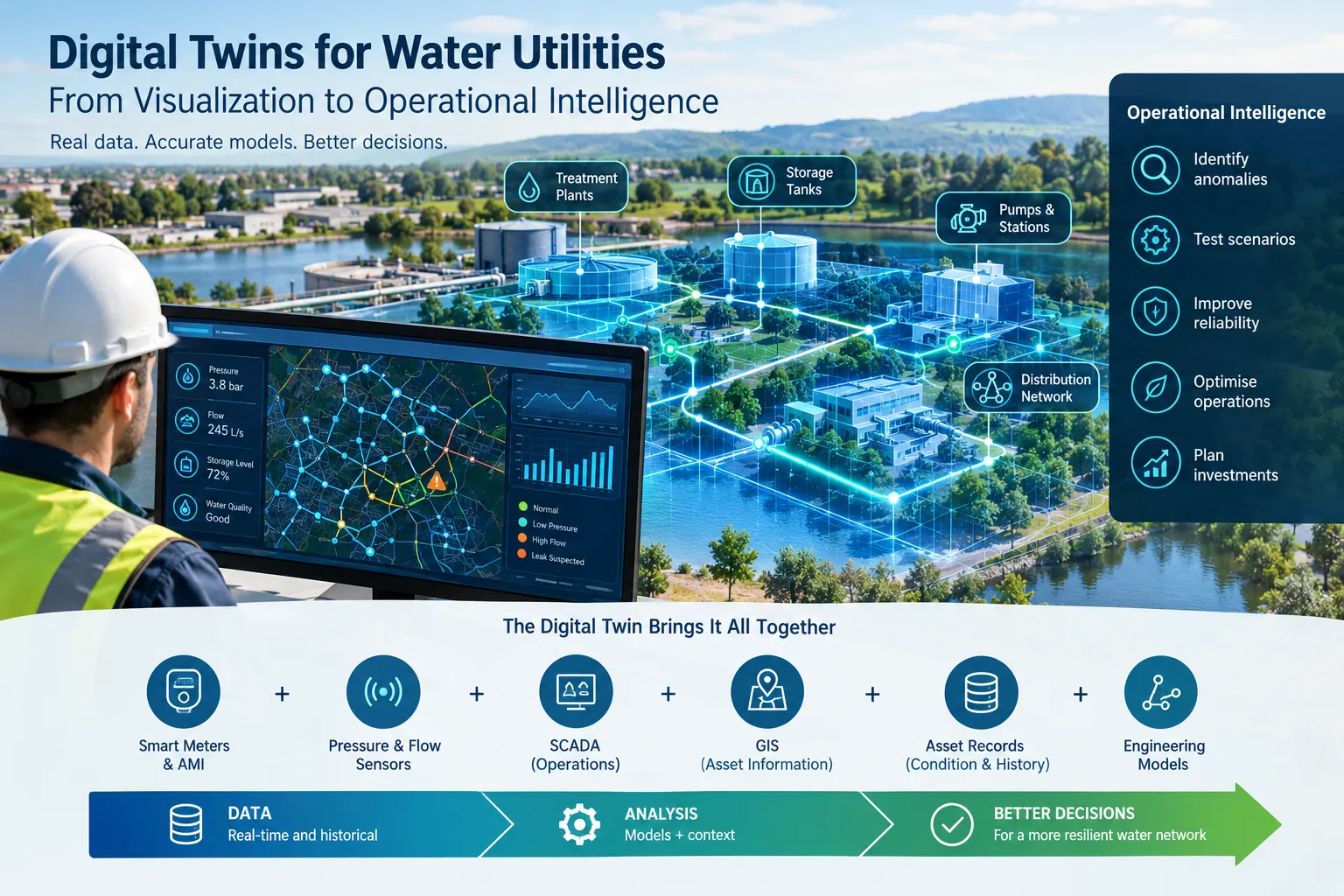
Water utilities are collecting information from more sources than ever before. Smart meters provide consumption readings, pressure and flow sensors reveal network conditions, SCADA systems monitor operational assets, and GIS describes the location and relationships of infrastructure.
However, having more data does not automatically mean a utility understands how its network behaves or how it might respond to changing conditions.
A digital twin brings together information about physical infrastructure, engineering models and analytical capabilities to help utilities investigate system behaviour and evaluate possible actions.
The distinction is important: visualization helps operators see the system; operational intelligence helps them interpret it.
Key Takeaways
- A digital twin is a dynamic digital representation of a physical asset, process or system.
- A sophisticated 3D visualisation alone does not make a useful digital twin.
- Digital twins can support pressure analysis, leakage investigation, scenario evaluation and asset planning.
- AMI contributes consumption information but cannot represent the entire physical water network.
- Pressure, flow, GIS, SCADA, asset records and engineering models provide complementary information.
- Data integration, model calibration and operational ownership are critical implementation challenges.
- Simulation results depend on model accuracy and assumptions; they are not guaranteed predictions.
- Utilities should begin with a specific operational decision rather than attempting to model everything.
What Is a Digital Twin in Water Utilities?
A digital twin is a dynamic digital representation of a physical asset, process or system. Depending on its purpose, it can combine operational data, engineering models, asset information and analytical tools to support monitoring, simulation and decision-making.
For a water utility, the scope could be a single pump, a treatment process, a district metered area (DMA), or a larger water distribution network.
The important distinction is not whether the system has a sophisticated 3D interface. It is whether the digital representation is sufficiently connected to real-world conditions and useful for the decisions it is intended to support.
Where Can Digital Twins Create Value?
1. Understanding Network Pressure and Performance
Water distribution networks respond to changes in demand, pump operation, valve positions and other operating conditions.
A digital twin supported by suitable network models and reliable pressure and flow measurements can help engineers investigate these relationships.
For example, when pressure falls in a particular area, engineers can compare measured conditions with modelled expectations and explore possible contributing factors.
The model does not automatically identify the cause. Inaccurate asset records, inadequate sensor coverage or outdated models can produce misleading results.
2. Investigating Leakage and Unusual Consumption
A digital twin can bring together information that would otherwise be examined separately:
- Smart meter consumption patterns
- District-level inflow measurements
- Pressure and flow data
- Network topology and asset records
- Historical operating conditions
For example, a DMA may show an unexpected increase in inflow while recorded customer consumption remains relatively stable. This discrepancy could justify further investigation.
The digital twin can help engineers explore possible explanations and identify areas requiring closer examination.
However, an anomaly is not proof of a leak. Meter errors, timing differences, unrecorded consumption, operational changes and incomplete data can also create discrepancies. Field verification and engineering judgement remain essential.
3. Evaluating Operational Scenarios
One valuable application is examining possible operating conditions before making a real-world change.
Engineers could investigate how a proposed pump schedule, valve adjustment or change in demand might affect pressure and network performance.
Instead of relying entirely on trial and error, the utility can compare modelled scenarios and identify potential risks.
The reliability of these results depends on the underlying model and its assumptions. A simulation should not be treated as a guaranteed prediction of actual network behaviour.
4. Supporting Asset Planning and Investment
Digital twins may help utilities examine asset performance, identify areas for further investigation and compare infrastructure improvement options.
When asset condition, operating history and relevant performance data are available, engineers can assess where additional inspection, maintenance or investment may be justified.
This can strengthen the evidence supporting capital planning, but it does not eliminate uncertainty or replace asset inspections, engineering assessments and financial evaluation.
The Role of Smart Metering and AMI
Smart metering can contribute valuable information to a water utility's digital twin.
AMI can provide consumption readings and, depending on the meter and system configuration, additional information such as alarms or selected event data.
At scale, this information can help utilities examine consumption patterns, investigate unusual readings and understand demand across different locations and time periods.
However, AMI represents only one part of the physical water system.
Smart meter readings alone may show that consumption patterns have changed, but they may not establish why pressure has fallen in a nearby network section. Pressure measurements, network topology, operating records and suitable hydraulic analysis may be needed.
AMI can strengthen a digital twin, but it cannot replace the network measurements and engineering models required to represent the wider water system.
Why Digital Twin Projects Can Fall Short
Data Integration and Quality
Data may come from systems developed at different times, using different identifiers, formats and measurement intervals.
If information is incomplete, inconsistent or poorly aligned, the digital representation may not reflect actual conditions.
Connecting more systems does not automatically produce better insight. Utilities must understand timestamps, asset identifiers, measurement intervals and data quality.
Model Accuracy and Calibration
Engineering models depend on assumptions and input data. A model that has not been calibrated against suitable observations may produce results that look precise but are unreliable.
Utilities need a process for checking model performance, updating relevant inputs and understanding where uncertainty remains.
Operational Ownership
A digital twin must fit into real workflows.
Who investigates an alert? Who validates the analysis? Who authorises an operational change? How is the outcome recorded?
Without clear ownership, a technically impressive system may become another platform that staff consult occasionally rather than a tool that consistently supports operations.
Scope and Cost
A project can expand quickly when it attempts to integrate every asset, data source and analytical capability from the outset.
A broader scope also increases integration, validation, maintenance and training requirements.
Starting with a defined operational problem is usually more defensible than beginning with a vision of a complete digital replica of the utility.
A Practical Way to Start
Utilities do not need to model their entire network before exploring digital twins. A more disciplined approach is to begin with one decision or operational problem and build outward.
- Define the decision: Identify what the utility wants to improve, such as investigating recurring pressure problems or understanding abnormal DMA inflow.
- Identify the required evidence: Determine which meter readings, pressure and flow measurements, asset records and operational data are needed.
- Select the appropriate model: A focused asset or process model may be sufficient; broader hydraulic questions may require a network model.
- Validate the results: Compare model outputs with actual observations and field findings. Document assumptions and uncertainty.
- Integrate the analysis into operations: Define who reviews the results, what actions can follow and when engineering approval is required.
- Measure operational value: Assess whether the approach improves investigation, reduces unnecessary work or supports better planning.
This staged approach helps test whether the digital twin solves a real problem before the utility commits to a larger implementation.
From Digital Representation to Better Decisions
Digital twins are part of a wider shift in utility technology: moving from collecting and displaying data towards interpreting system behaviour and evaluating possible actions.
But the transition is not automatic.
A digital twin is only as useful as the evidence supporting it, the models representing the physical system and the operational process through which its insights are applied.
The objective should not be to create the most detailed digital representation possible. It should be to improve understanding of the network, make investigations more effective and support decisions with better evidence.
Conclusion
Smart metering and AMI can contribute valuable consumption information to a water utility's digital twin. Their greatest contribution emerges when that information is combined with pressure and flow measurements, GIS, asset records, engineering models and operational knowledge.
A digital twin should not be judged by how closely it resembles the physical system on a screen.
Its real value is whether it helps the utility understand the system, investigate problems more effectively and make better operational decisions.
The objective is not simply to visualise the water network. It is to understand how the network behaves and make better decisions about it.